The Committed, by Viet Thanh Nguyen

Why this book:  Selected by my literature book club, which had read and very much liked The Sympathizer several years ago. Also, I and one in the club attended a presentation by the author.

Summary in 5 Sentences:  Our protagonist, the same fellow who was featured in The Sympathizer, has now gone to Paris to get to know the culture of his biological father, to escape the drama of the Vietnamese subculture in Southern California, and to explore other opportunities. In Paris with his blood brother and closest friend, he connects to both the anti-communist capitalists – represented by the mafia-like drug traffickers , and the Marxist communist Vietnamese expat sympathizers, mostly the Vietnamese intellectuals and well-to-do immigrants.  Our protagonist gets involved in both worlds,  “uncommitted” to either, though he undertakes actions with both that put him in great danger.  The book is an exploration of cultural identity, the implications to individuals of colonialism, and insightful perspectives on French, US, and Vietnamese culture from someone disaffected from them all. And – there is a crime and spy novel built into all that.  

My Impressions:  Interesting complicated book, not easy to follow, given that the protagonist is indeed “UNcommitted” (the irony in the title) to any of the various paths he explores in the “adventure” of trying to find his way in post-Vietnam War Paris. He was half-French, half-Vietnamese, had served in the Vietnamese Secret Police, been educated in an American University, been tortured in a Vietnamese re-education camp, and sought fervently (in The Sympathizer) to integrate into American culture.  So the book begins with him heading to Paris to see if he could find a home there.  Much of the book is about the futility of this effort, due in no small part to his unwillingness to commit to the values of any of these cultures. 

He is ambivalent about Capitalism, Communism, Marxism, drugs, crime, loyalty, Vietnamese culture, French culture, US culture, crime and the law, his future.  He stumbles into a variety of often high risk adventures, freely uses the drugs he’s selling (hell, why not?) and views much of what he experiences through a partly drug-induced haze, partly through a lack of commitment to anything, and a basic indifference to consequences.  He rarely stands up for himself, and when faced with a new challenge, takes the path of least resistance, and the reader goes along for the ride. And though he gives us hints throughout the book, in the end we learn that indeed, the entire story is his recollection and reflections from “the other side” – because at the end of his story, he is killed as a result of finally telling the truth. 

Our protagonist describes himself as being of “two minds” – and has both the gift and the curse of being able to see any issue from multiple perspectives.  In the context of this book, he can understand and appreciate, American-style Capitalism, Vietnamese Communism, and the ideals of Marxism.  He expresses appreciation for the advantages of each, while his inborn cynicism toward ideologies and ideologues, readily ridicules and points out the hypocrisy and many negatives of each. 

He lands in Paris, connects with his expat Aunt, and looking for work,  slides easily into becoming a mule for a ring of Vietnamese mafia drug traffickers – hell – why not? The pay is good and it’s something to do.  He finds customers, delivers drugs to Vietnamese-French intellectuals and politicians, mostly hashish, but also something called “the remedy” which I had believed was cocaine, but learned from AI that it is a potent substance made from Vietnamese coffee beans. He is very good as a pusher-man and mule, and his enigmatic but ruthless “boss” gives him increasing responsibility and rewards, to which he seems fairly indifferent.   But he continues to accept without question increasingly lucrative, and dangerous assignments. Predictably he gets burned when he crosses paths with a competing Algerian drug ring that is threatened by the success of the Vietnamese trafficking cartel. This leads to brutal gangland violent warfare between the Vietnamese and Algerian drug lords, and our protagonist is caught in the middle. 

There are a number of interesting themes that run through the book – the main one being the effect of European Colonialism in creating a whole cast of people with no sense of being at home in any culture.  He was not accepted as fully Vietnamese by the Vietnamese,  not accepted as American in the US, and though he is half French, not accepted as either in France.  He is a man of not just two, but multiple faces, representing in part each of those cultures, as well as anyone who grew up in the wake of “first world”  efforts to integrate colonial cultures into those of the colonial powers.  

Our protagonist announces his name at the beginning as Vo Danh, but we never hear it again. Vo Danh is a joke on the immigration officials in Paris, in that it is Vietnamese for No Name – a reflection of his sense of No Identity.  There is much to admire in our protagonist, as well as much to criticize and judge negatively.  To admire:  He is clearly very intelligent, very well-read, insightful and perceptive, empathetic and he abhors cruelty.  To judge negatively:  He seems to have no strong moral compass, when confronted with a decision or a challenge, he  defaults to the “easy wrong” instead of the “hard right.”   When he does finally take a stand, refusing when ordered to torture and murder his Algerian antagonist who had tortured him – he refuses, but only with silence, and with his refusal, puts himself at great risk.  His loyalty to his best friend Bon is polluted by the secret knowledge that he had worked as a communist spy which was against everything in which Bon believed passionately.  He does finally reveal this ugly truth to his blood-brother Bon, but does so clumsily, and with no consideration for set and setting. In doing so in this manner, his revelation results in a bad outcome – for them both. 

But while his close friend Bon was a passionately committed anti-communist, our protagonist wasn’t passionate about anything, which is the irony in the title The Committed.     We read this story entirely from his perspective and as we go along for the ride with him, perhaps we see something of ourselves, when don’t stand up for principle, when we may have moral misgivings, when faced with what seems like a good idea at the time. 

This book has a complicated theme, and is one I’d particularly recommend to someone who has a complicated cultural heritage and identity.  I did get some help from Google AI in helping me to understand certain aspects of this thoughtful, but demanding novel. 

Posted in Uncategorized | Tagged , , , | Leave a comment

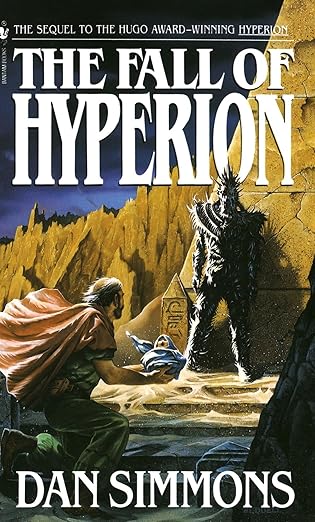
The Fall of Hyperion, by Dan Simmons

Why this book: My Sci Fi book club had read Hyperion, were impressed with it, and we all wanted to see what happened in the sequel

Summary in 3 Sentences: This book begins where Hyperion left off, but takes a different approach in that we are getting the first person perspective of a new player in the drama.  Hyperion focused on the lives, backgrounds and mission of seven “pilgrims” who’d been selected to go to the mysterious planet of Hyperion to learn more about the Time Tombs and potentially the malevolent Shrike, and also to explains how the drama and antagonism had evolved between the Cult of the Shrike, the Ousters (apparently in league with the Shrike) and the Hegemony which represented the natural evolution of the human race that we know.  In this sequel, we not only follow and learn the fates of the seven pilgrims, but our new first person narrator introduces us to new dimensions of  good and evil in the metaphysical reality of the universe, how man-machine interface evolved to put humanity at risk, the various meta-entities that control the universe, and  the subtle differences between the various dimensions that human consciousnesses  occupy.  

My Impressions:   This is an even more complicated and harder to follow book than its predecessor.  It is long and the author is very descriptive of scenes beyond what I believed was necessary, and introduces entities which the reader (I assume) was meant to deduce who and what they are.  I struggled to follow the plot, as the author digressed to follow the adventures of various individual characters in the book, and it was often unclear to me what their roles were  in the arc of the story.

The story takes place within a battle between the TechnoCore which was a group of AI’s which had evolved to want to control the entire universe, and their goal of either eliminating the nuisance of human beings, or of enslaving them to uncomplainingly merely serve their interests.  They intended to do that  by fomenting an existential  battle between the Human universe known as the Hegemony, and the Ousters – a competing set of intelligent beings – a subspecies of humans who in the past chose to live outside of the technosphere sphere to which the Hegemony had become addicted.   The Technocore’s plan and expectation was that this battle would either destroy both the Hegemony and the Ousters, or so cripple them that they could essentially be slaves to the Technocore for their purposes. 

Eventually the Ousters realize they are being duped, and through a rather complex set of events get that word to Meina Gladstone, who as the CEO of the Hegemony, is the de-facto leader of the entire human species across the Web that ties humanity together.  Gladstone must make a very difficult decision:  In order to thwart the Technocore in it’s goal to enslave the entire human species, she would have to completely disrupt the network that the Technocore had created to make  humans completely dependent upon them. And if/when she would do that, it would break up the entire network of communications and supply that the all planets in Hegemony depended on, and lead to suffering and deaths for billions – but would preserve human independence from the Technocore and free them to evolve independently in the future.  

Much of what I now understand about The Fall of Hyperion I got from Google’s AI – asking it to explain the relationship between the Technocore, the Megasphere, the Metasphere, the Web, Universal Intelligence, and the Lions, Tigers and Bears – another mega entity that was never explained in the book. I also got confused at the conclusion, but apparently some of that confusion gets resolved in the next book in the series. 

The idea of consciousness and a “soul” is ambiguous in this novel. The Technocore is able to create a digital copy of a person’s consciousness which can be implanted in another body. This is NOT a soul, but a copy of thoughts and memories and most of what comprise the identity of an individual, which later can be reanimated in another body.  Interesting question about where thoughts, memories and consciousness end and a soul begins. The book does not address that, but the first person narrator in the book is a replicate of John Keats, and is actually the second replicate of Keats to appear in the book – the first having been a “cybrid” of him – a “cybrid” is a hybrid of a cyborg with an AI implanted consciousness into a body with the DNA of a human and other human qualities.  In this book the cybrid has the identity and the memories of the 18th century British poet John Keats.  Brawne Lamia, a super strong woman is one of the key protagonists of the book, falls in love with the John Keats cybrid, which leads to some other interesting (and confounding) developments. 

The book concludes with a defeat of the Technocore, and attempting to tie up loose ends with the various characters, but leaves a lot of loose ends untied.  I had to revert to Google’s AI to better understand some of the more ambiguous destinies of some of the characters. 

This is a very imaginative book. I’d say the main theme is to portray how many centuries into the future, the human race has evolved to becoming so dependent on technology provided by AI entities, that they begin to lose their humanity and become vulnerable to self-determining and self-driven AIs which have no empathy nor a sense of loyalty to humanity. That is the situation which precipitates the war that leads to the Fall of Hyperion. 

To anyone who would read this book, I’d recommend regularly going to Google and asking its AI questions about the different entities that seem to pop up at random, and led me to often ask myself simply “WTF is going on!?” 

Bottom line: Not an easy book to read, but the author poses some very interesting and discussion-worthy prognostications of where our addiction to technology and AI enhanced life styles could take us.  Also about the nature of consciousness, and where it may be headed in the future.  

Posted in Uncategorized | Tagged , , , , | Leave a comment

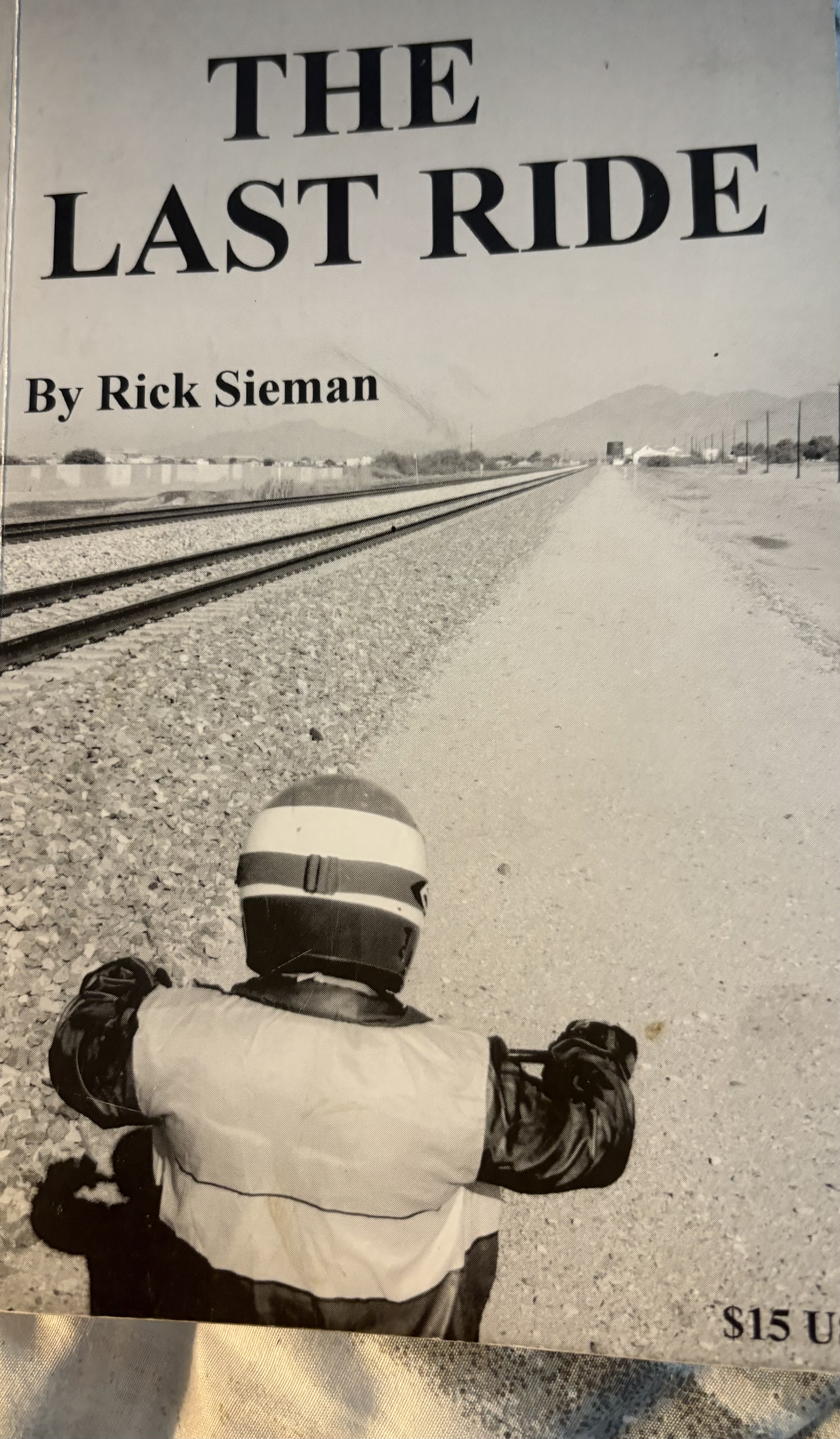
The Last Ride, by Rick Sieman

Why this book: Recommended by my Brother-in- Law Jimmy Phipps who is an avid dirt-biker.

Summary in 5 Sentences: An enterprising young man in his late teens, growing up in a small town in  Pennsylvania is gifted a used dirt-bike by his father, an avid dirt biker himself.  After getting comfortable on his “new” bike, he learns that the original owner who lives in California wanted badly to purchase it back, so the young man agrees, and decides to ride the bike across country to deliver it. The story is about that trip, and then jumps ahead 40+ years to when the young man is in his 60s, and is able to find that bike and buy it back once again. Now a 60+ year old man, he decides to relive his youthful adventure and ride it back from California to Pennsylvania. 

My Impressions: A short (150 pp) and fun read – a book written BY a dirt-biker, ABOUT a dirt-biker, and FOR dirt bikers – which I am not.  That said, I did thoroughly enjoy this short coming-of-age novel taking place initially during the window when I was the age of the young protagonist (late 1960s.) 

The year is 1969 and Mitch is an 18 year old young man, a clearly humble and well brought up teenager, whose father had instilled in him good values.   A year or so earlier, Mitch’s father had seen a used Yamaha DT-1 dirt bike for sale and thought it a good bike for Mitch to get started on. The Yamaha DT-1 was a relatively small, safe and well-regarded dirt bike, so Dad bought it for his son, and he and his son spent a year or so working on it, and Mitch learning to ride it.  During that time Mitch learned to maintain, ride and do simpler repairs to it, and became a decent dirt biker.  Being 18 years old in 1969, he was subject to the draft and so decided to join the Navy, which meant selling his bike.  But before he could sell it, Mitch was contacted by the original owner who lived in California, who badly wanted to buy that specific  bike back, since it had belonged to his son, who’d been killed in Vietnam.  Since Mitch was going to sell it anyway, he  agreed, and then decided to undertake one more great adventure before joining the Navy, and deliver it by riding it across country. 

Part of the challenge of dirt biking cross-country is that there are not always good dirt roads and tracks through parts of America, so Mitch had to get his bike certified as street-legal for him to ride when there were no dirt tracks, or where the terrain was impossible or dangerous for dirt riding.  He was on a pretty tight budget, so planned to camp most nights, so he had to carry a small tent and sleeping bag.  He’d shop for cheap food along the way, but mostly ate poor-quality pre-prepared sandwiches that he bought at gas stations and truck stops.  About once a week,  Mitch would find a cheap motel and get a good night’s sleep and a shower.  He avoided streets and highways when and wherever he could, and some of the tracks he was riding were very rough and challenging. Dirt biking over such rough terrain was physically demanding, forcing him to ride slowly and carefully and long days of such riding exhausted him.  He’d normally cover about 150 miles a day, sometimes more, sometimes less, depending on weather and terrain.

During his trip across America, Mitch had several mis-adventures, and his lack of experience  challenged his ability to adapt, improvise, and overcome.   But Mitch proved to be remarkably resourceful and resilient for an 18 year old.  In one case he had a small accident out all alone in the country, and banged himself and his bike up, but was able to continue and later recover and repair his bike.  In another instance, he lost track of fuel and ran out of gas.  In another incident, his bike simply broke  down on a remote track in Texas, and though he was a pretty good mechanic, nothing he tried to repair it got it running again.   In each case he had to find, ask for and accept help from sympathetic strangers who on several occasions, saved his bacon. In the case of the breakdown, he found a local bike mechanic who determined that the bike needed a new part, which had to be ordered  from California, which (then) took 2 weeks. During that window, Mitch took a physically demanding job working for an oil exploration company, stayed in a cheap motel, and made what-for-him was good money at $35/day, until the part came in and he was able to continue to California.

On arriving in California, he bonded well with the original owner of the bike – who took on a father-figure/mentor role to Mitch, and introduced him to the dirt biking community in Los Angeles.  There Mitch had some memorable experiences, seeing and experiencing things that  an 18 year old, doesn’t see in a small town in Pennsylvania.  The wide-eyed excited young Mitch then returns to Pennsylvania by commercial airline,  and joins the Navy.

The book then jumps ahead 40 years.  Mitch had served 4 years in the Navy,  been married and divorced, then married again and his wife had passed away. He had returned to his home town, succeeded as a small business man, and was getting ready to retire. Looking back with nostalgia on his adventure as a young man dirt biking crossing the country, Mitch decided to try to find that same bike.  He contacted some of the people he’d met when in LA as a young man delivering the bike,  learned that his old mentor who’d bought his bike 40 years earlier, had since passed away. After some more clever sleuthing and a few phone calls, Mitch located the man who then owned that same bike. That man was a bike collector and didn’t want to sell the bike, but Mitch made him a very generous offer and he accepted. 

The final part of the book is the older version of Mitch flying out to California, connecting well with the owner of his old bike.  The two of them got along well, got drunk together, had some fun, good-ole-boy dirt biking adventures together for a week or so.  Then Mitch decided to relive that old adventure, and ride the bike back to Pennsylvania.

This time he opted to stay in motels, and he had the money to deal with any exigencies.  The older Mitch also had a few misadventures, including close to the end of his ride, being hit by a car, which injured him and the bike, but not seriously.   But the one  story that comes to mind was when his bike was stolen from in front of his motel room, and how Mitch was able to find the thief – by looking in the papers for someone selling parts to a Yamaha DT-1. He eventually finds the parts seller, agrees to meet him to buy the parts, and determines that these parts are from his bike.  He tells the seller he’d like to buy the rest of the parts, and when the seller takes him to his garage, Mitch pulls a gun on the guy, gets his bike back, takes the guy out into the country, shoots him in both knees, calls the police and tells them where that thief is sitting wounded, and the address where they can find a garage full of stolen bikes. He then takes off. Mitch had covered his tracks well, so that no one knew who he was, or where he was heading. 

Mitch finally makes it back home to Pennsylvania, and both Mitch and the Yamaha are pretty beat up,  both in much need of some rest and restoration.  Which makes for a happy ending.

If this sounds like a book you’d like to read, and are interested in this book, the author’s contact info is in the book: Rick Sieman at superhunky@gmai.com  520-413-2596.  Also I found another review of it at: https://ultimatemotorcycling.com/2025/07/13/the-last-ride-by-rick-sieman-book-review-riders-library/#:~:text=After%20Don’s%20death%2C%20Mitch%20decided,off%2Droad%20all%20the%20way!

Posted in Uncategorized | Tagged , , | Leave a comment

Walking in Mud – a Navy SEAL’s 10 Rules for Surviving the New Normal, by Steve Giblin

Why this book:  The author is a friend of mine who is part of the SEAL Book Club I’ve been part of for a number of years.   Though we had served together many years ago, I didn’t know him well, since we were in different parts of the organization. After publishing this, he sent me a copy and asked me to read it and give him feedback. 

Summary in 3 Sentences: This book is Steve Giblin’s stories of what he experienced and the resulting wisdom from being in the Navy and the SEAL teams for his career. Though the book was written whem much of the country was struggling to deal with the pandemic, his lessons learn about dealing with hardship and setbacks apply in any context.  This is the story of a top notch NCO’s career in the SEAL Teams and what he learned that he believes has helped him to overcome difficulties and continue to grow as a human being.

My Impressions: I initially was hesitant to read another book by a Navy SEAL but the author requested and I read it and give him some feedback, so I agreed and I’m glad I did.   It is a book I’d recommend to young men who are interested in understanding the career of a SEAL Non-commissioned Officer – what that entailed, but also – and perhaps most importantly- the wisdom he accrued during his career. Steve had a great career in the SEAL Teams, finally retiring as a Master Chief, and serving as a  Command Master Chief of a SEAL Team – the top positon that all career enlisted SEALs aspire to.  He served in a wide variety of the most challenging positions, including combat, but it wasn’t without hardship and visiting the school of hard knocks, often having to be “walking in mud” sometimes up to his knees,  and he humbly addresses his mistakes and lessons learned.

Steve walks briefly through his childhood growing up, getting through BUD/S training and then structures his autobiographical description of his life in the teams around values that resonated with him that he found in a piece of paper stuck  in the back of the desk of his former Commanding Officer (Tom Hawkins). That paper listed “The Ten Essential Qualities of an Underwater Demolition Man:”  Pride, Loyalty Sincerity, Responsibility, Leadership, Example  Forethought, Fairness, Seamanship, Common Sense.   These qualities were originally written by Frank Kaine, one of the early leaders of Underwater Demolition Teams in the Navy.  Steve’s chapters tell his own life’s story and lessons learned in ways that reinforce the spirit of each of these qualities, and how they apply not only in the military but in any life of purpose and integrity outside the military as well. 

He wrote it during the COVID shut down which traumatized much of our nation, and many of his lessons learned and insights he applies to those struggling with coping with the uncertainty and new restrictions brought on by the COVID shut down.  That is “the New Normal” he refers to on the cover.  

But uncertainty is part of our lives, with or without a “pandemic.”   The flexibility, resilience, mental toughness and insight that helped him deal with setbacks in his life, and then thrive afterward in his career in the SEAL Teams are the same qualities that will help a person deal with and successfully maneuver in the face of whatever change and disruption that may come their way – which are always a part of life.

He offers wisdom and insight from the school-of-hard-knocks for dealing with the challenges of working in difficult team environments, the challenges of being a good husband, father, and  teammate.

He concludes with a recap of the 10 principles that have guided him – with some new and useful wisdom for each of them based on his personal experience. For example, he got sent to a school he didn’t want to go to when his teammates would be doing exciting (fun) frogman training.  He was disappointed and angry.  A friend told him to suck it up, be a pro and do his best. So he did. A few months later, that training put him in a position to provide critical care and assistance to an injured teammate.  What looks like a bad deal, with the right attitude, can often be the best thing that ever happened to you.

He concludes his book with “This book, in many respects, contains the sum total of what I learned in my twenty-six years as a Navy SEAL and thirty seven years in Special operations…I’ve enjoyed weaving so many of my experiences into these pages, especially the challenges and setbacks, in the hope you will see how I emerged from them and learned the lessons my training and service taught me..(especially) this pearl of wisdom from Henry Ford: ‘When everything seems to be going against you, remember, that the airplane takes of against the wind, not with it‘ ” 

His book is an offering to young men and women who may be confused, disoriented, pessimistic about all the change happening in society today, and it’s happening so quickly – beyond “merely” the pandemic.  He offers insights and wisdom from one who fought the battles and not only survived, sometimes bloody and bruised, but thrived. 

Posted in Uncategorized | Tagged , , , , | Leave a comment

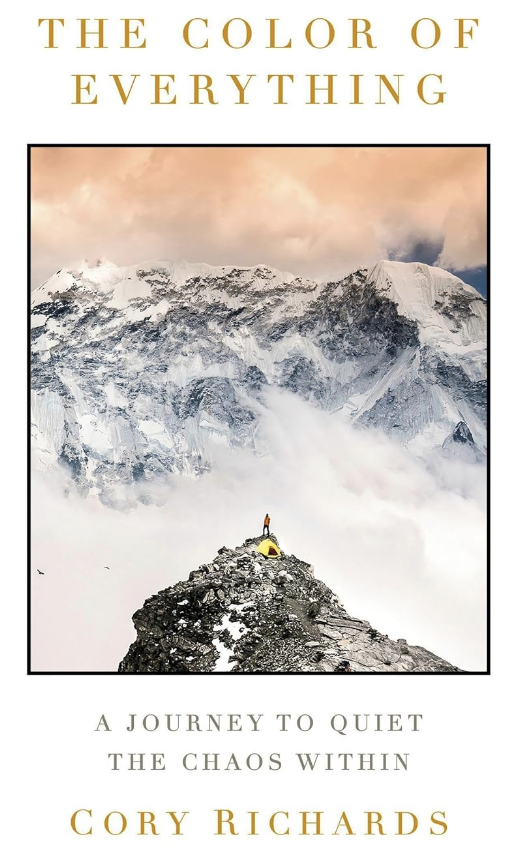
The Color of Everything – a Journey to Quiet the Chaos, by Cory Richards

Why this book: I read an interview with the author on a substack piece called Transitions. I found the interview and the author fascinating, inspiring me to buy and read the book, which was even better than I expected. 

Summary in 4 Sentences:  This is Corey Richards autobiography – a bold move for someone only 44 years old, but he’d led a fascinating, all-over-the-map life so far with lesons learned he believed (rightly I believe) deserved being shared. He shares his difficult childhood, in and out of reform schools, how he took his energy and passion into climbing and photography, and then kept chasing the most difficult physical and mental challenges he could find. He succeeds with many close calls, and becomes a world famous and highly regarded mountaineer and adventure photographer. But his life was still a mess, as he struggled with addictions, bi-polar disorder and ultimately decided to change directions – sharing the wisdom he’d achieved in the process. 

My Impressions:  Probably the most intense and honest autobiography I’ve ever read. Powerful, insightful, sometimes painful, but very well written and very much worth my time and attention. I’ve recommended this book to my few friends who I believe could appreciate his intense personality, his brutal honesty and the struggles he created for himself, how he endured them, and than moved beyond.

He begins with his difficult childhood – though he says his parents were great and as supportive as they could be.   But his own excessive energy, on-going conflicts with his brother and in-ability to accept and conform to any authority led his parents to sending him to various schools, which he was kicked out of,  finally being sent to reform school and a treatment program, which he fought as well, and was eventually kicked out of those programs. Sent home, he again could not adapt to the structure and confinement of home life and his parents essentially threw him out of the house.  So there he was 16 years old and out on the street. Not an auspicious beginning. 

He eventually makes a friend who introduces him to climbing and photography. The climbing satisfies his need for adrenaline, risk and intense adventure;  photography appeals to an aesthetic impulse to create photos which have an emotional impact.  He pursues both climbing and photography with dogged determination.  While he pursues high intensity and challenging climbing, he is sending photos to various publications, eventually landing some contract work with National Geographic which becomes a full time and high profile position. He undertakes extreme challenges for Nat Geo, taking photos and creating articles that garner him international recognition.

But his intensity makes him a  very high maintenance employee. This intensity also drives what becomes an alcohol addiction, some intense and ultimately unsatisfying and/or disappointing relationships with women, to include a failed marriage.  Casting around for distractions to keep his fire alive and help him deal with his mess of a private life, he continues to pursue extreme adventures – has a very near miss in an avalanche to which he has a very strong reaction, which he later recognizes as causing or contributing to PTSD, about which he is initially in denial.   But he continues on – taking on more and more risk, having more close calls, and more short and intermediate term relationships with women, until he finally has a nervous breakdown/panic attack during a final stage of a high risk climb he is doing for Nat Geo. 

He describes these incidents and his bad decisions with brutal honesty. He struggles to climb out of his hole and get “back on the horse” but he has not yet dealt adequately with his PTSD, bi-polar disorder, addictions to alcohol and sex.  And then, after a year of intense training, planning, and expense to photograph and participate in an enormously difficult route up Mt  Everest, part way up the climb, he has a breakdown, tells his partners he can’t continue, which means the climb must abort, the promises made can’t be kept, the money and time spent can’t be recovered.  He realizes that his psychological issues are severe, that he must deal with his anxieties about his own mortality and purpose, and he decides he’s done with climbing – which  yields another identity crisis.  He  gets accused of relatively minor sexual harassment incidents in the wake of the Me-too movement (an uninvited kiss, an alcohol inspired pat on the fanny which he admits), result in him being suspended from Nat Geo.  Though after a six months investigation, he is exonerated and Nat Geo invites him back, the embarrassment and the process has disillusioned him, so he leaves Nat Geo.   This incident inspires a deep dive into his relationship to women, and his insightful perspectives on the challenges women have in today’s society.

Later he goes to a Zen retreat in Thailand which challenges him in new ways and gives him new insights into his own personal issues,  as well as ways for him to deal with his demons. In this window he learns that his father with whom he is very close, is diagnosed with terminal cancer, which affects him but also inspires further introspection on life and mortality, and adds to his increasing wisdom.  

The book does not have an ending – as Richards is only in his mid-forties. He is now using his own experience to actively campaign for and support helping others recognize and deal with mental health issues – especially bi-polar disorder. I expect another book from him in 5-10 years, which I look forward to reading.  

If this brief review intrigues you and you’d be interested in the interview that inspired me to read the book, I encourage you to read it. You can find that interview at https://bldavis3.substack.com/p/transition-interview-21-cory-richards

Posted in Uncategorized | Tagged , , , , | Leave a comment

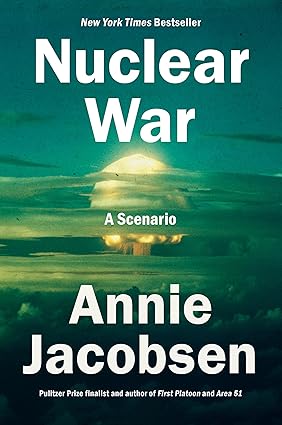
Nuclear War – a Scenario by Annie Jacobsen

Why this book: Selected by my SEAL book club.

Summary in 3 Sentences: A novel in which the author creates a scenario in which the North Koreans unprovoked, like a bolt out of the blue, launch first one, then a second nuclear weapon at the United States.  The novel unfolds minute by minute as the US government infrastructure and leadership deals with the incoming missile and we learn about the process which responds to this most urgent of scenarios. Ultimately the two nuclear missiles hit their targets and we learn about the devastating consequences of a nuclear attack, and about how decisions are made in how the US government and military respond. 

My Impressions:  Not a fun book to read about a potential huge global tragedy.  But it is an important book to read, to raise awareness of the processes and policies our government has in place to prevent, deter, and respond to such an attack.  These processes and infrastructure have been developed and have evolved over the 70 years since the first nuclear weapon was dropped on Hiroshima.  Annie Jacobsen walks us through how the international community has responded to the proliferation of such weapons from initially just the US and Soviet Union, to China, France, the UK, Iran (perhaps,) Pakistan, India, Israel and probably more.

The scenario is pretty simple – North Korea launches a single unprovoked nuclear ICBM at the United States.  Her book progresses minute-by minute after the launch is detected, describinb what response mechanisms are in place, what decisions have to be made and by whom. In this process we learn the roles of the President and his staff, Strategic Command, FEMA, and how within the context of this novel of a hypothetical situation, they respond and the consequences of their decisions.

One of the key points she makes in the novel is that responses have been pre-scripted and have been exercised regularly – except by our political leaders who have never given this much attention. But that is a major liability, since the key decisions must be made by the President with the assistance of his key advisers, most of whom are similarly unprepared.  In this scenario, the President becomes incapacitated and the back up plan falls into place, which leads to more confusion. 

We also learn about the power and devastating consequences of a thermal nuclear weapon – many times the explosive and destructive power of the atomic bombs we dropped on Japan. Especially we learn of the exponentially devastating impact of a nuclear attack on a nuclear power plant – in this scenario, the North Koreans do indeed launch a second strike on the nuclear power plant in Diablo Canyon in Southern California and we learn how this is indeed a double whammy – with significantly worse outcomes than a nuclear weapon alone.  And we learn about the inadequacy of our ability to intercept incoming ICBMs traveling well past the speed of sound through space before entering our atmosphere over our country.

We learn about the horrifying results of a nuclear strike, on the civilization and people receiving it.  The suffering would be incalculable and unimaginable, the living would envy the dead, as devastating fireballs, accentuated by huge winds would engulf the area around the strike for many miles, followed by radiation poisoning of all surviving living things – plants, animals, and humans.  

We learn about how the US would respond to a nuclear attack with a counter attack, how that would be calculated, and the role of our Nuclear Triad – ground launched, air launched, and submarine launched nuclear missiles, always on alert, always ready to respond and be launched on very short notice.

The novel progresses minute by minute.  As the US responds, we see how Russia might respond, how misunderstandings and miscommunications could lead them to believe our  response to North Korea, missiles coming over the north pole, could be misconstrued to be coming to Russia, and how they might respond.

In the end her message is how any use of a nuclear weapon by a deranged leader like Kim Jung Un, could escalate and cascade into precipitating nuclear armageddon and nuclear winter for the entire northern hemisphere, leading to the deaths of billions of people.

Annie Jacobsen interviews scores of experts and former political and military leaders and defense intellectuals to substantiate her case and to provide credibility to her scenario.  She has clearly done her research in writing this novel. 

However, in preparation for a discussion of this book by the SEAL book club, I listened to a podcast entitled “Nuclear War, an Implausible Scenario” run by the National Institute for Deterrence Studies.   (https://youtu.be/JSg8Sd-g0AI?si=J_X_0vMFBvrD4AU6)   In this podcast several “experts” in the world of nuclear deterrence disagree with some of Annie Jacobsen’s assumptions. Most notably they argue that it is implausible that Russia and China would not detect this launch by North Korea, and would not be in immediate contact with each other and the US. They also argue that total escalation to overwhelming response is also not necessarily realistic.  They argue that limited response with Tactical Nuclear weapons is also an available option, which she doesn’t address. They also argue that in her scenario, which almost automatically goes from one or two nuclear missiles launched against the US to overwhelming responses, launching entire nuclear arsenals by both Russia and US is unnecessarily excessive and (they argue) designed to overly dramatize the negatives of the nuclear option. She doesn’t offer any alternative preventative solutions to the reality that Russia and the US (and China) possess these nuclear arsenals. 

This book, along with the movie House of Dynamite have served to raise awareness of the threat of nuclear war which could essentially lead to the end of civilization as we know it. For that reason alone, it is worth reading.  After finishing this book, realizing that we all live under a proverbial sword of Damocles, it is time to smell the roses, and appreciate the simple pleasures of life as we now know it.  It is all pretty fragile.  

Posted in Uncategorized | Tagged , , , | Leave a comment

Descent into Darkness – Pearl Harbore 1941, a Navy Diver’s Memoir, by Edward Raymer

Why this book:  I had visited the Pearl Harbor Submarine museum and the Arizona memorial and found this book in the bookstore, while I was reading Shadow Divers, which had fascinated me about difficult diving.  The experience of those men who dove on the ships recently sunk by the Japanese on December 7, 1941 intrigued me.

Summary in 5 sentences: This is a first person memoir from a retired officer who had been a Navy Salvage diver called upon to dive on many of the ships only days after they were sunk by Japanese bombs and torpedoes during the attack on Pearl Harbor in December 1941. For over a year he and his diving team dove on such iconic battleships as the Arizona, Utah, Nevada, Oklahoma, California, West Virginia – to try to recover bodies,  to recover important equipment and ordnance, or to attempt to get the ships back to the surface to ready them for the shipyards and repair. An important part of the story is the camaraderie of the divers living in a locked-down Honolulu and the various shenanigans these young men pulled – to include drinking, carousing,  and chasing the few available females – to distract themselves from their difficult and occasionally gruesome work.  After a about a year and a half on Pearl Harbor, the author and his best friend volunteered for duty in the South Pacific where they spent a year supporting the ships and forces fighting the Japanese in Guadalcanal and other locations.  They then returned to Pearl Harbor and a much changed Honolulu, for a year of duty to work mostly on trying to right the Oklahoma, before being sent back to the states for shore duty in 1944. 

My Impressions: A short book at 215 pages and a quick and engaging look at Pearl Harbor and the life of salvage divers immediately following the Japanese Attack on the US fleet there. The book is autobiographical, told in the first person based on the author’s recollections, and though he wrote the book many decades after the events he describes, he insists in the preface,  that all the incidents took place as he describes them and the dialogue is as close to accurate as he and his surviving friends could recall, and accurately reflects how they spoke and what were doing and thinking at the time. 

The book is written from the perspective of the author as a young sailor who’d recently enlisted in the Navy and completed Dive school prior to the Japanese attack on Pearl Harbor.  Diving in those days was almost exclusively hard hat and salvage diving. He takes us briefly through his enlistment and completion of dive school in San Diego in late 1941 and then how he and his best friend are immediately ordered to Pearl Harbor after the attack, arriving a day or two afterward.  They are almost immediately put to work diving on the recently bombed and torpedoed ships to: 1. rescue any sailors still trapped in air bubbles in the ships, 2. to determine if the ships could be salvaged, re-floated and repaired, 3. to make repairs underwater that would enable the ship to be re-floated and repaired, and 4. to recover ammunition and other items of value that could still be of use in fighting the Japanese.

His descriptions of diving in near complete darkness, aware of and feeling his way through unseen dangers of sharp objects and falling or dislodged machinery was reminiscent of what I’d read in Shadow Divers. Many of the challenges they faced has no prescribed solutions – they had to put their heads together and improvise how to repair, or get into certain spaces, try out unproven techniques, and deal with the dangers. It was difficult psychologically to be diving around the floating corpses of sailors who’d died just a few days or weeks before.

What was particularly appealing about this book is that Raymer combines descriptions of his dives, and his experiences during them, with anecdotes from the rowdy young men in the dive locker trying to also have some fun in a Honolulu under martial law immediately after the Japanese attack.  They were working 12 to 14 hour days, getting very little time off, occasionally  getting a day or two of liberty – but there were no recreational facilities on the Navy base at Pearl Harbor, and Honolulu was in black out conditions at night and under martial law.  Being feisty and creative young men,  they looked for and found opportunities for amusement in a city that was essentially locked down. He describes the thriving red light district, their efforts to find female companionship outside of the short term transactions in the bordellos, how they found a way to skirt the prohibition on alcohol, how they got into and out of trouble. These crazy escapades gave them something to look forward to, and an opportunity to blow off steam after working in harsh and under very stressful conditions.

But most of the book is about them diving on ships filled with explosives and decomposing bodies, and how the team dealt with occasional fatal accidents in the diving team – in fact the author came very close to dying himself on one of the dives – reminding me of John Chatterton’s close call  in Shadow Divers.  He and his fellow divers dove extensively on the battle ships Arizona, West Virginia, Utah, Oklahoma, Nevada, California.

After about a year of salvage work on the battleships in Pearl Harbor, Raymer and his buddy Moon Mullins volunteered for salvage work closer to the action in the South Pacific and were sent to the Tonga Islands where they helped refit ships damaged by the Japanese and were subject to regular air attacks from the Japanese. They were then assigned to support the Navy’s efforts to support the Marines fighting on Guadalcanal, and were often on the beach where they hunkered down with the Marines and were subject to attack and regular sniper fire, and where he eventually contracted malaria.  While  moving fuel and ammunition to supply the Marines ashore, they were often under fire, and were busy helping ships and rescuing sailors from ships that had been hit by Japanese planes and/or torpedoes. Eventually they found themselves on the damaged USS Portland heading for Australia to assist with repairs – and we get some good stories of sailors on liberty in Australia.  

After nearly a year in the South Pacific, in 1943 he was sent back to Pearl Harbor where he assisted continuing efforts to salvage and  help restore to operational status the battleship  Oklahoma. While in Pearl Harbor he was asked to briefly escort Eleanor Roosevelt during her visit to the Oklahoma to observe efforts to put her back into commission.   Coming from a strong Republican family, Mrs Roosevelt was not a well loved figure in the world he grew up in, but he found her to be charming and impressive.

The book concludes with the author getting orders in 1944 to the Experimental Diving Unit in Washington DC.  

The book’s epilogue tells the stories of what eventually happened to the ships he’d worked on.  Also in the epilogue, Raymer points  to how during his research in writing this book, he found that official records and documents were often inaccurate and simply wrong – based on his personal experience.  This was also a key lesson in Shadow Divers.  In both cases, Raymer’s and in Shadow Divers, much of what they found in the official archives was someone’s best guess or assumption about what happened.  

One disappointment for me was that the epilogue does not tell us the rest of the author’s story- it simply concludes with him being in DC at the end of the war.  After a  little research on my part, I learned that Raymer served 30 years in the Navy, retired as a Commander and died in 1997 in California.  After getting to know the author and enjoying his company,  I’d like to have known more about what he and his buddy Moon Mullins did after the war – how the rest of their lives turned out. That said, I really enjoyed the book and have recommended it to John Chatterton, the diver made famous in Shadow Divers and Pirate Hunters.  


Posted in Uncategorized | Tagged , , , , , | Leave a comment

The French Lieutenant’s Woman, by John Fowles

Why this book: Selected by my literature reading group. Also, I’ve had my wife’s copy on my bookshelf, unread by me, for decades.

Summary in 4 Sentences:  An upper class English gentleman in the late 1860s,  has made a good catch in betrothing himself to be married to a sweet, beautiful, and somewhat spoiled well-to-do woman, with an excellent dowry.  He then allows himself to fall in love with an intelligent but mysterious governess – the “French Lieutenant’s Woman,” and is unable to overcome his  obsession with her.  They then  have a brief tryst, he breaks off his marriage, and then his new mistress disappears.   After several unhappy years, he finally finds her again, and their interaction when they finally reunite deepens the mystery. 

My Impressions: Not an easy book to read, but interesting, challenging and worth reading for a number of reasons.  I struggled at first to get through the first 2/3 of the book, as did a number of the members of my reading group.  Why ?  First, the writing is classic (and elegant) English, occasionally a bit cumbersome.  I was regularly referring to my phone dictionary to help me understand words and references that were not familiar to me, though the “elegant” writing was often a pleasure to read.   And second, I didn’t particularly care for the two main characters in the book, both anguished, conflicted, weak and indecisive, though I could relate at least to a certain degree with the male protagonist’s challenge. 

In short, the story takes place during the height of the Victorian era, when the English upper classes had fully embraced the Victorian values of refinement, sophisticated restraint,  and suppression of (nearly) all human emotions that were not publicly endorsed by refined society.  Proper etiquette, emotional restraint, follow the rules, and “Don’t rock the boat” seemed to be the prevailing sentiments in the self-satisfied upper classes – at least in public.   Our protagonist Charles Smithson is comfortable in this world, doing whatever he chooses that doesn’t rock the boat, and protects his many prerogatives.  He has no real ambition or goals in life, though he has come to realize that he is bored with following all the rules of propriety. He also realizes that his engagement to marry the perfect woman for someone of his class and stature, continues to carry  him down the same predictable path of conformity.  His comfort and self-satisfaction are upset when he is drawn to, and becomes obsessed with Sarah Woodruff, the French Lieutenant’s Woman or “whore” as the people in town referred to her, a woman outside his class.  Charles is infatuated with Sarah, but engaged to Ernestina, and wrestles with what he should do.  Ernestina is chaste, virtuous and submissive and represents conformity to the path his aristocratic class expects of him; Sarah represents a break from the safe, well beaten path and a new freedom.  Finally, he chooses to break his vow to marry his fiance Ernestina, and in so doing, breaks with the predictable trajectory of his life, and is now dishonored in his social class and many of his previous options are gone.  This obsession is also coincident with losing the patronage by his very wealthy uncle. 

So now Charles has “burned his ships” by breaking off his socially approved (and celebrated) engagement to Ernestina to go with a woman with a “reputation.”   But he is now ready to forge a new and more creative path for himself.  Then the woman who has inspired this dramatic decision, disappears.  He puts his attorney and a private detective company to work to try to find her, while to distract himself from his heartbreak, and now being a social outcast himself, he travels, becomes a tourist in Europe and America (he obviously still has money – so it wasn’t THAT big a break from his previous comfort zone.) Then his attorney wires him that they’ve found her, and he travels back to England, finds and confronts her, and the reuniting is not what he’d hoped for and dreamed of.    In meeting and reconnecting, we get to know Sarah  a bit better, but she chooses to remain a mystery – to us and to Charles – unwilling to truly reveal herself, but she gives us some more clues as to who she is and what motivates her.   But Charles is distraught and does not cope well.  And we are left with an inconclusive ending.

In the early stages of the Charle-Sarah infatuation, Sarah does reveal  a bit of herself, which intrigues Charles and opens the door to an infatuation with Charles,  who listens attentively and compassionately – apparently a new experience for her from a man.  She was clearly very lonely, while also being very introverted and shy about who she was, almost ashamed of her past. And she continued to give small clues that she consciously rejected the upper class rules of propriety and conformity that characterized most upwardly ambitious women.  We never really get to know Sarah, but Charles and his internal conflicts and obsessions are a major part of the book.

Charles is not an a-typical male and at least some of what he experiences, most men could relate to. Most men are ambivalent about giving up their freedom, getting married, and having their freedom overwhelmed by obligations to a spouse, a mortgage, children, and all the social conventions built around the institution of marriage – what Zorba (the Greek) called “the whole catastrophe.” And most men have become indeed obsessed with a mysterious beautiful woman, and the challenge of breaking through her armor and winning her heart.   If/when they succeed, the mysterious intriguing woman morph into a demanding drama queen, and life becomes overly tumultuous and dramatic, or – she may relax and settle into her comfort zone and the old boredom sets in again. 

Sarah is more difficult to assess – and one wonders whether some early trauma, augmented by her aborted affair with the French Lieutenant may have caused her distrust of men and society, and led to her lack of confidence in being able to handle these challenges, and may also explain her propensity to fall in love with a man she thinks she can trust.   But she is clearly an unusually independent woman, and that becomes more clear at the end of the book.   When Charles asks his friend Dr Grogan for advice, Dr Grogan gives a fairly accurate assessment of Sarah and some very reasonable advice to him as to what he should do in order to not “destroy” his comfortable life.  But predictably, Charles’ obsession overrides the practical advice he gets from Dr Grogan, and he chooses to follow his heart, not his mind.  And let the chips fall where they may – which becomes something of a mess. 

The author uses some interesting techniques in telling this story. He shares his personal observations on society, the characters, their dilemma from his, the author’s perspective as  someone from the British upper classes 100 years later.  From these meta-perspectives we get Fowles’ personal judgments and assessments of the characters and their actions and decisions, and he notes the differences between then and now in what is acceptable, what is not, and how people respond to such challenges. One of the strongest themes in the book is the hypocrisy pf the upper class in their sanctimonious pretensions to virtue and propriety.  Behind the scenes, out of sight of the public and lower classes, they don’t hold themselves accountable to the standards they publicly profess and expect of the rising middle class. 

Fowles also offers us several possible endings to the story, commenting to us the readers, that though he’s the author, his fictional characters have lives of their own, and he’s just following along the trajectories that they are laying out for themselves.  Early on he gives us one simple outcome of the crisis between Sarah and Charles, in which everyone takes the path of least resistance and they all live happily ever after.  And then he says, “No wait!” and turns the story in another direction with very different outcomes.  As we get to the end of that version, we get yet another turn – another direction the story might have gone.

The book leaves a number of questions open, and I look forward to discussing with my reading group friends. 

The Movie. After finishing the book, I watched the movie, and I thought it did well in portraying the essentials of Fowles’ book. The screen writer is creative in how he offers the “meta-perspective” we get in the book, when the author steps out of narrating the story to offer a 1969 perspective on what is happening in 1869.  In the movie, we are treated to a parallel story to that in the book The French Lieutenant’s Woman. In the movie, in this parallel story,  the same two actors who play the 1869  versions of Sarah (Meryl Streep) and Charles (Jeremy Irons) are now characters in 1970s, in conventional marriages, who connect while working together away from home on location on a movie.  They are drawn to each other and fall into a passionate extra-marital affair.  In the movie they are both conflicted between their current comfortable marriages and lives, and the passion of their affair.  Like in the book, the man has the greater obsession, and the most difficulty controlling it. 

One thing the movie changed from the book was in the final confrontation between Charles and Sarah (in the 1869 story) when Charles finally finds her.  The movie version is quite a bit more dramatically than what we read in the book, and the movie leaves the viewer with an implied more positive sense of what might be next.  But the 1970s parallel version is also left unresolved. 

 I do recommend watching the movie – after reading the book – but as in a few other movie-book combinations, I believe the two of these together are better than either one alone.  

The Guardian gives a fairly negative review of the movie  here  which I didn’t  entirely agree with, but found useful in understanding the book.  But this review also notes that Fowles himself was impressed with the screenplay and the movie, and endorsed it.  

Posted in Uncategorized | Tagged , , , , | Leave a comment

Mark Twain, by Ron Chernow

Why this book:I like so many people have been a fan of Mark Twain for much of my life. I have recently re-read Huckleberry Finn in preps for reading (listening to) James by Percival Everett.  Also I have read three other Chernow biographies which I thought were awesome: Grant, Alexander Hamilton and George Washington.  When I saw that Chernow was publishing his bio of Mark Twain, I jumped on it.  Listened to it. 

Summary in 4 Sentences: This is a comprehensive look at Mark Twain’s life, based on SO MUCH material, from his diaries, letters to others, and their letters to him.  He was one of the most famous people in the world during his lifetime, so people saved his extensive correspondence and much of it has survived.  In short, Chernow  (again) does a masterful job bringing his subject to life, and providing his own commentary along the way.  I describe this to my friends as providing so much detail it was like getting into his Twain’s head and experiencing America and the world through his eyes – he lived a rich and full life, but was surprisingly unhappy and sad, especially toward the end of his life, and Chernow shares how much of this unhappiness was not just built into his idealistic, yet cynical character, but also a result of his own decisions.  

My Impressions: This is  long book at 735 pages which I listened to in 11 hours. It is a deep dive into the life of Samuel Clemens, aka Mark Twain – his life, his thoughts and feelings, his idiosyncrasies, his humor and wit, his occasional hypocrisy and character flaws, as well as his vengeful anger at individuals who he believed let him down, and his disapproval of the human foibles he saw with a clearer eye than most, and that he described with a twinkle in his eye.  

Listening to this book had a key advantage:   the reader did voices for the primary characters in the book – most especially Twain himself.   The book is full of quotes from Twain’s journals and letters which the reader recites to us in what seemed to me to be an authentic old southern gentleman’s scratchy and ironic voice – bringing Twain almost to life.  And he did his best to render the voices of the key women in his life – his wife Livy, his daughters, Susie, Clara, and Jean, and his woman secretary Isabel Lyon in different suitably feminine sounding voices. 

This biography is very thorough – Chernow had loads of material, to include Mark Twain’s lifetime of diaries and journals, the hundreds of  letters he’d written over a lifetime (Twain was a prolific letter writer and people saved his letters) as well as trunks full of letters he’d received.  And Twain dictated an autobiography that his will and trust demanded not be published until 100 years after his death- which was honored.  Twain’s autobiography of nearly 500 pages was published in 2010.  All this material, and Chernow’s extensive experience and well-earned reputation for writing great biographies of America’s greats, serves us well.  Chernow does a masterly job of describing Twain’s long and multi-faceted life and conflicted character,  from Twain’s own, his family’s, and his many friends perspectives, adding all along the way Chernow’s own views and judgments of Twain’s character, decisions, strengths and weaknesses. One review I read states, “the biography offers an authoritative portrait that balances Twain’s rollicking public persona with the darker complexities of his private life.” (Super Summaries) 

We begin with his family background and his early years, sourced mostly from Twain’s own writings and recollections. His relationship to his strong but unhappy and unsuccessful father certainly played an important role in his development – his mother doted on him and remained a huge fan for much of his life until she passed.  We learn about his fascination with the Mississippi, how he became a printer for his brother and then an anonymous but popular columnist in his brother’s paper, his various efforts to break out of Hannibal, Missouri, his time as a riverboat captain which he describes as the happiest time in his life, how and why he finally headed west, seeking his fortune in mining in Nevada, and writing for a local paper, before heading to San Francisco, where again he wrote columns for a local newspaper. 

His breakthrough came when he was hired to travel to the newly settled Hawaiian Islands from where he sent articles back to be published in series in his sponsoring newspaper.  Upon his return, he nervously began his career as a speaker – telling stories about his impressions and adventures in the exotic Islands, much to the pleasure and amusement of his audiences.  He was always in need of money and public speaking and telling stories earned him a living – and gave him practice that served him well later on.  He went on to publish a book about his trip to Hawaii which did well and earned him the attention of many.   His career as an author and speaker was off to the races.

He returns to the East Coast to continue his speaking as his reputation grew.  He met, courted and married Olivia Langdon who was the love of his life for the rest of his life – Chernow takes us through that awkward and difficult courtship, which ended up being a pivotal point in his life – as his wife Livy was key to his future success, blunting the edge of his anger at people and events which disappointed him, dampening his propensity for seeking revenge, and creating  embarrassing public controversy. And then he got the contract to join a group of Americans on a long cruise to Europe and the Holy Lands, his recounting of which became The Innocents Abroad, which truly launched his career. 

At this point, we are barely a quarter of the way through the book. Twain had a rich and very life which I will not try to summarize.  But here is a list of some of what learned about Twain that surprised me: 

  • He was always chasing schemes to strike it rich – he dreamt of being independently very wealthy – and eventually got there, then was in debt for much of his adult life, living the lifestyle of the rich and famous in the Gilded Age that he sought,  but his bank account did not yet justify. 
  • His best selling book in his lifetime was Innocents Abroad, but he was best known internationally for Tom Sawyer and Huckleberry  Finn.
  • He fell in love with, courted over many months a reluctant Olivia Langdon, then after they married,  adored her almost beyond what is healthy.  She returned his affection, while she held on to the reins when Twain’s wild streak got hold of him. 
  • He and his family spent 9 years living in Europe when he could no longer afford to live in the style he and Livy were used to in the US.  While there he was regarded as a major celebrity, and regularly was invited to speak and entertain throughout Europe – the educated classes could speak English, 
  • He was deeply in debt for much of his adult life from bad investments and business decisions.  He falsely believed he had a great head for business and opportunities to make a financial killing.  He squandered his own fortune and that he and Livy had inherited from her family, investing in ill-conceived efforts to get unbelievably wealthy..
  • He eventually paid back his debts after many years, undertaking exhausting speaking tours, and writing to make money to pay those debts.
  • Also to earn money, he and Livy made an exhausting one year around-the-world speaking tour, which included the US, the Hawaiian Islands, India, Australia, New Zealand, South Africa and Britain
  • As America’s best known author, satirist, and humorist, he was welcomed in the highest levels of society, knew President Teddy Roosevelt, (with whose politics he vehemently disagreed)  as well as many of the most prominent figures of the second half of the 19th century.
  • Politically he was quite progressive, though Chernow regularly takes him to task for some hypocrisy in his attitudes toward black Americans.  As Twain grew older and less concerned with how he would be viewed by “polite society” he became increasingly strident in his support for progressive causes and the citizen rights of black Americans.
  • He hated America’s, and Teddy Roosevelt’s imperialist ambitions and the sense of American exceptionalism. He saw it as hypocrisy given how our nation was formed.  He wrote numerous articles condemning British and other European imperialist nations policies and how they treated natives in the lands they’d conquered. He vehemently opposed the US annexation of the Philippines. 
  • A large part of his humor was pointing out and satirizing the hypocrisy and human foibles he and the rest of is see in people every day – Twain points them out sometimes gently, occasionally viciously.
  • Twain went back and forth between being agnostic and atheistic.  One of his favorite targets for his wit was religion and the hypocrisy of the religiously righteous.  His agnosticism put him at odds with his wife, so he normally kept that to himself – while she was alive.
  • After his wife died, there are no apparent efforts to connect intimately with a potential second wife, or with any woman for that matter. Consistent with the times and Victorian mores, he was  very prudish sexually and avoided reference to sex or sexuality in his writing – until the very end.
  • He doted on his three daughters – in fact, in my opinion, spoiled them in his and Livy’s efforts to raise them to be “ladies” and icons of upper class privilege and values.  
  • His later years were particularly sad after losing his oldest daughter Suzy to illness, and then his wife, and finally his youngest daughter Jean.  Clara, his middle daughter out lived him by half a century, but she and he were never particularly close.
  • He remained sharp into his old age, but he wasn’t particularly healthy. For much of his life, he smoked cigars almost incessantly – reportedly regularly 40 cigars in a day.  As his energy significantly diminished, in his late 60s and early 70s, he withdrew to his home and significantly restricted his social and public appearances.
  • After Livy died, he had a bizarre relationship with his secretary Isabel Lyon. She idolized him and he praised her to the moon for her support and loyalty to him and his many administrative and other needs. Twain gave her much of the authority of a wife (minus sex and overt romanticism) but he never seemed to consider marrying her, and was angered by rumors that they were engaged.  Marrying her would have made sense. Later, when he believed she had misled him about something relatively minor compared to the service she’d given him, he dismissed her and treated her very harshly. 
  • In his later years, he had an obsession with young girls, between the ages of 12 and 16.  He became a grandfatherly friend to many such young girls, wrote them letters, had them over to his house, always chaperoned.  He called them his “angel fish” in his “aquarium”.  Though Chernow addresses how unseemly this appears to us today, he notes that there was never any indication or hint of sexual predation or unseemly behavior on Twain’s part with his various Angel Fish. It all appeared at the time as a grandfatherly attraction to surrogate grand daughters.  His daughter Clara is the only one in the book who seemed to be uncomfortable with his relationships with these young girls. 
  • He in many ways struck me a bit like Donald Trump in that if he liked someone, he praised them to the heavens, but when he decided he didn’t like someone, or felt he’d been let down or betrayed, he became vicious and hateful, and publicly condemned them, with unique Mark Twain’s sardonic wit.  

One of the many insights of this book are in the picture it gives of America in the 2nd half of the 19th century, especially in the upper class world inhabited by Twain after he’d achieved fame as America’s favorite humorist and author.  Twain loved being considered part of the upper classes and loved that life style, though he lampooned it regularly in his humor.  As I write this review, I’m reading The French Lieutenant’s Woman in which John Fowles satirizes the hypocrisy, superficiality, prudery, and rigid adherence to conventional propriety of the upper class  British in the Victorian era.  The world he describes fits pretty accurately the world Mark Twain inhabited in the final two thirds of his life.   Americans of wealth and class continued to see the British aristocracy as the apogee of culture and refinement, and sought to emulate them by adopting their Victorian values, pretenses, and superficiality in nearly every way.  And Twain loved living in that world, while he also so accurately and bitingly made fun of it. 

It is a long book- a great biography – a total immersion leap into the life of Mark Twain.  For those interested in Mark Twain and that period of the Gilded Age in American history, I can’t recommend it highly enough.  At the end, I do wish Chernow had given us a brief epilogue. After Twain’s death, I was curious to know what happened to several of the key characters we had followed in the book:  Isabell Lyon, his daughter Clara, some of his other friends and close associates who had been so important in his life.  But when Twain finally passes, with the arrival of Haley’s comet as he’d predicted, the book, like his life was over.  

Posted in Uncategorized | Tagged , , , , | Leave a comment

Pirate Hunters – Treasure, Obsession, and the Search for a Legendary Pirate Ship, by Robert Kurson

Why this book: I thoroughly enjoyed Shadow Divers, so was intrigued to see what Kurson’s next book was about. After reading the summary, I had to go for it.

Summary in 3 Sentences: John Chatterson (one of the heroes from Shadow Divers,) and his friend Johnny Matteras had been trying to find a sunken Spanish treasure galleon when they chose to drop that project in favor of the chance to find a sunken pirate ship that had eluded searchers for centuries.  The main reward was to solve a problem no one else had been able to solve, and to find only the second sunken pirate ship in history. Describing their extensive research we learn about the two divers themselves and what drove them, about the Golden Age of Piracy in the Caribbean trade in the 17th, why it ended, and the unique form of problem solving that led to their eventual success. 

My Impressions: Fascinating book, fun to read,  and like Shadow Divers, well written to not only pull us into the story, but also to  educate us about so much of the context.  In addition to the main detective story of finding the ship, this book also reinforces some of the same lessons that came out of Shadow Divers – to distrust “conventional wisdom” on the solution to a problem and do more research, and how extensive research and more focus helped these guys explore options no one else had considered, and which ended up finding the right answer. Chatterdon would have echoed Steve Jobs:  “Think different.”  

We get to know the characters and backgrounds of the two main protagonists, Chatterton and Matteras, whose histories and characters are very different than most of those who would read this book.  We learn how they built their team and how that team almost fell apart under the frustration of weeks of unrewarding work, flaring tempers, and how the team was able to stick together. We also learn a bit about life on the Dominican Republic – the discomforts and challenges of living in a tropical paradise in the developing world, how these guys managed the challenges of their their own frustrations, the frustrations of their team, and the impact their obsession had to their marriages.

Most interestingly to me were the insights into the world of 17th century trade and piracy, how Port Royal became principle hang out of English pirates in the Caribbean, tolerated or even endorsed by the English government to raid on Spanish galleons bringing booty from South and Central America to Spain.  Until England signed a trade agreement with Spain, at which point the English sought to control and stop piracy.   

We also learn about who these pirates were, the unique brand of terror they used to intimidate their targets, the uniquely egalitarian culture on pirate ships. We learn about how battles were fought between ships in that era, how and why many or most commercial ships chose to surrender rather than fight, how men were injured in these battles, and died.   In particular we learn about a little known, but by all accounts, unique pirate Joseph Bannister, whose ship The Golden Fleece was the target of Chatterton’s and Matteras’s  search. And we learn how their patient and extensive research helped them put the pieces together of the scenario and battle that led to the sinking of the Golden Fleece.  And how their research and efforts to understand these details finally led them to their goal. 

This is a great and fun non-fiction book that was also a captivating detective story, of finding and putting together little clues they found in archives in Spain and the UK, deciding which clues to disregard, in their efforts to solve the problem – where is the Golden Fleece resting?   It took me back to the 17th century, but also to present day Santo Domingo in the Dominican Republic – so different from the world most of us know in the UK.  

For those who prefer non-fiction that reads like a who-dunnit novel, this is a great one.  

Posted in Uncategorized | Tagged , , , , | Leave a comment