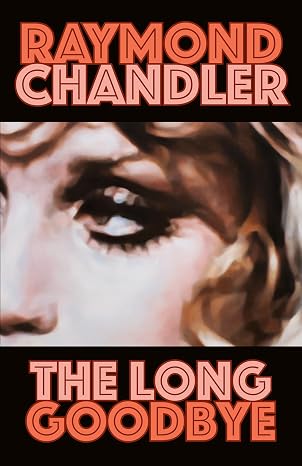
Why this book: I’d read The Big Sleep by Chandler and was impressed. I was looking for another highly regarded book and page turner for my long flight to Europe.
Summary in 4 Sentences: Philip Marlowe (Chandler’s Private Eye) meets a guy who who needs help – he helps him, and then encounters him a few more times, they become familiar but not particularly close, and finally this fellow shows up at his door and mysteriously asks for a ride to the airport to fly to Mexico, and Marlowe obliges. Not long afterward, Marlowe is accused of being accessory to murderer – and Marlowe gets to deal with the police and justice system trying to frame him. Then this issue is left hanging as Marlowe gets involved in some additional seemingly unrelated sticky situations which in the end are indeed very related to the murder and the escape of his “friend” to Mexico, but it remains unclear how. And of course, Marlowe figures it all out while the authorities are left scratching their heads.
My Impressions: As was The Big Sleep, this is a fun and good read, though for much of it I really wasn’t sure what was going on. Marlowe is an appealing character – pretty much fits the mold of the hard-boiled private eye of the popular mystery-detective genre. The setting is LA in the early fifties and Chandler clearly enjoys pointing out the self-centered extravagances and eccentricities of the wealthy class who our humble hero Marlowe encounters – the beautiful women who manipulate men for their own ends, the wealthy weirdos who buy beautiful trophy wives and trophy houses to show off their wealth and success. How they then are able to manipulate the justice system to support their goals and extravagant lifestyles.
Marlowe’s meeting and discussion with Mr Potter in chapter 32 is precious. Mr Potter is a multi-multi-millionaire – which is really wealthy in 1952. It was his daughter that Marlowe’s “friend” was accused of murdering. When Marlowe questions the pat solution to the crime that the police, the DA and the press are reporting, Mr Potter summons Marlowe to a meeting to carefully warn him to back off, and in the process, tells Marlowe about how the world works:
“We live in a democracy, rule by the majority of the people. A fine ideal if it could be made to work. The people elect, but the party machines nominate, and the party machines, to be effective must spend a great deal of money. Somebody has to give it to them and that somebody, whether it be an individual, a financial group, a trade union or what have you, expects some consideration in return. What I and people of my kind expect is to be allowed to live our lives in decent privacy…There’s a peculiar thing about money…. In large quantities it tends to have a life of its own, even a conscience of its own. The power of money becomes very difficult to control. Man has always been a venal animal….The average man is tired and scared and a tired and scared man can’t afford ideals. He has to buy food for his family. …. (p 233-234)
There were a number of subplots, branches and sequels to this story and how Marlowe inadvertently got himself wrapped up in this very strange case. In the end the actual solution and surprise ending confused me, and I had to think about it and go on-line to help me sort out what Chandler (through Marlow) actually uncovered as the answer to who committed the crime, why and how – which included a couple more dead people.
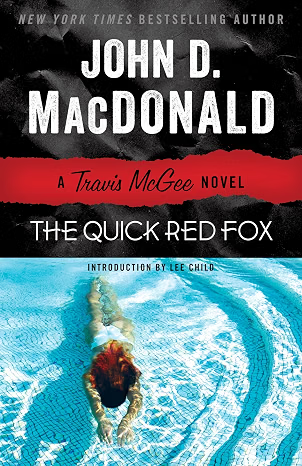
Raymond Chandler was one of the original masters of the true detective crime novel genre. Chandler’s Philip Marlow was clearly a model for John D. MacDonald’s Travis McGee who came along in the early 1960s. Marlowe, the world weary hard-boiled detective, worked in the Sin City environment of Hollywood and LA, whereas McGee was the easy-going society drop-out living on a house boat in Florida. But as characters, they had much in common and both appeal to me for their honesty, lack of personal ambition, insightful about people, each is compassionate but not a chump, favoring honor and principle over personal advantage and self aggrandizement.
The story was interesting though at times, hard to follow. Chandler’s commentary through his characters about the lives and eccentricities of the wealthy elites of LA is worth the read itself. If you like this genre and excellent writing, you’ll like this book.