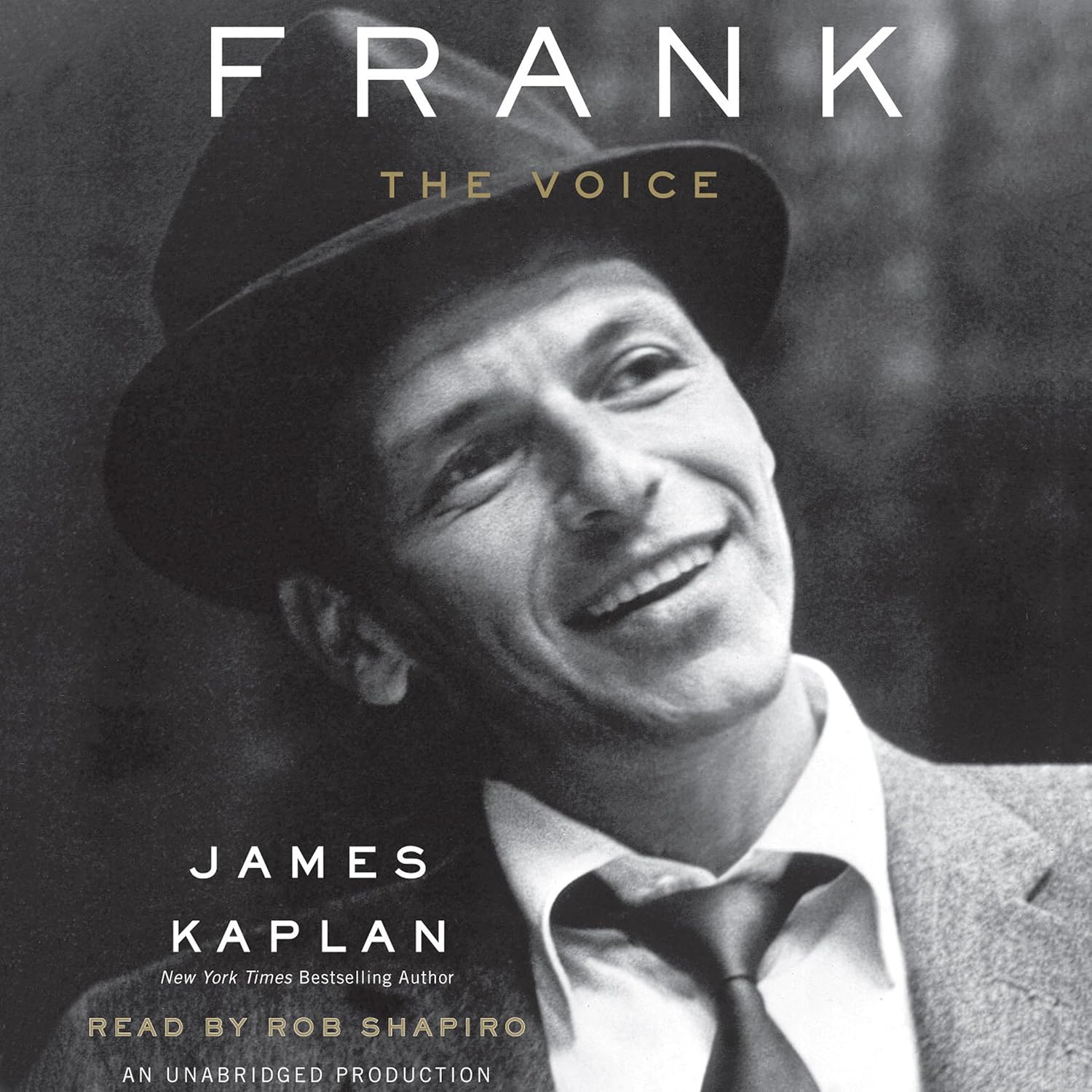
Why this book: I’ve been a big fan of Frank Sinatra’s singing for a long time, but knew little about his life. I’ve been wanting to read this biography for years, but just wasn’t getting around to it. So I purchased it on audible and listened to it.
Summary in 4 Sentences: The book starts with what is known from several sources of Sinatra’s childhood and family life growing up in Hoboken, New Jersey and how through a driving ambition and belief in himself, he went from a kid on the street who could sing, to become a national and worldwide star. We follow Frank Sinatra’s rise from a decent night club singer to national phenomenon, and heart throb of young women, his many mistakes, his doomed marriage, his character flaws which he overcame with hard work, luck and help from friends, family and others who believed in him. The last part of the book is about Frank’s transition into young teen idol as a young adult, to what led to a significant downward turn in his popularity, his tumultuous love affair and marriage to Ava Gardner, and concludes in 1953 when his star begins to rise again, after winning an Academy Award for his performance in From Here to Eternity. The “rest of the story” – Sinatra’s career from being “the Voice” to becoming “the chairman of the board” will be told in part two, Frank – The Chairman
My Impressions: I thoroughly enjoyed Kaplan’s telling of this story, and Rob Shapiro did a great job narrating on audible the story that appears in print. I’ve told my friends that this book takes more than a peek behind the curtain of Hollywood’s glamour and celebrity to reveal a lot of ugliness in the “star-making machinery” during the glory days of music and Hollywood of the 1930s, 40s, and early 50s. Frank’s ambition and belief in himself gave him the energy to overcome disappointments and keep driving toward the stardom he so badly wanted and felt was his destiny, but it was also a big part of how he became very much his own enemy – his unbridled self-centeredness and ambition creating his many unhappy experiences. That said, his drive and sense for what would serve his ambitions supported his tremendous talent that ultimately pushed him to the top of the world of stars and celebrity.
Kaplan is unsparing in his admiration for Frank’s special talent for singing from the heart and putting emotion into his singing, and also unsparing in his reporting on Frank’s self-centeredness, his lack of responsibility to those who loved and supported him, and his routine exhibitions of poor character. But his charm, charisma and talent drew supporters who (usually) forgave him these flaws, and continued to support him, and offer him valuable advice, which he sometime took, often didn’t.
This biography of one of American pop cultures major heroes of the middle of the 20th century provides a lens through which we can look at American culture during that period. Radio and phonograph records were relatively new in America – creating new opportunities for musicians to become mega stars by reaching large audiences in the American population. During the 1930s and early ’40s, the big bands of Tommy Dorsey, Glen Miller and others provided a setting for dancing and partying and were all the rage . Bing Crosby was the first “crooner” who achieved mega-stardom breaking through the almost monopoly that the big dance bands had on the American tastes in popular music. Frank Sinatra created his own niche appealing to the young, so-called “bobby-socksers” – the teenage and young girls who swooned at Franks concerts. Crosby’s appeal and audience was a bit older, and grew when he began acting in movies. That’s when Frank looked for and got limited opportunities to get parts in movies, but without much success.
As the 40s progressed Sinatra’s star began to fade as other stars rose to prominence, Perry Como, Eddie Fisher and others. His misbehavior in his private life, his public philandering while married earned him many enemies in the press and many considered him to have been a flash in the pan. In the late 40s, his star was in decline, and many believed he was all washed up. But Frank’s drive and ambition were formidable and he would not give up on his goal of becoming and remaining a Hollywood, pop-culture star.
I was surprised to learn that Sinatra was an avid reader. When he read a book that was very popular in the late 1940s, From Here to Eternity by James Jones, he identified very much with the character Magio – a smart alecky precocious youngItalian kid from a poor neighborhood who kept getting into trouble. The story takes place in Honolulu just prior to, during, and immediately after the Japanese attack on Peal Harbor. When Frank learned that Hollywood would be making a movie from the book, he lobbied hard to get the role of Magio – to the point that he was signing his letters, “Maggio,” arguing convincingly that he was the ideal guy to play that role -it was him – who he used to be – a poor, smart-alecky kid from the streets of New Jersey. He was not the producer’s first choice, as his popularity was sinking and he had not been impressive in his previous movie appearances. But his persistent lobbying succeeded, he got the role, and as promised delivered a great performance for which he was recognized with the Academy Award for best supporting actor. This validation was key to turning his career around and at this point, in 1953, his popularity and self confidence were on the rise.
This is where Frank – the Voice concludes. For the rest of his life’s story – from 1953 until his death in 1998 – I’ll need to read or listen to part 2 – the next book Kaplan wrote: Frank – The Chairman.
It was a lot of fun to listen to this book – very well narrated – about the adventures, foibles, and private lives not only of Frank Sinatra, but also of the biggest Hollywood stars of the era – nearly all of whom became the TV stars I grew up with. I don’t follow Hollywood stars, but this book is a treasure trove of scandals, salacious gossip and social excess from that era. With all that ego driven narcissism, money and licentiousness, it would almost seem that they were all screwing each other, madly and with impunity. And Frank Sinatra was certainly one of the most prolific “cocksmen” of the era – he could and did get almost every beautiful woman he wanted before, during, and after his marriages to his first wife Nancy, and later, Ava Gardner. The last part of the book is very much about Frank and Ava’s very tumultuous marriage – which made him psychologically unstable, which hurt his career. This was in part due to Gardner’s own self-centeredness and apparent indifference to Sinatra’s hyper-sensitivity. The more she didn’t respond to his entreaties to be with him, the more it drove him crazy. Their behaviour before and during their marriage was toxic to both of them.
Here are a few of my key take-aways from the book:
Celebrity hustle – marketing and publicity teams, agents, the press, the struggle to find gigs – behind the glamour, we see very competitive, dog-eat-dog hustle for money, publicity, promotion, fame, opportunities for career enhancement. Frank depended on a whole host of people to get him gigs and help him get publicity and increase demand. He also sabotaged many of their efforts with his impulsive behavior in public and with key personnel.
The Perks of Fame and Celebrity – For Frank it was not just money, but sex – as much as he could handle(perhaps more!) it seemed. Multitudes of young attractive women wanted to have sex with the famous crooner and sex object and Frank was only too willing to fulfill their fantasies. Also the money, all the hangers on who wanted to bask in the reflected glow and glory of his success, and the power that gave him. He was “the man.” He got very used to spending a lot of money, he got used to luxury and living the high life – and when his divorce took much of that away from him, he struggled to cut back, and was often broke or deeply in debt. He had to borrow money and take a lot of work he didn’t really want just to financially keep his head above water.
The banality of sex and beauty. Frank was obsessed with beautiful women, as most men are. But most men are lucky enough to NOT get what their genetic make-up tells them to want – lots of beautiful women. Many or most of those who desired Frank didn’t have lot more to offer other than to be able to satisfy his immediate desire for sex and beauty. Fun to read about a guy who got what most guys want – and to see how the fulfillment and pleasures were ephemeral, while the complications and the problems lasted a lot longer. For young men and women with strong sex drives, it is a bit like candy for kids – it’s so much fun to be able to satisfy the impulse, eat all you want, but over the long term, it is ultimately unsatisfying, unhealthy and unfulfilling. That said most of us men would still like to learn that lesson from experience rather than vicariously….
Importance of arranging to music Frank paid a lot of attention to the arrangement of the music behind his songs. He and his team were always looking for a song that would be a big hit, and take him to the top of the charts, garner him publicity and more demand from the public, which meant more fame, glory, women. However, a great song needs a great musical arrangement to accentuate the beauty and feel of the poetry in the lyrics. rank finally discovered Nelson Riddle who was a master/genius at composing and arranging the instrumental backups to songs Frank chose (or were chosen for him) to sing. I now pay a lot more attention to the nuances of the arrangements of the music I listen to. The lyrics and beat are important – but the backdrop and musical arrangement often gives the song its feel and power.
Frank’s Genius – what made him special as Kaplan repeatedly points out in this biography, Frank had a gift of singing from the heart – putting his personal emotion into his songs. In his best songs and classics, it feels like he’s singing to you the listener. When he was in his prime as a bobby-soxer idol, the young girls felt like he was singing from his heart to them. Later, when he was more mature, and feeling good about himself, that emotion came through in his singing and he sang beautifully. When he was down (often because of financial problems or his struggles with his second wife Ava Gardner,) his singing was flat and there was no “feel” to it. He worked a lot on his diction and pronunciation in songs to mitigate his Joy-zie accent. He also would study at length the lyrics to the songs he would sing, to get a sense for the feel that they imparted, so that he could put that into his voice as he sant. He sang a number of songs in his down period that were at best, unremarkable. After his career took off after his success in From Here to Eternity, there was more life and emotion and power in his singing and his popularity began to rise again.
Infatuation Much of the last part of the book is about his complete infatuation with Ava Gardner. She was in love with him, but not nearly as infatuated as he was, and while he couldn’t get enough of her, she started feeling crowded and began keeping her distance – he was a very demanding lover and partner. He actually attempted suicide a couple of times, and once almost succeeded – he was so distraught over Ava’s distancing herself from him. No amount of sex with other beautiful young women could relieve that pain. Most of us have been infatuated and love-sick at one time or another, and that helps the reader to have some sympathy for Frank – but his infatuation was epic and truly toxic, which doomed their marriage.
