
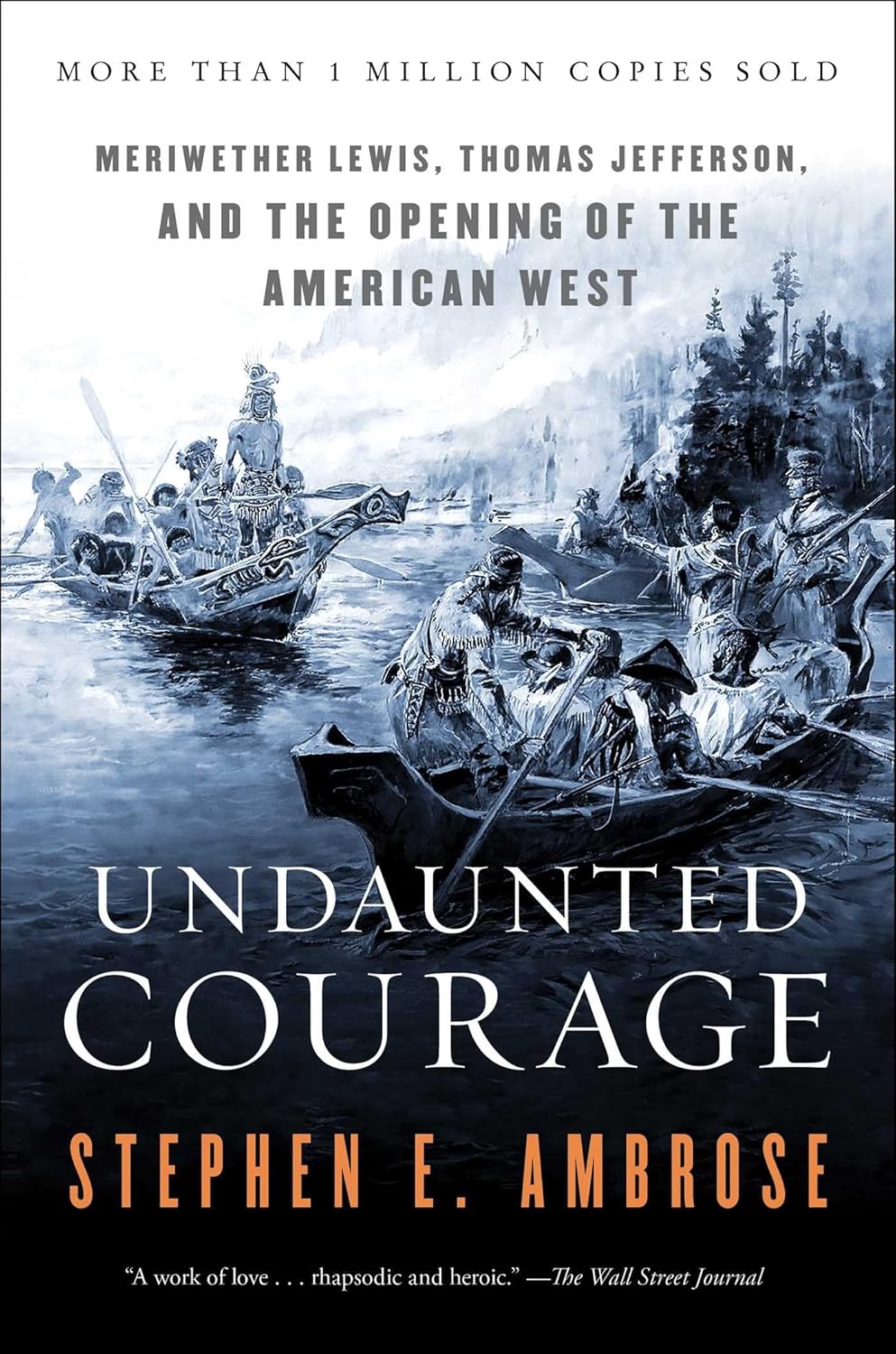
Why this book? I’ll be on a cruise visiting the region where Lewis and Clark moved toward the Pacific on the Colombia and Snake Rivers. I’ve read this book once, and later listened to an abridged version – both over 30 years ago. I wanted to re-read it.
Summary in 4 Sentences: As the title suggests, this book is largely about the Lewis and Clark expedition, but is also a biography of Meriwether Lewis as his life before, during and after through the lens of his leadership during the Corps of Discovery, also known as the Lewis and Clark Expedition. We learn about his childhood and upbringing, his almost familial relationship to Thomas Jefferson, and then about his activities, thoughts, (to some extent) his emotions and leadership during the over two years it took them to reach the Pacific Ocean and his decline after his return to St Louis. The last part of the book is a sad post script to his many successes during the expedition, and Ambrose tries to understand what led to his suicide, and concludes with a strong tribute to him. William Clark and Jefferson are strong and much admired adjuncts to the story, but Lewis is the main player.
My impressions. Loved this book (again!) Ambrose clearly had a love for his subject. As he explains in the introduction, for many years he’d taken family vacations into the Northwest and visited and camped in or near many of the sites where L&C had camped. He clearly enjoyed the research he did on the Corps of Discovery, and that love for his subject matter came through in his writing.
What I had forgotten from my earlier readings was the extent to which this book was also a life-and-times of Meriwether Lewis and Thomas Jefferson. Lewis was the primary chronicler of the Corps of Discovery and though not all, a lot of his journals and notes survive, Ambrose also reviewed the journals and notes of others on the Corps of Discovery and provided his own commentary on differences and discrepancies between them. He also refers to numerous other books and the research previous historians have done on the expedition. Ambrose’s perspective and writing makes the entire enterprise more readable and enjoyable for the lay, vice academic, reader. He provides not only the original texts (with original “creative” spellings) but also the perspectives of other researchers and writers, and then adds his own.
This was Thomas Jefferson’s project. He selected his protoge – Merriwether Lewis – to lead it and Jefferson makes the convincing argument that his background and character made him a near-ideal candidate to lead the expedition. He was a experienced and stong in the outdoors, was passionate about geology, and nature in general, and very detail oriented, which enabled him to make detailed notes on the flora, fauna, geology, and geography of what he encountered – nearly all of which were new to Western civilization. I say “near ideal” because he did apparently have bouts of depression, of which there were hints during his time on the expedition, but he was so focused on his mission, he seemed to sublimate those negative feelings. His previous time in the army served him well as a leader of men who were cut from the same cloth as elite soldiers – he respected him and they respected him. He also selected an outstanding candidate in William Clark to be his co-leader. Congress and others wanted there to be only one leader – Lewis – but Lewis himself insisted that Clark be a co-equal, and indeed that partnership appeared to work superbly.
It took over a year to prepare for the launch of the expedition from Saint Louis and Ambrose spends nearly the first quarter of the book not only describing Lewis and Jefferson and their relationship to each other, but also the extensive preparations that needed to be made, as well as Jefferson’s struggle to get funding to pay for the expedition.
The expedition lasted over two years, and nearly everything they encountered was new to Western Civilizations. Some of the Native Americans had never seed Westerners before, though all were aware that there were white people with new technology trading with tribes farther East – traders coming from British controlled Canada – and from the West – coastal tribes trading with (mostly British) ships pulling in along the northwest coast of what is today the US and SW Canada. Their encounters with the Native Americans were for me among the most interesting parts of the book, and Ambrose had separate chapters on “ethnographic” studies of a number of the tribes, take directly from Lewis’s notes and observations.
They had a number of close calls, not only with the physical challenges of moving all their group and gear upriver through unexplored terrain, but also with the Natives who lived there and considered it their territory. They had one very close call with the Blackfeet tribe – the most warlike of the numerous Indian tribes they encountered. WIth the more friendly and cooperative tribes, language was always a problem, and it frequently occurred that the one person who knew the Native language, had to translate it into sign language or French, and another one on the expedition who knew sign language or French would translate it from there into English. Communication always took a long time and often it was questionable how accurate the content was translated.
The men of the Corps benefited from very different sexual mores among natives, who believed that a man could gain the strengths and attributes of another man if his sexual partner had sex with that man. So as one friend of mine noted, who’d read this and other books on the expedition, there was a lot of “shagging” going on between the men and the native women, and Ambrose noted that when the Corps was camped on the Pacific Coast waiting for spring when they could recross the Rockies, sex was one of the few diversions the men had. There is nothing in the record that would indicate that Lewis or Clark participated.
One of the other things that struck me: Reading about the Corps of Discovery’s trip into the near Stone Age world of the American Northwest at that time, was like a confrontation of Western Civilization and the world of our ancestors. Simple necessities like eating and surviving became prime drivers. Those on the Corps had to become like a primitive tribe, and take care of each other for over two years, as they realized how very dependent they were on their teammates and their leaders, just to survive. They traveled with dogs and young horses (colts) which they brought to use for meat – which I have difficulty comprehending. And this chasm between primitive and modern life we saw in how the native Americans lived and reacted to the simple items brought by the Corps – needles, guns, iron implements of any type, mirrors, glass beads. That is hard for us to fully comprehend, who take for granted our modern conveniences, get our meat and whatever we need to live, by simply going shopping. Ambrose took us with them back into primal times before most of the comforts and conveniences we take for granted were available.
One of the most remarkable accomplishments of the expedition was that over the 2+ years they were gone, they only lost one man and that was to what later researchers believe was appendicitis. They did have a lot of very close calls. A number of the members of the expedition died relatively young, and some believe from the long term effects of syphilis, probably contracted from the native women. Lewis himself served as the Corps doctor, using some methods that current medicine believe had merit, and others (like bleeding) that probably did more harm than good. But that was a remarkable survival rate given the dangers and extreme conditions they encountered, and the lack of facilities or opportunities for healthy recovery from illness or accident.
Ambrose did spend some time on the aftermath of the expedition, and the challenges Lewis and Jefferson had in optimizing the incredible insights and results from it. There were so many urgent and challenging issues facing America at the time, and the excitement and future opportunities presented became background noise and a curiosity. Also, as a single young man (32 yrs old) Lewis was rather abruptly thrust into the role of short term national hero, public speaker, chronicler and publisher of his journals, and political leader when Jefferson appointed him to be Governor of the Louisiana Territory. His predilection toward depression had been held at bay during the expedition by his need to intensely focus on the enormous challenges of taking care of his men and mission. Afterward, with that pressure off, he succumbed to the many distractions of social life, alcohol, and a multitude of other duties and commitments – which opened the door for his depression to hit him full force. Ambrose discusses with compassion and insight, these sad truths and the circumstances which led to what most believe was his suicide.
This book is not just a great story but imparts insights about the politics and culture of the early United States, about native Americans in the far northwest during their earliest contact with Europeans, and about how men behave when forced to live together in a new and unforgiving environment. And it’s about heroism, as well as human frailties. Definitely worth a re-read.
W


