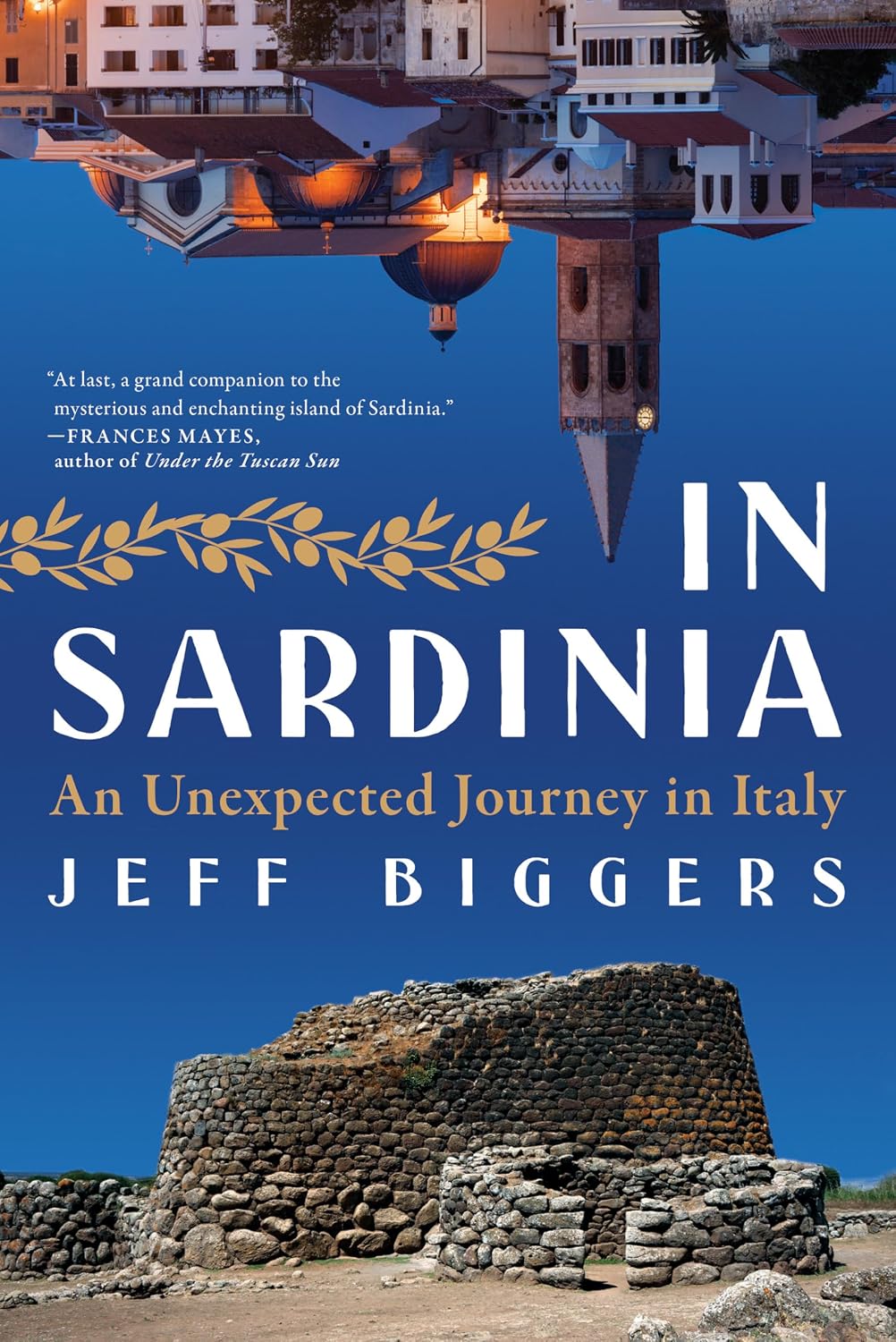
Why this book: I read it in preparation for my trip to Sardinia with “Friends of Bob” in a few months (Oct ’26)
Summary in 3 Sentences: The author covers history, culture, art and more of Sardinia in a personal story – he is an American author and teacher, married to an Italian lady and they spend their time between America and Italy. He became interested in Sardinia, moved there for an indeterminate period, and shares his fascination with all that he learned there, visiting all parts of the island, researching its history and speaking to both prominent and regular folks. He covers a lot of the history, as well as current dimensions and challenges of those who live on the Island.
My Impressions: In Sardinia covers Sardinian history, culture, historical challenges, with a very broad brush, stopping at fascinating points along the way. He writes from a first person perspective, sharing experiences and insights he and his family have gained from living there for a year or so. The author writes very well – and comes to this new area of his and his family’s fascination from having previously written a number of books dealing largely with American culture and history.
I was amazed to learn that Sardinian history goes back not just centuries but millennia BCE and that archeologists are still finding and learning about different civilizations that lived there millennia before recorded history. I’ve learned that Sardinia is one of the richest places in Europe for archeological research, given that it has been isolated for most of its history from many of the wars and encroachments of civilization that the rest of Europe has experienced. There are thousands of stone Nuraghe – megalithic towers, edifices, ruins – all over Sardinia, built by the Nuragic civilization occupying the island for thousands of years before they eventually became subsumed in the Phoenician, Carthaginian, Roman, and then European and Italian civilizations.
In reading this book, I was struck by the many similarities I see with Scotland, where I have spent much time. Both are mountainous regions, isolated, to large extent insulated from major European civilizations, and which therefore developed unique and independent cultures. Both developed hardy rural populations of independent farmers living primarily in small villages, and were exploited by wealthy landowners from the more dominant European civilizations- the Scots by England; the Sardinians first by the Roman and then the Spanish, then the Savoyards (in SE France) and the Piedmont region of NW Italy, and finally and currently by the Italian government in Rome.
Both were treated essentially as colonies to provide resources, labor and soldiers to their dominant wealthy European overlords. In both cases their exploitation led to widespread resentment and then, rebellions which were brutally suppressed. In both cases, their hard scrabble male populations often turned to banditry and which led to the entire cultures being described and put down as barbarians, brigands and bandits. In both cases they were forced to provide soldiers to the armies of their overlords, and their soldiers were among the toughest and most effective fighting men, fighting for those who had exploited them. In both cases, they were eventually peacefully integrated into the dominant culture – Great Britain for the Scots, and the Kingdom of Italy for the Sardinians. But in both cases they remain generally self-governing, and fiercely and proudly protect their culture and cultural identity.
A few other interesting “facts” I learned about Sardinia from In Sardinia:
- In 2006 Sardinian language became the official language of Sardinia, though much official work is still done in Italian. The Sardinian language has some similarities to Italian and Romance languages as a result of centuries of interaction Sardinia had with Italy, Spain, and France. But in addition to Latin, Sardinian includes elements remaining from other ancient languages. There is currently an aggressive effort to keep the Sardinian language alive, and nearly 80% of the population speak it.
- In order to save the coastline from tourism, they’ve passed a law prohibiting new construction within 3km from the coastline. This is to prevent coastal spoilage by aggressive developers wanting to build future major centers of tourism on the beautiful beaches and coastline. There is at least one such large tourist destination, Cosa Smeralda in NE Sardinia, which resulted in this law – to severely restrict or prevent future exploitation of their coastal resources.
- There are several World Heritage sites on Sardinia to include Domus de Janas – groups of ancient tombs cut straight into rock over 5k years ago, and an old well-preserved Nuraghi from the Bronze Age.
- There is an almost hidden mysterious ancient village “Tiscali” built entirely inside a massive hidden mountains cave. Very hard to see – one has to hike into the mountains to see these (apparently) fascinating ruins.
- The town of Orgosolo is characterized by extensive beautiful and graffiti-like murals depicting life and various key events int the history of Sardinia. Reminds me of what I saw in Christ Church, New Zealand.
- Sardinia’s population was decimated by the black plague that arrived from Europe in the 14th century, and an estimated 30-50 percent of the population died. Malaria- infected mosquitos also brought into Sardinia by foreign commerce in later centuries later became endemic and led to several thousand deaths per year into the 20th century, especially in the lowland regions. The government undertook to spray heavily with DDT after WW2, which essentially eliminated malaria as a threat.
- Emilio Lussois a name of one of the most prominent figures in Sardinia during the 20th century and his name comes up a lot in Biggers’ book. During my hikes in the Dolomites, I was intrigued by my visits to various trenches and other remains from WW1 which inspired me to find and read Lusso’s book The Sardinian Brigade. This is his highly regarded first person account of trench warfare based on his experiences as an officer in the Italian Army fighting the Austro-Hungarians in Italy in the trenches of WW1.
- During the 1930s and 40s there was a strong Fascist movement in Sardinia. The Fascists, with Mussolini’s support, essentially took over the country. Many Sardinian patriots were imprisoned and as a result of his anti-fascist, anti-Mussolini views Lusso was able to escape to France to avoid imprisonment.
- I was surprised to learn that many in Sardinia resent NATO’s presence in Sardinia, specifically the NATO naval base in La Maddalena in the north, and because of NATO’s efforts to appropriate rural areas from farmers and shepherds for military training.
- It was interesting to learn that all the way into the 20th century, Sardinians have been fighting the image of themselves as they were described by Roman visitors two thousand years ago. Biggers notes that “The image of the ill-clad plundering highlander remained a vibrant prototype for the next two thousand years.” So very similar to the Scottish Highlanders fighting the same image given them by the English.
- There had been a malaria epidemic in Sardinia for years in the 18th and 19th centuries, caused by mosquitos inadvertently brought in by traders. In the post ww2 20th century, the Sardinian government was fed up with heavy negative impact malaria was having on Sardinia, killing hundres and thousands annually, and waged a successful campaign to rid the island of the mosquitos using DDT.
SHORTCOMINGS of In SARDINIA: I really enjoyed the book, though in several chapters Biggers went into detail on some things I wasn’t particularly interested in. But what did frustrate me was that he mentioned and described so many interesting and obscure places in Sardinia that were not included on the one map of Sardinia in the frontispiece of the book. Occasionally, I’d get my phone out to find out where ARE these places located, and how does one get there. The book needs lots more maps. Also he described several aspects of Sardinian history that assumed I knew more than I did. For example he referred to the Savoyards and the Piedmonts as absentee landlords exploiting Sardinia. Who were they? Nearly a whole chapter on Garibaldi – a key figure in Italian and Sardinian history – I knew the name but not much more. I repeatedly had to go to google, or ChatGPT for explanations that should have been included the book. That said, I have described the book to my friends as very well written for an intelligent audience, and I’ve strongly recommended it to my friends who will accompany me to Sardinia in a few months.
In Sardinia is expensive to buy ($50) but I got a copy at the Coronado Library. It is well written by a published author for an educated audience. But if you are not inclined to read the whole book, and you are planning to visit Sardinia, I highly recommend reading at least the following short chapters, between 4 and 10 pages ea, a total of about 75 pages of big print:
8. Monte Prama
16 Monte d’Accoddi
18. Valley of the Nuraghes
19. Girl Writer Found dead in Mystery Case
22. In sos logos de Angioy
23. Su Patriotu Sardu
24. Saving the Coasts
26. Tiscali
33. Of Stele’s and Islanders
About schoultz
CEO of Fifth Factor Leadership - Speaker, consultant, coach. Formerly Director, Master of Science in Global Leadership at University of San Diego; prior to that, 30 years in the Navy as a Naval Special Warfare (SEAL) officer.