
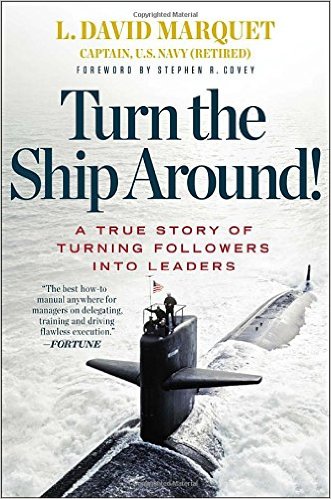
 Why this book. This is one of the keystone books used by All American Leadership, a company I do work with. Intereseting that a number of the leaders of AAL, including its CEO Rob Nielsen, are West Point graduates and have little experience of the Navy, but are embracing the leadership model that this book offers in their consulting in the corporate world. I read it as part of the catechism of being part of AAL. I realized that an important part of why I choose to work with them is because they embrace the principles in this book.
My Impressions: I wish I had read this book before I had command in the Navy, and before I led my team at University of San Diego. I sent a copy to my son, who is going into his own “command” in a few months, and I think he will get some good ideas from it. Though I believe I followed many of his principles in my own command style both in and outside the Navy, I learned a lot from this book. Marquet lays out in a simple and very readable form a great philosophy and outline of how to transform a culture from a traditional, top-down, leader-follower organization, to a less traditional, leader-leader and much more engaged culture. He backs up his philosophy with engaging anecdotes from his experience leading a fast-attack submarine. His approach requires that the leader be willing to give up control, to delegate much more authority and responsibility than most leaders are used to, in order to get greater engagement, and greater response from the team s/he is leading. Yeah – I know – you can delegate authority but not responsibility, but his point is that if only the leader feels responsible, the leader is not getting full engagement from the team. He talks about how the leader can make those on the team BE and FEEL responsible for the mission and performance of the whole team.
I enjoyed that Marquet challenged the traditional military model of Leader-centric leadership that I grew up with. He challenges the concept of the leader as the center of attention and the fount of all wisdom, experience, and authority in an organization. Such a model is not only not optimally effective, it does not optimally develop future leaders. Success in the leader-centric model depends on the leader being right all, or nearly all the time and has fewer mechanisms for the wisdom of the team to contribute to success. Most of us grew up with this leadership model in books and movies – the charismatic leader who everyone looked up to, who gave orders, leads with an iron fist, and saves the day. All of us wanted to be that leader – the hero, the father-figure, the great one who everyone admired and aspired to be. But it is an old model that may work in some limited circumstances, but not in most environments in today’s complex and well-developed society, and doesn’t adequately respect the competence, energy, and insights of others on the team.
Marquet explicitly says that he chose to overturn much of what he had learned about leadership at the Naval Academy and in the Navy to create his own model. I think he overstates that case somewhat – though I think he has some original and creative ideas, his model is not unique or new; I have seen other leaders who have succeeded with similar styles and methods. But this book offers an excellent approach, and when I talk to junior (and senior) military people about leadership, I often refer them to this book. I also think the book has much to teach non-miltary organizations, and All American Leadership uses it extensively in their corporate consulting. I have suggested to rising CPOs to read this book with their new division or platoon officers; to new XOs and COs to read this book together. I suggest that leaders in any organization read this book with their teams and discuss how and to what degree they can implement the tenets Marquet proposes within their organizations.
So what does he recommend? In short, pushing authority and responsibility down as far as they can go. But this must be done incrementally and carefully, as the leader and his/her team must ensure that adequate technical competence and organizational clarity on objectives are in place to ensure the team is ready to succeed when given increased authority and responsibility. Marquet inherited a ship that was used to traditional top-down leadership, and in his book, he shares his deliberate, and often frustrating process of getting people to assume more responsibility than they were used to, and to take initiative in their jobs, rather than waiting to simply be told what they’re supposed to do. When everyone on the team knows and “owns” their job, owns the consequences of their performance, feels a sense of ownership of and responsibility for the mission and the team, well trained and good people don’t have to be told to what to do or to work hard. Leaders are then freed up to do more work on quality, give more attention to developing people as leaders, and less on giving direction and providing oversight
A few specific lessons from the book: Below are a few takeaways from Turn the Ship Around.
Use language of empowerment:
- Have people say “I intend to….” instead of “Request permission to….”
- Have people say “I plan to…” instead of “”I would like to…”
- Have people say “I will look at alternatives and come back with my recommendation…” instead of “What should I do now?”
Don’t Brief. Certify. Leaders shouldn’t brief their people on what needs to be done. They should provide intent with constraints and restraints and then let their subordinates brief them on how they will fulfill the mission, the leader’s intent. Briefings by leaders allow people to passively sit and be told what the plan is and what they are supposed to do. For the leader to “Certify” demands that people know the plan and what they’re to do. They brief the leadership on what they plan to do, and the leader(s) ask them questions to “certify” that they know the plan and their responsibilities, thus allowing the leaders to determine that their team is ready.
Resist the urge to provide solutions. This is hard. Leaders must be teachers, and the best learning is done when people struggle with a problem, have to think, to be creative, and then ultimately attain the satisfaction of finding a solution. Then leaders provide input and positive feedback, and if appropriate, suggest other considerations. Learning takes place – and people begin to learn how to think.
Reward initiative. Seek to build a culture focused on achieveing excellence rather than avoiding making mistakes. To achieve excellence, mistakes are necessary. Tolerate and even embrace well intentioned mistakes.
Decion making. Making decisions is the most important job the leader has. HOW s/he makes them is perhaps more important.
- If a decision needs to be made now, make it. Then debrief and critique it afterward with your team. YOU ARE FALLIBLE – and can learn. And in understanding how and why you decided as you did, involves teaching AND learning.
- If a decision needs to be made soon – get input – then make the decision. You are fallible. You’ll get surprisingly good input – if you are open to it.
- If a decision can wait (and most can) – force the team to give inputs. Give them boundaries and general guidance. Encourage and cherish disagreement and dissension. To whatever degree possible, embrace THEIR decision. And give them credit for it.
Understand the objectives of process. Change processes when they don’t make sense.. Marquet offers many examples of people simply and blindly following process without consideration for the objectives the processes are in place to achieve. Leaders keep objectives in mind and see processes as means to achieving objectives, not as ends unto themselves. Leaders look to modify processes that are ineffective, or if there is a better way, to achieve objectives.
Specify goals, not methods. This goes with resisting the urge to provide solutions. Encourage thinking and creativity to achieve goals. People will develop methods that the old-hands never thought of. Ask for in-progress reviews to keep “methods” on track.
Repeat the message, continuously, consistently. A constantly repeated message – key values, principles, guidance – will stick. Constant repetition reinforces the importance of the message. Pick the most important values, principles, guidance, and repeat them continuously and consistently.
Think outloud. Marquet dismisses the idea of closed and “professional” communications that are typical in military culture. He encourages leaders to share their thought processes, so that team members understand and feel included in the process of making decisions. He says that “thinking outloud is essential for making the leap from leader-follower to leader-leader.”
He concludes his book with this simple line: “Give Control. Create Leaders.”


 Bob's Books
Perhaps the single most powerful act of leadership demonstrated by Marquet was his decision
to retain essentially the same team. Even though the commodore offered him the opportunity
to change personnel, he stuck with the existing crew. This was a sorely needed confidence
and morale booster for the crew early on. So with essentially the same team, he took this
organization from worst to first in two years. What an inspiration for CEOs who look themselves
in the mirror each morning wondering if they have the right people in the right seats.
But an even greater achievement than this is “the captain will give no further commands”. This
in my view is the holy grail of superior effective communications. Imagine a CEO running
his/her organization vowing to “give no further commands”? Who will take the challenge?
And just when you think it can’t get any better….Marquet achieves the unachievable:
a government entity that achieves more with less. Here is a government organization
that went from worst to first with reduced spending. Not only did he put a smile on
taxpayers’ faces by reducing operational spending, the Navy picked-up on this and only
authorized the following year’s budget based on the previous year’s reduced spending.
Talk about inspiration! Why is this book not required reading for all government entities?
This, along with his entire body of work, culminates in why I refer to Marquet as a superior
leader: he was essentially able to achieve his vision; that is, much of the behaviors displayed
aboard Santa Fe were disseminated throughout the submarine force. And when he left
Santa Fe, the organization performed equally as well if not better with the new CO.
My challenge is to decide what I like most about Turn the Ship Around. Perhaps it’s the fact
that Marquet has given us a blueprint for how to execute a game plan. He’s given us
everything: a Purpose, Guiding Principles, Mission, Vision, Strategy, Strategic Initiatives,
and Tactics. I don’t know how he could make it any easier for us.
RL – this is a fabulous addition to what I wrote! You saw some really important aspects of what he accomplished, and the strengths of his leadership style, and these are really key insights. Thank you so much, and I will include your perspective in my discussions with other leaders about how much this book can help.
Pingback: Tribes, by Seth Godin | Bob's Books
Pingback: The Checklist Manifesto, by Atul Gawande | Bob's Books