
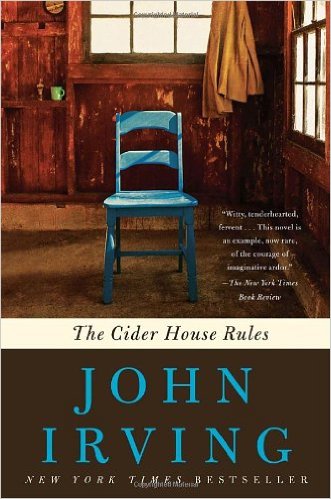
 Why this book: Selected by my reading group for our meeting in late November 2015. I nominated it after hearing it referred to at a memorial service. The pastor noted Wilber Larch’s imperative to “Be of Use” in one’s life, and in how one lives in a community. I looked into it and found that The Cider House Rules is very highly regarded and considered almost a modern American classic.
My Impressions: I looked forward to sitting down to immerse myself in the story of this book – mostly because of the interesting characters and the choices they made in their lives – not because it was a cliff-hanger or so-called page- turner. The setting is rural Maine in the 1930’s through 1950s. There is section early on which takes us back to the slums of Boston in the 1880s to provide background on one of the main characters – Dr Wilbur Larch, obstetrician and director of a small orphanage in a remote part of Maine. Going back to his earlier period is key to understanding how Dr Larch became who he was – not only an obstetrician and orphanage director, but also an underground abortionist, performing abortions whenever requested – not for money, but on principle. He delivers children of women who come to the orphanage, pregnant with a child they can’t or don’t want to raise, and then his orphanage would raise and nurture the child, while Dr Larch sought a family to adopt it. He performs abortions for women who come to him pregnant within the first trimester, who don’t want to bring their child to term. In The Cider House Rules, Dr Larch is always in the background as the conscience of the book – an imperfect, but a very rational, selfless, and principled conscience.
THE main character of the book is Homer Wells, one of Dr Larch’s orphans who is truly exceptional from early on in his childhood. Dr Larch essentially adopts him, and given his unusual precociousness, trains him to be his assistant, and he becomes very good as an obstetrician. As an unlicensed doctor and obstetrician, Homer is uniquely talented – Dr Larch calls him his work of art. But Homer has a philosophical position against abortion and refuses to participate in or support Dr Larch in these operations. When as a young man, Homer leaves the orphanage with a wealthy young couple, the story takes on and challenges conventional wisdom on: Love, work, marriage, principle, duty, honesty, compromise, WW2, loyalty, and the racism and prejudice of the day. It is truly a multi-dimensional and great story.
One of the sub-themes in The Cider House Rules is the tension between fatalism and free will, and John Irving definitely takes a stand. One also sees the subtle interplay between life and death, birth and dying. Religion, moral theory, spirituality are not directly addressed but are clear sub-themes in the book. Much to discuss in these areas, where principle and theory bump up against practicality. Following one’s heart is a key message in this book, that only by doing so can one find one’s proper destiny. Throughout this story, we see how the good life, and the good in life come from feeding and nurturing the heart. Much more so than following the “rules” of society.
The “cider house rules,” from which the book gets its name, are rules that are posted in a dormitory where migrant workers lived during apple picking season. No one reads nor follows these rules. In the cider house, the workers follow their own rules, driven by their own imperatives, and the posted rules have little impact. Lots of rules are broken in the cider house, and life goes on. In fact people break the rules sometimes in order that life can go on. There are internal and external imperatives that drive people to act and live as they do – and people choose to live by rules that work for them in their specific circumstances. The importance of listening to and living by the rules of one’s heart is an important message of this book. Follow your heart, he tells us.
The story rolled along very well, unique and idiosyncratic without becoming too bizarre. But Irving didn’t develop his cast of fascinating characters as well as I would have liked. The reader can’t help but like and admire Homer Wells, but we don’t learn much about his emotional life. We learn a bit more about Dr Larch – but sense that he almost doesn’t have an emotional life, except in his devotion to Homer, his duty, and his work. There are several interesting women in the book, but I felt I never really got to know them. Compared to how Tolstoy developed his characters in Anna Karenina, the characters in The Cider House Rules were two dimensional. Great story, great characters, I loved reading the book – but I wanted to know these fascinating characters better.
That said, the book deserves its outstanding reputation. A few lines from the book that caught my attention:
“You think an engine is so special? I could teach you how the heart works, thought Wilbur Larch- his own heart teaching him about itself, and much more than its function as a muscle.”
“Wasn’t life in nice places shallow?” (particularly meaningful to me, living in San Diego.)
Dr Larch: “What is this fascination the world has with death?”
A quote from Jane Eyre which was read and re-read to the girls in the orphanage: “…it is madness in all women to let a secret love kindle within them, which if unreturned and unknown, must devour the life that feeds it….”
Another quote from their reading of Jane Eyre: “It is vain to say that human beings ought to be satisfied with tranquility; they must have action; and they will make it if they cannot find it.”
“….never underestimate the darker necessities of the world…”
“You can’t protect people, kiddo. All you can do is love them.”
“’History,’ wrote Dr. Larch, is composed of the smallest, almost undetected mistakes.’”
“He knew what Larch would have told him: His happiness was not the point, or that it wasn’t as important as his usefulness.”


 Bob's Books