
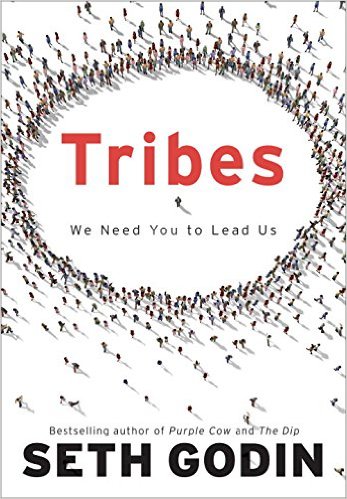
 Why This Book: I often speak about developing a “tribal culture” as an ideal that leaders should strive for. I recently assumed the role of president of my Toastmasters Club and have begun referring to our club as a “tribe,” and wanted to meet with my board and get buy-in to taking steps that would tie our members even more closely each other – more like a tribe. I thought reading Tribes would give me some ideas. It did – more so and differently than I expected. (Numbers below refer to pages in the hardcopy edition published by Portfolio.)
My impressions: I really liked this book. It is short, inspirational, and fun to read – just shy of 150 pages of large print on small pages. It doesn’t provide a checklist of how to create or sustain a tribe. Nor does it offer a lot of analytical perspectives of tribal vs non-tribal cultures, or the difference between the two, or at what point can one refer to an organizational culture as having crossed the threshold of “tribal” – whatever that may be. So, it is not an academic book written to appeal to those looking for an analysis of the idea of a “Tribe.” Nor does it pretend to be. And that is what I liked about it.
Its message is not new or unique. Very similar messages to Disrupt YOU! and Innovator’s DNA , and very consistent with Legacy and Turn the Ship Around, but Godin offers up his message in an aphoristic way – fun, powerful, easy to relate to . Godin’s message is that tribes need to be dynamic and agile to keep up with change. Anyone can be a leader of a tribe – it just takes courage to take the initiative to do so. The economy and our culture are changing rapidly, and those who choose to keep their head down, stay safe, and stay put, are going to be left out, left behind, out flanked or run over by those who break away to find other innovative, energetic, and impatient leaders who will connect and form new tribes.
The book is full of interesting ideas. He devotes one whole section to his discussion of fear, faith and religion. He calls “Fear” the “F” word and demands we acknowledge it, understand it in ourselves and others, and then overcome it. He describes religion as representing “a strict set of rules that our fellow humans have overlaid on top of our faith. Religion supports the status quo and encourages us to fit in, not to stand out.” (80) He says that religion works great when it amplifies our faith, but it is at its worst when it “reinforces the status quo, often at the expense of faith.” (81) When Godin talks about religion, he is not necessarily referring to “the church” or spiritual practice – but any organized dogma which demands that people conform. Throughout the book he talks about “faith” outside of the context of religion. He goes on to talk about the tension between religion and faith, all in the context of his message – Become a Heretic.
He says that, “All you need to know is two things. The first thing …is that individuals have far more power than ever before in history. … The second thing …is that the only thing holding you back from becoming the kind of person who changes things is this: lack of faith. Faith that you can do it. Faith that it’s worth doing. Faith that failure won’t destroy you.” (71)
Tribes is written in short disconnected sections. It can be opened at any place and the reader can jump in, go from middle to front, to back, back to middle – each section can be read independently. You can put it next to the john and be inspired while doing your daily constitutional. His approach reminded me of Nietzsche’s Thus Spake Zarathustra – unstructured, anecdotal, provocative, inspiring and in some cases simply polemic and disruptive. Insightful, and incite-ful. His message is also not dissimilar from Nietzsche’s: It’s your choice. It’s all on you, baby! Go grab life by the throat, fall down, get back up, go for the gusto, take charge of your destiny – and don’t look back. Leaders use their fear as fuel to take off, rather than as brakes to stop, back up and hide. Godin’s Leaders (roughly equivalent to Nietzsche ’s “Supermen”) believe in themselves, are filled with passion for what they’re doing and what they stand for, and are not held back by convention or convenience. Others are drawn to that. And they form tribes around these leaders and their ideas…
DOWNSIDE? – As I read this book, I was going to give him a down check for being unstructured, disorganized, and non-linear in his approach. But then I decided that this was a strength. At the very end he says, “I can tell you that I’m going to get a lot of flack from most people about what you’ve just read….it’s too disorganized, or not practical enough or that I require you to do too much work to actually accomplish anything. That’s ok…criticism like that almost always accompanies change.”
FAVORITE QUOTES: This book is FILLED with great lines. I wanted to narrow this down to just a few, but I decided to leave in most of the ones I selected as candidates –just so that I can have them handy to review, and use in remarks, or meetings, or conversation. Just like the book – scan the quotes below, jump around, see if any of them resonate with you. I also found a list of 70 quotes from this book in Good Reads, including many of those I selected. These are some of the ones I liked most:
The most important tribes are bored with yesterday and demand tomorrow. 31
How many Fans to you have….too many organizations care about numbers, not fans. 33
The Web….and other factors involved in social media mean that everyone…has far more power than ever before. The king and the status quo are in big trouble. 37
By factory…I mean any job where your boss tells you what to do and how to do it…<Most people> want the absence of responsibility that a factory job can give…. 39
Organizations are more important than ever before. It’s factories we don’t need…organizations have the scale to care for large tribes. 41
In a battle between two ideas, the best one doesn’t necessarily win. No, the idea that wins is the one with the most fearless heretic behind it. 42
What people are afraid of isn’t failure. It’s blame. Criticism. 46
Heretics are engaged, passionate, and more powerful and happier than everyone else. And they have a tribe that they support and that supports them in turn. 49
Can you imagine Steve Jobs showing up for the paycheck? It’s nice to get paid. It’s essential to believe. 49
Great leaders focus on the Tribe and only the tribe. 50
Great leaders are able to reflect the light onto their teams, their tribes. Great leaders don’t want the attention, but they use it…to unite the tribe and reinforce a sense of purpose. 50
I’m interested in the second kind of marketing, the act of tightening your organization and spreading the word within the tribe. 53
Great leaders don’t water down their message in order to make the tribe a bit bigger. 67
If you’re not uncomfortable in your work as a leader, it’s almost certain you’re not reaching your potential as a leader. 55
A leader who backs off is making a commitment to the power of the tribe, and is alert to the right moment to step back in. Someone who is doing nothing is merely hiding. Leadership is a choice. It’s the choice to not do nothing. Lean in, back off, but don’t do nothing. 59
Ultimately, people are most easily led where they wanted to go all along. 66
You’re not going to be able to grow your career or your business or feed the tribe by going after most people. Most people are really good at ignoring new trends or great employees or big ideas. 68
The art of leadership is understanding what you can’t compromise on. 79
When you fall in love with the system, you lose the ability to grow.83
The easiest thing is to react. The second easiest thing is to respond. The hardest thing is to initiate. 86
It takes guts to acknowledge that perhaps this time, right now, you can’t lead. So get out of the way and take the follow instead. 87
I define sheepwalking as the outcome of hiring people who have been raised to be obedient and giving them brain-dead jobs and enough fear to keep them in line.96
Tribes don’t do what you want; they do what they want. 107
The only thing that makes people and organizations great is their willingness to be not great along the way. The desire to fail on the way to reaching a bigger goal is the untold secret of success. 108
The secret of leadership is simple: do what you believe in. Paint a picture of the future. Go there. People will follow. 108
The safer you play your plan for he future, the riskier it actually is. 111
The timid leave a vacuum….That’s why initiative is such an astonishingly successful tool: because it’s rare. 112
If you hear my idea but don’t believe it, that’s not or fault; it’s mine….If I fail to persuade you to implement a policy that supports my tribe, that’s due to my lack of passion or skill, not your shortsightedness. 117
…real leadership rarely comes from the CEO or the VP of leadership. Instead, it happens out of the corner of your eye, in a place you weren’t watching. 122
Leadership comes when your hope and your optimism are matched with a concrete vision of the future and a way to get there….122
Managers are the cynical ones…pessimists. Leaders, on the other hand, have hope. 123
Caring is the key emotion at the center of the tribe. 125
Remarkable visions and genuine insight are always met with resistance. And when you start to make progress, your efforts are met with even more resistance…the force for mediocrity will align to stop you…129
What’s hard now is breaking the rules. What’s hard is finding the faith to become a heretic, to seek out an innovation and then, in the face of huge amounts of resistance, to lead a team and to push the innovation out the door into the world. 130
Tribes grow when people recruit other people…. The tribe doesn’t do it for you, of course. They do it for each other. 129
If your organization requires success before commitment, it will never have either. 132
Managers stamp out deviants…..Great leaders embrace deviants by searching for them and catching them doing something right. 133
On positive deviants: Find leaders (the heretics who are doing things differently and making change) and then amplify their work, give them a platform, and help them find followers – and things get better. They always get better…<this> might be the most important practical idea in this entire book. 134
Einstein: “Imagination is more important than knowledge.” … You can’t manage without knowledge. You can’t lead without imagination. 137
Belief: People don’ t believe what you tell them. They rarely believe what you show them. They often believe what their friends tell them. They always believe what they tell themselves. What leaders do: they give people stories they can tell themselves. Stories about the future and about change. 138
Every tribe is different. Every leader is different. The nature of leadership is that you’re not doing what’s been done before. If you were, you’d be following , not leading. 146.
You can choose to lead, or not. You can choose to have faith, or not. You can choose to contribute to the tribe, or not. 146
Once you choose to lead, you’ll be under huge pressure to reconsider your choice, to compromise, to dumb it down, or to give up…. That’s the world’s job to get you to be quiet and follow. The status quo is the status quo for a reason. 147


 Bob's Books
Pingback: From “RIP Duo” to the Runway: Which Theory Best Explains Duolingo’s Viral Fame? – Kai-Heng Chen