
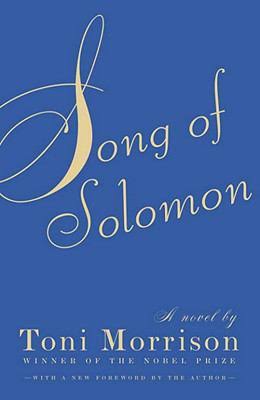
 Why this book: Suggested by one of the members of my literature reading group, who had read it in college, was intrigued, wanted to read it again, and wanted to discuss it with this group. Toni Morrison is a very prominent American Author and her book Beloved had won a Pulitzer prize.
My impressions: Song of Solomon is a different sort of book. I just finished it, and am still digesting how it affected me. It had a lot of parts and sub-plots – it may have been a mistake to read it in increments, rather than in a concentrated couple of sittings, within just a few days. The prose is wonderful. It is a fascinating, but complex book.
The central character is a black American– before the term “African-American” came into vogue. His name was Macon Dead, same as his father and grandfather, but was knows as Milkman – a nickname he didn’t understand until adulthood – that came from having been breast fed beyond his toddler years. Milkman was born in the early thirties and grew up in urban Michigan (Detroit?) in the 30s, 40s and 50s, and the meat of the story takes place in the early 1960s, just before the civil rights movement and Martin Luther King became national phenomena. Lots of inside-the-black-community use of the “n” word. Not many white characters in the book.
Milkman is the youngest of three children, and the only son in a strangely dysfunctional family. The history of both his parents’ families is obscure and confused, a mish-mash of old stories, rumors, and family remembrances. This becomes increasingly important later as Milkman, stumbling through life, begins to search for – or rather create – his identity. A confusing but influential figure in Milkman’s life is his very eccentric and almost other-worldly Aunt Pilate, his father’s sister, who his overbearing father orders him to not to have anything to do with. Later we come to understand why.
Milkman matures into a directionless, self-centered young man with no vision for himself beyond going-along-to get-along, looking for the easiest path to immediate gratification. Along the way, a number of things start coming together that help him realize that the uncertain pieces of the puzzle of his family’s past may have more significance to him than he had realized. The promise of great wealth at the end of this obscure rainbow inspires him to go after his roots, to uncover the confusion of his family’s past. What he discovers gives him (and the reader) insight, not only into the source of his own personal confusion, but also into the disparate threads of the African-American experience in America, from just after the Civil War until the 1960s.
This book is filled with interesting and eccentric characters. The story seems to meander along with a number of mini-stories and vignettes, which though they do hang together, the theme isn’t readily apparent – and it takes some stepping back from the pieces of this mosaic, to see the picture Ms Morrison is painting. There were times in reading it when I thought the book was as wayward and unfocused as Milkman’s life, and I wondered if that may have been the point. It was not.
As I read the last 50 pages or so, I began to get a sense for what it was all leading up to, as Milkman visited the rural South, where things had not changed dramatically since the Jim Crow era, and Milkman got to know the people of his roots, their world, and about his ancestors and relatives. Milkman then returns to urban Michigan. and shares what he has learned with his family– to include his eccentric Aunt Pilate. He agrees to take her back to rural Virginia, to help her put some closure on a tragic incident in the family’s past, and we are left with a fascinating conclusion, which does NOT tie a nice ribbon around the story. Many questions are left unanswered.
One of the many disorienting mini-stories within this book is about Milkman’s best friend from childhood who is on a campaign to surreptitiously kill innocent whites, to avenge the deaths at the hands of whites, of innocent blacks. Milkman stays apart from this terrorism, but it affects him. His friend has focus and purpose – albeit evil. Milkman remains uncommitted to anything in his life, but is confused and unsettled by his friend’s commitment to a cause Milkman finds unjust, even obscene.
I’d recommend reading Song of Solomon with others, so that as a group, you can help each other sort out the pieces to this interesting story. A few themes that came up in the fascinating discussion in my reading group regarding this book:
-Urban life vs Rural life. The juxtaposition of urban life in the North with rural life in the South . Urban life is quick hurried. People don’t have time to listen, watch, pay attention. Rural life is much slower and there is time to pay attention and remember. Milkman was challenged in his effort to adjust to the slow pace of life in rural Virginia. But it seemed to mature him.
-Milkman’s life was dramatically affected by events in his family’s past of which he had little or no knowledge. So are we all – and most of us don’t realize the impact on us of things that happened in the obscure past in our families, events of which we are not even aware.
-Toni Morrison threw a LOT of symbology into the book, which we had fun trying to decode: the sudden appearance of a white peacock; Aunt Pilate’s gold box earing, biblical names, flying…
-A lot of occult references – Aunt Pilate’s relationship with the ghost of her father, and other fascinating allusions to an unseen order of things.
– There is a sense of “magical realism” in the book. There were times I wasn’t sure whether what I was reading was meant to be a dream or real, whether I was reading about a “100 years of Solitude” event, or whether it was an event that Ms Morrison wanted us to believe really happened. And maybe it doesn’t matter….
– In the end, all of the characters somehow redeemed themselves as not completely good, or evil. As the book concludes, Milkman seems to be on the threshold of great insight, but we’re left wondering what really happened to him.


 Bob's Books