
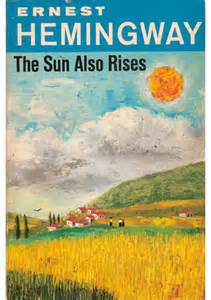
 Why this Book: My reading group had selected The Paris Wife and A Moveable Feast to read for our next selection. Hemingway wrote The Sun Also Rises during his time living in Paris described in these two books. A member of our group noted that reading The Sun Also Rises would add a lot to understanding the other two, and recommended listening to it on Audible -that William Hurt was the reader and he did an excellent job. He was right. As I normally do with classics, I read the Cliff Notes along with the book – going back and forth to see what their reviewer had to say about the section I had just read. It helped a lot. There is a lot more in the story than I had picked up, just listening to the story.
My Impressions: Listening to William Hurt perform the various characters in this book, with different voices and accents was fascinating and enjoyable. Given that the book had French, Spanish, Scottish and English accents as well as American, that was quite a feat and he did it well. It was a different experience listening to rather than reading the story, and I know I missed a lot. I know that because of insights I got out of the Cliff Notes. In this case I realized that there was a lot going on beneath the surface of the story that I just wasn’t catching. Listening to it, the story just rolls along, and it is easy to appreciate as an interesting story, but there was indeed much that I missed that I might have picked up, had I read it, taken it a bit slower, paused as I read, and gone back and re-read some sections. I will read it again, with a new appreciation.
Hemingway’s style is well known and remarkable for its simplicity and austerity. He eschews elaborate descriptions – just tells us what he sees and what happened, and leaves it up to us, the readers to visualize it, experience it, seek to understand it, and derive our own interpretation. I’ve heard that he described his style as following the “iceberg theory” – on the surface we see only his sparse and economical prose, just the bare facts, but most of the meaning and significance is unstated and below the surface. Through his seemingly simply story telling, Hemingway seeks to build a relationship with the reader and trusts us to sense and grasp his intent, what is really happening, without having to explain things. There is a certain Zen-like quality to his descriptions – just what is, without elaboration. I recently listened to an interview with Paolo Coelho (The Alchemist) share the same philosophy of writing.
The protagonist in The Sun Also Rises is Jake Barnes, a young man living in Paris, a few years after having received a wound in WWI which made him impotent. And though this “fact” is alluded to, it is given very little explicit attention; it remains part of the iceberg in this story – unseen, but sensed, below the surface of the story. Jake is part of a group of expat friends, most notably Brett, a very attractive and “liberated” English woman with whom Jake is in love, and Robert Cohn, an American with whom Jake has a rather tense friendship. Brett is very sexual, openly has a brief affair with Cohn, while also being engaged to marry one of the other members of the group. Brett and Jake have a history – we are not clear what it was – but they clearly know each other well and are close.
The story mostly takes place in Spain during a trip the group takes to visit the running of the bulls in Pamplona. The context of the story is this adventure – the experiences, interactions and tensions within the group during the bull fights, the running of the bulls, and the partying that goes on around this annual event. As Hemingway describes this remarkable setting in Spain, we see the tensions grow between Jake and Cohn, and between Cohn and Brett’s fiancé, and we sense the evolving relationship between Jake and Brett. And yes, there is a bull-fighter involved. The story finishes with an interesting and inconclusive “epilogue” that I found very well done.
This is a story about people – somehow unhappy – dissipating their time, in search of something. This book was written during the window when Gertrude Stein referred to Hemingway as the voice of the “Lost Generation” – those who were disoriented and alienated after the trauma and loss of idealism during and after WWI. It was very instructive to read The Sun Also Rises after reading The Paris Wife, which I’ve reviewed elsewhere, and which it seems, pretty accurately describes the world in which Hemingway was living when he wrote The Sun Also Rises. In The Paris Wife, we see that Sun is very autobiographical – Hemingway did indeed take a trip with a group of friends to Pamplona, and many of the characters in the book are based on real characters in Hemingway’s life who were on that trip with him. The story itself is interesting, as is the back story on which it is based. Indeed, a book has recently been published about the “true story” behind The Sun Also Rises, entitled Everybody Behaves Badly. It looks like a good read.
The Paris Wife and The Sun Also Rises together fascinated me, and I’m intrigued to know Hemingway better. I also look forward to reading Sun again, and soon – and once again explore these somewhat self-indulgent, alienated literary misfits of my grand parents’ generation, trying to sort themselves out and find meaning, in each other and their own lives in both Paris and a small city in 1920s Spain.


 Bob's Books