
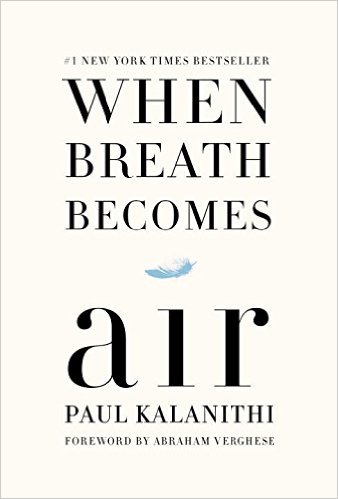
 Why This Book: This book was recommended to me by my son, who said it was short, powerful, and very much worth reading. Then another friend told me she had read it and her reaction was identical to my son’s. So I put it at the head of the line of books I was planning to read.
My Impressions: This is indeed a powerful book. I recommend it to anyone who is willing to learn about life and mortality from a gifted and thoughtful doctor, scientist and writer, who unexpectedly was forced to face a much shorter life expectancy, just as he was hitting his stride in the prime of life. As a New York Times reviewer commented on the book jacket, this is not a book you’ll forget. I just finished it and have already given it as a gift to three friends who I know will thank me for it.
My most recent Bob’s Corner post is entitled “Living Heroically,” and this book provides an excellent first person account of living heroically, and dying heroically. Paul Kalanithi’s story is an example of a thoughtful, intelligent man heroically facing uncertainty and death, which unless we avert our eyes, we all face. With his extensive background in medicine, science AND the humanities (he had a BA in English literature and an MA in Philosophy and History) he offers us a unique perspective. I was inspired not only by how Paul Kalanithi struggled against cancer, but also how he struggled to live well, to continue his life’s work while in pain and discomfort, only retreating when his energy dramatically ebbed and he saw that his time was very limited.
The first part of the book is a brief autobiography, in which he shares his life’s trajectory up to the point he learned that he had aggressive lung cancer. We learn a bit about his childhood, decisions to go to Stanford University, choosing medicine over becoming an English professor and writer. We learn briefly of the struggles of medical school, how he decided to go into neurosurgery, one of the most demanding branches of medicine. And then as a resident surgeon, he shares how he struggled with and eventually learned to serve patients who found themselves afraid, disoriented, and feeling helpless in that netherworld between life and death. Some of the most moving parts of his story are his accounts of doing all he can on behalf of patients who did not survive, or who did survive, but with unexpected disabilities, and a few stories of those who miraculously and unexpectedly made complete recoveries. The work of neurosurgery is figuratively and literally on the cutting edge of what we know about the brain and how it affects who we are and how we live.
He tells of courting and marrying his wife Lucy who was also going thru her medical residency in a different field, while he was. Within a few years, their marriage is struggling because of the stress of two very demanding schedules, and so little time together. They work on their marriage, and as he becomes one of the rising stars in neurosurgery at Stanford Medical Center, and separately an award-winning researcher in neuroscience, he finds out he has cancer – that has already metastasized.
The second part, entitled “Cease Not ’til Death,” is about his struggle to hold on to his calling, to maintain some semblance of the trajectory of his life, while fighting, and ultimately losing in his battle against cancer. The disease brings him and his wife closer together; initially, there is hope for recovery, and they decide to have a child. As Lucy is going through her pregnancy, his cancer returns and hope fades. He has to give up many of the things that are most important to him as his body fails him, as his energy ebbs and as he sees his time running out. He has to prioritize in a most severe way. From his extensive readings in literature, he finds consolation in the wisdom of great thinkers and great stories of the past. He shares with us insights and inspiration that gave him solace and allowed him to love and appreciate what little time and energy he had left -never abandoning his love for his family, his life, for life itself. He shares with us a brief but beautifully inspired explanation for why he rejected a purely materialistic view of life and the “reasoning” behind his faith, stating that “…the basic reality of human life stands compellingly against blind determinism.” He fought the temptation to feel a victim of a cruel fate, and never fell into bitterness. His life’s final project was to write this book, to tell his story and share with the world what he learned about himself, about life, and about death through his own struggle.
The epilogue is written by his wife, who shares how important it was for him to write this book – how he struggled to write it, while under the effects of not only the cancer, but the drugs that sapped his energy as they eased his discomfort and perhaps prolonged his life. She told us of his last months, after he no longer had the wherewithal to write, and ultimately, of his last weeks, days, and hours. After we got to know this amazing man and his struggle in his own words, it was hard to read Lucy’s description of his final days and hours without tearing up.
My Key Take-Aways:
- Surgeons – especially neurosurgeons – work really hard. The closest thing I can think of is being in a SEAL detachment, deployed into a combat zone. The intensity, commitment and hours are similar. Every time they perform surgery, they have the life and future quality of life of their patient in their hands – in my mind that is far more difficult than putting one’s own life at risk.
- When Paul learned he had cancer and began treatment, he decided to do all he could to hold on to his pre-cancer life’s trajectory. He heroically stayed committed.
- One of his key messages was the consolations that he got from the wisdom of literature and the humanities, teaching him not only how to live well, but how to die well.
- He only spent about 2 pages on religion and faith, but these two pages were very well done and profound. He found consolation in a faith was very different from that of most people – his was a faith born of a very thorough study of science and philosophy.
- As his time and energy shrank, he had to make hard decisions about how to spend what little time and energy he had. We see the greatest importance he gave to his very closest friends and family – when all else was fading into the realm of no-longer-important.
- His and Lucy’s daughter was only a few months old when he died. But the last words in his book address how important it was to him to leave a positive legacy to his daughter.
- A practical lesson: He wrote-off signs symptoms of his disease as “merely” the consequences of stress and too much work, and not enough rest. Doctors are notorious for ignoring their own guidance. If I’m tired, weak, and losing weight, I need to go get checked up, to see if I can catch this monster before it grows too big.
- He didn’t mention this, but I was reminded of the Stockale Paradox named by Jim Collins (author of Good to Great) after VAdm Jim Stockale’s quote: “You must never confuse faith that you will prevail in the end—which you can never afford to lose—with the discipline to confront the most brutal facts of your current reality, whatever they might be.” Stockdale advocated holding on to one’s values, principles, and fundamental identity, even (especially) when there is no light at the end of the tunnel. VAdm Stockale was awarded the Medal of Honor for his leadership as the senior PoW for nearly 8 years in North Vietnam. Stockade and Kalinithi fought hard to hold on to their honor and values, when there was no light at the end of the tunnel.
- As I noted at the beginning of this piece, this book is a primer on living well and dying well; living heroically, and dying heroically.


 Bob's Books