
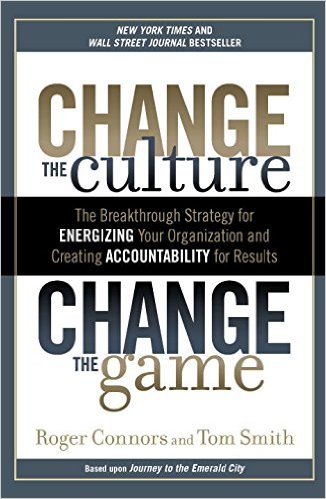
 Why this book: I had read this book about two years ago, but needed to re-read it prior to presenting to a company that is seeking to change its culture.
Summary in 3 Sentences: Cultures are complicated and are built over time, based on shared experiences, that lead to shared beliefs, which motivate specific and general actions, that yield the cultural results. The book explains not only these four key levels of what the authors call the “Results Pyramid” but it also offers a process for deliberately changing the culture – in order to get different results. The process takes time, patience, focused leadership and deliberate effort, that must begin at the bottom of the pyramid – experiences – ultimately to achieve improved results at the top.
My Impressions: This below graphic sums up the book- C1 is current culture, E1 are current experiences in that culture which lead to B1 beliefs, which lead to A1 actions, which yield R1 results. In order to get – or achieve – significantly different results over the long run – R2 – a culture has to change the experiences that underlie the beliefs which underlie the actions. This makes a lot of sense to me. The authors note how most leaders want to change the way people act without changing the way they think – they seek to get compliance, not commitment; involvement but not investment; immediate progress, but not lasting performance.

Below is NOT a review of the book. These are my notes, mostly quotes with page numbers from the paperback, which I used to review the book prior to giving my presentation. The notes/quotes are my major highlights through chapter 7. These quotes will be useful to me when I review this insightful book in the future, and may be of assistance to you as you consider reading the book.
Notable Quotes/Key points:
Leaders must create the needed culture. The culture produces the results. The most effective culture is a Culture of ACCOUNTABILITY. 16
Either you manage your culture, or it will manage you. 16
…you must ask yourself an all-important question: If everyone in the organization continues to think and act in the same manner as they do today, can you expect to achieve the results you need to achieve? 17
We know from long experience that the leadership team must shoulder the responsibility of shifting the culture. 17
Above the line are Steps to Accountability, to See it, Own It, Solve It, and Do It. Below the line is the all -too-familiar blame game or victim cycle. 20
…Below the Line, we become more focused on what we cannot do rather than on what we can do….we set our sights on the obstacles we face, not the actions we can take to get past those obstacles…21
…The entire organization moves away from the mistaken idea that accountability means “getting caught failing” and toward a more positive approach that empowers people to begin “starring in the solution.” 23
The most compelling reason to work on your culture? Culture produces results. 29
RESULTS
..all employees could connect the dots between their dailywork and the R2 they needed to achieve. 32
..essential that you determine in advance if your desired results really are R2. We suggest using four criteria:
- Difficulty, more effort to achieve than past results
- Direction, a significant change in direction for the organization
- Deployment, requires large scale deployment or redeployment of people or other resources.
- Development, A new capability or core competency. 35
…three essential steps to implementing the first tier of the Results Pyramid and forming R2 to accelerate a change in the culture;
- Define R2
- Introduce R2 throughout the organization
- Create accountability to achieve R2.
Managing a culture is a process, not an event. 42
When you effectively create accountability to achieve R2, people start to see their purposes and roles differently , defining their jobs in terms of the results they need to achieve rather than their job descriptions. 43
The act of claiming accountability for current and past results creates a powerful, positive experience for everyone in a company because it reinforced the idea that “if we are responsible for where we are, we can also r responsible for where we want to to go.”44
It bears repeating: Your culture produces your results. If you need a change in results, then you need a change in culture. 48
ACTION
Speeding up the cultural change means getting everyone to internalize the need for change and ask, “What else can I do to demonstrate actions more consistent with A2? What else can I do to achieve R2 results. 50
Bear in mind that culture changes 1 person at a time. 50
…an impetus to change (the input) causes one of three kinds of change (the output) to occur:
- temporary,
- transitional – incremental modifications ot exiseting patterns and consistent happy them over time. A matter of degree rather than a fundamental change…
- transformational – a significant shift in the way people think and act. 54
More often than not, you will not accomplish full-scale cultural transition without making a number of level 3 changes in the way people think and act. 54
During a time of organizational transition, we frequently see people at every level playing not to lose, rather than playing to win…when people worry more about protecting themselves rather than creating C2. 56
Seven ineffective change practices:
- Distribute the corporate values statement
- Restructure or reorganize
- Hire or Fire Someone
- Change the reward system
- Form a team and isolate it from the culture
- Promote someone
- Rewrite policy. 57
Three classic mistakes that leaders make during a time of cultural transition…
- Management teams attempt to prescribe A2
- Not supporting early A2 adopters
- Management focussed only on the Actions level of the Results Pyramid
At first, A2 runs counter to the C1 culture 62
The classic trap of trying to improve results by focusing solely on what people do. While that seems to work in some cases, it never works when what you need is a fundamental shift in culture in order to produce R2 63 (training the Iraqi National Army)
(what you need is) a shift from activity-based to results-based management practices. 65
BELIEFS
Nothing, absolutely nothing, gets people to change the way they act faster than getting them to change the way they think. 66
…experience has shown that most often people bring their old ways of thinking, their B1 beliefs, into a new job. 71
Not all beliefs are equal:
1. Category 1 beliefs do not reflect a high degree of belief bias. Easy to change.
2. Category 2 beliefs steeped in experience, are strongly held, fully embraced and not easily abandoned
3. Category 3 beliefs are at the very foundation of a persons values – moral, ethical, principles.73
Category 1 and 2 beliefs reflect “how we do things around here.”74
Category 1 and 2 beliefs are central to your organization’s culture and are reinforced and transmitted daily in an efficient, almost naturally occurring, self-perpetuating process that requires minimal direction and limited nurturing. 75
What would you want people saying to new employees when they seek guidance about how things work in your organization? 76
Our research shows that the more consciously and deliberately you approach the task of identifying B2 beliefs, the more effectively you can write your cultural beliefs statement. 82
Employees attitude about the job and about the company are the two factors that predict the behavior in front of the customer.85
Responsibility for creating an environment in which people buy into and live the cultural beliefs falls on the broad shoulders of the company’s leadership. 87
To foster the adoption of B2 beliefs, management must create experiences that will convince people to change their beliefs and begin thinking differently about their daily work. This is perhaps leadership’s greatest challenge…88
EXPERIENCES
We feel confident that when you focus on the foundation of the results pyramid and provide the right experience, people will change the way they think. If you change the way they think, then you can change the culture; and when you change the culture, you change the game. 89
Once employees translated experiences into shared beliefs, no one needed to tell them what to do.90
Keep in mind that for good or bad, you are already creating experiences E1 and beliefs B1 and a culture C1, and you will continue to do so, whether you do it consciously or not. Providing experiences that foster the right beliefs can take more than a little imageination and effort. 91
Four Principles:
- People validate rather than invalidate their current believes by filtering new experiences thought the lens of their current beliefs. We call this selective interpretation.
- People often cling to old beliefs and only reluctantly surrender them, falling prey to what we refer to as belief bias (confirmation bias.)
- People fail to take responsibility or accountability for their beliefs, believing instead that things they believe are natural and logical and obviousl
- The best indicator of future behavior is past behavior.92
Very few experiences will “stand on their own two feet.” You need to prop them up with the right interpretation. 93
- Type 1 experiences -> Immediate insight
- Type 2 experiences -> need to be interpreted ignorer to form the desired beliefs.
- Type 3 experiences -> will not affect prevailing beliefs because they are perceived as insignificant
- Type 4 experiences -> will always be misinterpreted regardless of amount or quality of interpretation.93
When it comes to experiences that instill beliefs, never underestimate the power of conscious and deliberate interpretation.98
Four steps to providing E2 experiences: Plan it -> provide it -> ask about it -> interpret it —-start over. 102
When it comes to living the Cultural Beliefs, who is the most important person who needs to change? Of course the right answer is “I am.” The most important E2 experience that you can provide is the experience of out living the Cultural Beliefs, demonstrating their application in the way you do your work each day.109
ALIGNING CULTURE
Neither meaningful nor raid culture change will occur unless the experience beliefs, and actions are aligned with the and reinforce R2 results.114
*Alignment is common beliefs and conceited action in collective pursuit of a clear result. 115
Culture is not something you can do once and then leave alone. It always needs to be managed relative to there results (Rx) you are working to achieve. (like Trust) Again, managing the culture is not an event; it is a process, and maintaining alignment among all the parts with the Results Pyramid requires constant and vigilant attention. 118
Forces that can push you out of alignment: territorialism and self-protection, conflicting priorities, lack of resources, short term operational pressures, C1 experiences. 120
You must keep an ever watchful ey on these threats. 121
Critical Mass for change: “Critical Mass” refers to the smallest mount of her right mrerial needed to create and sustain a nuclear chain reaction. it’s not just the right material that sparks the nuclear reaction; it’s the correct quantity of that material. To see off a “culture chain reaction: you need to form a critical mass of people who take ownership for the change process and buy in to both R2 and the Cultural beliefs associated with it.122
Making the case for Change means ensuring that the case for Change captures the reality the business environment, your competitive position, and the requirements of stakeholders. 123
Accelerating cultural transition is a leader-led endeavor in a team-participative environment. 127
The Leadership alignment process: 124-131
- Step One: Participation – get the appropriate people involved.
- Step Two: Accountability – identify who will make the decisions
- Step Three: Discussion – ensure that people speak up and are heard
- Step Four: Ownership – promote the decision as your own.
- Step Five: Communication – be consistent with the message.
- Step Six: Follow-up – check in and test for alignment.
For the transition to succeed, an organization needs more than one or two Champions. 128
Alignment is a process, not an event….Either you will mange the culture, or it will manage you. 132
APPLYING THE THREE CULTURE MANAGEMENT TOOLS
THE THREE TOOLS – Focused Feedback, Focused Storytelling, and Focused Recognition. 133
For good or ill, these stories transmit culture in a powerful way and have a significant impact on people at every level of the organization . As a result, stories are among the strangers influences on the bottom half of the Results Pyramid. 144
Every story you tell using Focused Storytelling includes three parts: a beginning , middle, and end. You begin by referencing the Cultural Belief title that corresponds to the story, using specific words to frame the context of the story. 144
The story ends by addressing the impact on the key R2 results. 145
(Regarding Focused Recognition) The positive reinforcement boosts moral and get people looking for what’s working when it comes to making the cultural shift happen…the recognition begins by identifying the Cultural Belief the individual has demonstrated…. 149
Winston Churchill once said: “First we shape our dwellings, and afterwards our dwellings shape us.” 151


 Bob's Books