
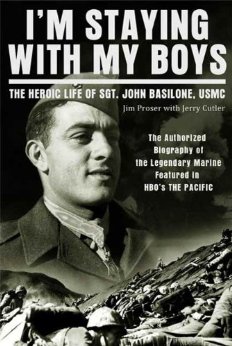
 Why this book: A good friend of mine was reading it and I decided to read it as well. I had heard of Basilone – there is a statue of him in Little Italy in San Diego, and part of Highway 5 going thru Camp Pendleton is named for him. And I was aware that he was featured in the HBO series The Pacific, but knew very little about him.
Summary in 3 Sentences: This is a full-life “authorized” biography of John Basilone, USMC Medal of Honor recipient from Guadalcanal, but it is written in the first person as an autobiography. The author, speaking as he believed Basilone would candidly tell his own story, begins with his childhood, continues into his troubled teenage and young adulthood years, and finally tells of his time in the Marine Corps, which of course include his actions at Guadalcanal, for which he was awarded the Medal of Honor. A good portion of the book takes place after Guadalcanal, and covers his recovery from that battle, his struggle with what we now call PTSD, and his discomfort as a war hero selling war bonds, until he returns to the war and ultimately is killed in Iwo Jima.
My Impressions: When I began the book, I wasn’t sure I wanted to read a novelized version of Basilone’s life – “authorized” by his family perhaps to enhance the already iconic image of this WWII marine hero. But I stuck with it and I’m glad I did. I thought the author did a credible job of making him into a real person, representative of the strengths and weaknesses of working class Americans of that era – what Tom Brokaw called “the Greatest Generation.”
In many ways this book was reminiscent of Unbroken, Louis Zamperini’s story of growing up in a first generation Italian immigrant family. Both grew up very Catholic, did not fit in at school, were inspired by their older brothers, and felt an agonizing tension between their need for excitement and adventure, and their need to not disappoint their traditional Italian immigrant parents, who simply wanted their sons to get a respectable job, a wife, and raise a family in the community. Both found an outlet for their energy in outstanding athletic performance, eventually found themselves in the military and World War Two, and became war heroes. Both became celebrities, were lionized by the public as war heroes, succumbed to excess with alcohol, women, partying, and found redemption in returning to religion to help deal with their confusion and identity crises.
There are however significant differences. Whereas Zamparini became a collegiate and Olympic hero before the war, Basilone was a classic n’er-do-well with an 8th grade education, and found no inspiration or opportunities in depression-era America. With few other options, he enlisted in the Army in 1935, excelled as soldier, was sent to the Philippines where he worked under Gen Douglas MacArthur, fought Philippine guerrillas for several years and became a boxing champion. But he became very disillusioned with the Army, got out after his 4 year hitch, and returned to New Jersey. He drifted again and did not finding anything that fit, until again, he joined the military – this time the USMC where he found a home. It was 1940, and he knew, as did many in America, that we would be going to war, and the Marines were seriously preparing for it.
Basilone’s first call into combat was to reinforce the Marines who had withstood the initial Japanese attacks on their foothold in Guadalcanal. The book describes several months of extremely intense combat, when Basilone served under his hero and legendary Marine, Chesty Puller, as the Marines desperately withstood all that the Japanese could throw at them. Their success was the first Allied victory against Japanese ground troops in the war. It is an incredible story of heroism in the most challenging and desperate of circumstances. Afterward, Basilone and his Marines were relieved and sent to recover in Australia where he was awarded the Medal of Honor for his actions on Guadalcanal. When his unit was ordered back into the war, Basilone was ordered home to serve as a spokesman to help drum up support for the military and the war bond effort.
Though Basilone was never comfortable as a war hero and public figure, he did enjoy the partying on the celebrity circuit selling war bonds. While he was living the high-life, he also experienced a lot of survivor guilt – guilt at being lauded a hero, after so many of his men, who he had felt responsible for, were killed on Guadalcanal. It didn’t feel right to be staying in nice hotels and treated to the best while his fellow Marines were still in the swamps and jungles, still in the fight in the South Pacific. After his war bond tour, he was ordered to a staff position in Washington DC to be available to be a show-horse to represent the Marine Corps at fund- raising and publicity events. He rebelled and requested that Gen Vandegrift, for whom he had served in Guadalcanal, get him orders back to the front. He was then sent to Camp Pendleton where he prepared himself and his new platoon to go back into the Pacific. Hence the title, “I’m staying with my boys.”
Basilone was an admitted lady’s man and unapologetic in telling of his playfully uncommitted sex life with women of “easy virtue,” and of his several mistresses. He was attractive to ladies, and loved their company and attention, but was not one to commit. There were four women he identifies with whom he had close and emotional relationships, to include the woman he eventually did choose to marry just before he was shipped back to the Pacific, where he was killed during the assault on Iwo Jima. One of those special women lovers was Virginia Gray, a well known movie actress of the day, who he met while on the celebrity war bonds selling tour. This relationship was apparently very close, though it had no future. It got into the press which enhanced his celebrity image, and also was highlighted in the HBO series The Pacific.
I found the book engaging and enjoyable. I felt I got to know, admire, partially understand and sympathize with Basilone’s struggles. I didn’t feel like the author tried to make him into a superhuman hero – really sought to make him humble, human and approachable. The author does well in capturing the voice of a working class Italian American hero of the 1930s and 40s telling his story, and in capturing the mood of America, and the Marine Corps in that era. Who’d a thunk – he was also a golfer and an amateur opera singer! It is a very American story, of an immigrant kid who struggles, takes on America’s values and lives to embody much of what makes America great.
A couple of quotes I marked:
It’s a terrible feeling when you know there’s something you could be great at but you just don’t know what it is. p47
Not doing things right becomes a habit, like anything else. Pretty soon nobody expects you to do anything right and you get shipped off to a relative like I did. Then the other side was, like in Army basic, you do something right, you get used to doing everything right, people expect you to do everything right and that’s how you become Manila John, undefeated in nineteen fights. 118
This was it then. It was the way you did things, not what y ou did, that mattered. 119
It looked like my path was something more slippery, something inside me that no one could see and was even hard to explain. Maybe my path was a way of thinking. p 120
I saw the blueprint for how I was connected to everything else and believed that I was onto something. More than anything I saw that I was the main ingredient in the recipe.120
Like the rest of us, he knew it didn’t really matter what you were doing or where you were. If you were in a frontline combat outfit like ours, the only things that mattered were the guys next to you. If they were alive, your chance were a little better than if they were dead. That was about it. So we didn’t care much for anything except each other anymore. p 193


 Bob's Books