
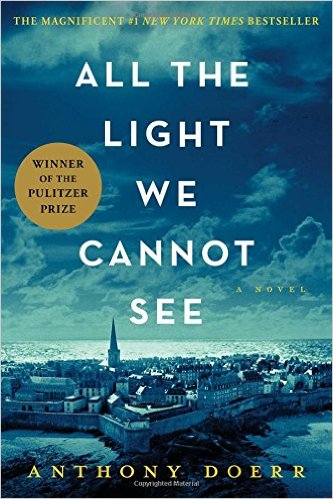
 Why this book: Selected by my Literature Reading Group. We are on a run with Pulitzer Prize winning Novels and this won the Pulitzer Prize in 2015.
Summary in 3 Sentences: The main part of the story takes place over a period of 5 or 6 years – beginning in the years leading up to WWII and progressing thru the war. The focus is on two lives: A young man, gifted in electronics, living initially in an orphanage and later in the German Wehrmacht, and a young blind girl initially living with her father in Paris during the anxiety of the pre-war years and later in the French coastal town of Saint-Malo. The story follows the lives of the young man and the blind girl in parallel, as the war impacts them each directly, alternating chapters from one to the other, until their lives converge in a very unforeseen way.
My impressions: The book is beautifully and creatively written. The author jumps in time back and forth between different periods and experiences of the two protagonists. With the young girl, we experience the disruption of normal life in occupied France when the Nazis invaded. Through the young man we experience how the single-minded fanaticism of the Nazi regime impacted the lives of those who had no particular interest in their agenda, but were forced along and conscripted to serve their cause.
There were several very interesting characters in the book who were well developed and intriguing, apart from the two protagonists. More than I want to list here, but the dark circumstances of the war brought out the best and the worst in several of the fascinating characters.
There are a couple of noteworthy themes I saw repeatedly: No matter what was happening, no matter how horrible or distasteful, we are always made aware of nature continuing around us – birds, insects, animals, plants, oblivious to the drama going on in the human world. The author has us step away briefly to see the wind, the trees, the birds while people are self-focused and engaged in the drama of their lives. The other theme was aesthetic beauty – in the form of music, gems, stories that served as an escape and outlet from the tragedy of war. Music in particular had transformative powers. It reminded me of stories I heard from both world wars in which soldiers would stop fighting and in some cases even come together to listen to or participate in beautiful music.
One of the sub characters in the book who was serving as one of the hunters and stealers of art on behalf of the Nazis , served as a warning against being too taken with aesthetic beauty. Beauty can also serve evil causes. One of the centerpieces of the book is very analogous to Tolkien’s ring – entrancing, but a source of pain, suffering and even evil.
At the end of the book we are taken decades into the future and experience how the wounds of the war did not heal, continued to impact the lives of those who lived through it.
The joy in the book was in the perspectives of nature and the healing power of music. Otherwise, there wasn’t much joy in this story. Some relationships were especially tender, but always transitory. It is a sad, and not particularly joyful book, describing the experiences of a few fascinating characters in a very difficult time. As already stated, beautifully and memorably written. I see why it won the Pulitzer – a creative, thoughtful and engaging story of people rising to the challenges of very difficult times. We see good, evil, beauty and ugliness, and experience it with compelling and believable characters.
Key Takeaways for me:
- How beauty – music, art, nature – exists and can provide depth of meaning and experience even in times of violence and brutality.
- The descriptions of how a blind person perceives the world were very insightful
- The incongruity between the inner-life of people and the often cruel and impersonal world they experience and live in.
An excellent book review of All the Light We Cannot See with which I was very much in agreement is written by William Vollmann in the New York Times – but if you are planning to read the book, I’d recommend not reading this one until after reading it. It is at New York Times Book Review of All the Light We Cannot See.


 Bob's Books