
 Why this book: This is the 4th Ivan Doig book I’ve read – loved them all and so I decided to take on his Montana Trilogy. English Creek is the first book in the trilogy, but chronologically, the second. I chose to read Dancing at the Rascal Fair ( the second book ) first – what was actual the pre-quel to English Creek, since a couple of my Doig loving friends suggested that it was the next Doig book I should read. Read it, loved it, and wanted to read the whole trilogy – even if not in the order written. English Creek won the Western Heritage Award as the best novel of 1984, and is widely regarded as a classic of modern Western literature.
(To my friend who insists that a trilogy must be read in the order the books are written, and therefore insists that English Creek should be read first, perhaps you’re right – but it also worked reading Rascal Fair first.)
Summary in 3 sentences: English Creek is a novel of an older man relating events that occurred over a period of several months in his life when he was 14 years old, living in the fictional English Creek area of northwestern Montana. He tells the story through his own eyes as that young man, facing the challenges of coming of age in rural and small town Montana in the late 1930s, and through those eyes we get to know the mountains and forests, the work on the farm and in the field, his family and the social fabric of that rural community. English Creek is not full of great drama or big-adventure excitement – but Doig’s amazingly descriptive language breathes life into the people and the events of these important five months in the life of this young man and his family, and captures the mood of that time and place.
My Impressions: A wonderful book – if one enjoys getting getting to know the people, culture and the world of rural and small town America, which I do.
Life in rural Montana – especially in that era, is simple but hard, and has an integrity and honesty that I find very appealing. Survival is not a given, and the people in the community take care of each other . While each family has its own struggles, they help each other as best they can with whatever they have. The community has a life of its own – people know each other and understand their inter-dependence. There isn’t a lot of anonymity – they grow up together, not much goes unnoticed, even less is forgotten, and they all know they have to count on each other to deal with the challenges of farming and living in a difficult environment.
The theme running through English Creek is the McAllister family as seen through the eyes of Jick – the youngest of two sons. His parents keep their feelings pretty much to themselves –and as a young man Jick tries to understand his parents and help mend the break between them and his gifted older brother. Neither side in that argument shares much with him, so he observes and tries to understand. Within that context, Jick is also trying to learn to be a man from his male role models – especially his father, but also from other men he observes, in particular, an alcoholic but wise old former forester and farm hand, with whom his father had had a falling out many years before.
To give an idea of the book – Jick spends nearly 80 pages of the book describing a series of events surrounding the 4th of July celebration of 1939. The 4th of July is still a major event in small western towns – often called the “Cowboy Christmas.” It was a magical day for Jick, and his description of the day truly captured the feel of the town and its people. We also join Jick as he works for nearly a month on his uncle’s farm raking and stacking hay with a group of neighbors and other part time help. Sound boring? Not the way Doig describes it. And the book concludes with a compelling description of the technical and very human side of wildland firefighting, as Jick joins his father in fighting what could have been a disastrous forest fire. The interaction between Jick, his father and between his father and the others fighting the fire is very telling.
The story is told from Jick’s perspective, looking back as a mature adult decades later. Only occasionally does he inject his retrospective perspective into his story telling –for the most part we are seeing the world through Jick’s 14 year old eyes. The book concludes with an epilogue; we learn what happened to the people and the community in the months and years following that fateful summer, which turned out to be a turning point in the lives of all those described. In the acknowledgements, we learn that it is all fiction, but based on extensive research into the people and way of life around Depuyer, Montana. The story f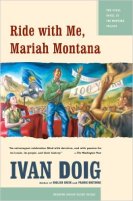 elt very, very real. Doig did a masterful job creating and bringing to life a fictional world of rural Montana, that felt so very real.
The next and last book in Doig’s Montana Trilogy is Ride with Me Mariah Montana which I will get to by next summer.
Some Quotes: Doig told a great story and part of it was how well he seemed to captured the language and the spirit of the people in that time and place. Great stuff – here are a few of the many expressions I marked:
Casual as a man waiting for eternity. 73
Putting this day out of its misery seemed a better and better Idea. 76
“Doctor Hall, ” he repeated as he brought out his good hand from a pack, a brown bottle of whiskey in it. “Doctor Al K. Hall.” 77
At that age I could have slept through a piano tuner’s convention. 77
If you’re going to be in the Forest Service, you better be able to fix anything but the break of day. 84
..dry farting like the taster in a popcorn factory. 85
…the fascination of pawing over old times. 92
Alice always was as flighty as a chicken looking in a mirror. 104
I heard somebody say once that the business section of every Western town..looked as if it originated by falling out the back end of a truck. 133
<He’s> green as frog feathers, ain’t he? 148
Glacier Gus was an idler so slow that it was said he wore spurs to keep his shadow from treading on his heels. 153
As tidy as spats on a rooster 169
…my chin session with Dode Witherow at the beer booth. 171
Heads swiveled like weathervanes being hit by a tornado. 173
Earl held the job of announcing the Gros Ventre rodeo on the basis by which a lot of positions of authority seem to get filled: nobody else would be caught dead doing it. 175
..faster than Houdini can tie his shoe laces. 177
It sounded like hell changing shifts. 190
The night’s still a pup. 194
I tell you, a situation like that reminds a person that skin is damn thin shelter against the universe. 252
Innocent as a bluebird on a manure pile. 256
That joke had gray whiskers and leaned on a cane. 259
It was aining like bath time on Noah’s Ark. 260
Wendell Williamson always looked as if he’d been made by the sackful. Sacks of what, I won’t go into. 264
She’s Hungarian…she leaves you hungrier than when you came to the table. 265
Each day is a room of time. 274
He sailed off to worry the camp into being. 295
Paul had been going through the camp at such a pace that drinks could have been served on his shirttail. 297
It was a matter of grit and bear it. 306
Hotter than dollar chile, aint it? 317
The ride to town was mostly nickel and dime gab. 323


 Bob's Books
Pingback: Ride with me, Mariah Montana, by Ivan Doig | Bob's Books