
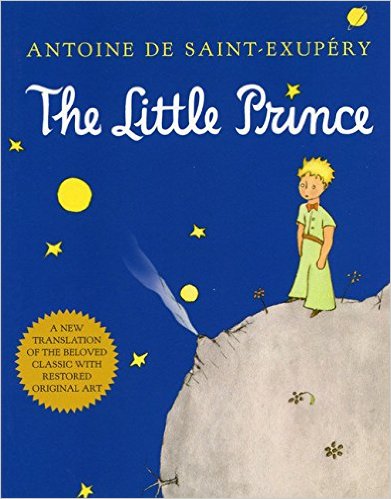
 Why this book: Selected by one of the reading groups I’m in.
Summary in 3 sentences: A classic children’s story with lessons that are important for adults as well. A young prince from another planet meets our narrator – a downed pilot in the deserts of North Africa – and with complete innocence and wonder The Little Prince tells him what he has experienced of the Universe, and asks lots of questions about why things are the way they are on earth. The two develop a friendship that transforms each of them.
My Impressions: I read this in college when it was cool -regarded as a kids book that had great insight and a piece of the wisdom of the ages -like Alice in Wonderland. It’s short, cleverly illustrated and fun and easy to read. My other two reading group members read it to their kids. It is clever and nicely done and makes some well-worn points about what is truly important in life, and how most people miss those things, being too busy with chores, making money, whatever. It reminded me a bit of Kurt Vonnegut’s Breakfast of Champions, in how it exposes how ridiculous so much that we take for granted appears to someone whose sensibilities have not been corrupted or made numb by our social and cultural practices and prejudices.
The story begins with a pilot who has crashed in the desert and is frantically trying to repair his airplane before he dies of thirst. A young boy stumbles upon him in the desert and claims to be from another planet. Most of the rest of the story is the young boy telling the pilot – the narrator of our story – how he got there.
He tells of the very small planet he grew up on – he was essentially alone and lonely on the planet but eventually became friends with a rose – which on this planet could talk and had a personality. He and the rose loved each other, but were different and struggled to get along, so The Little Prince goes on an expedition through the galaxy and visits various planets that represent different personalities that magnify human strengths and craziness. We learn of his experiences meeting and talking to a king, a vain man, a drunkard, a businessman, a lamplighter, and a geographer. Each was a strangely preoccupied individual, living alone on their planets. He meets, talks to, and tries to understand each, before he comes to earth, and meets our downed aviator.
The aviator gets his plane fixed but is concerned for The Little Prince, who wants to get back to his planet and his rose. The Little Prince was looking for water and meets a snake who tempts him and a fox who shares with him great wisdom.
Eventually The Little Prince is ready to return to his planet and our aviator/narrator is sad to see him go. But then the snake bites him – and he falls down and disappears. Does he really go back to the planet? Or does he die in the desert? The story concludes with the aviator looking at the stars and thinking that the dreams and innocence and goodness of the Little Prince are there and always to be had by looking at the stars.
This little book is full of metaphors which are sometimes quite clever, other times just a bit too obvious, but then this was written as a children’s book. My friends who read it to their children found that their kids didn’t have a lot of patience with what 70 years ago was an exciting and fascinating story -today’s world moves so fast and is so constantly exciting and stimulating, it’s hard for kids – and even fro most adults – to slow down and enjoy a simple little story.
This is short and a fun one for good friends or a family to read and discuss – as long as all are willing to take Saint Expupery seriously -and think about what he was trying to say. Antoine de Saint -Exupery indeed disappeared over the Mediterranean while flying a mission in WW2.
Some Quotes: (page numbers from the paperback edition)
If you tell grown-ups, ” I saw a beautiful red brick house, with geraniums at the window nd doves on the roof…, ” they won’t be able to imagine such a hose. You have to tell them “I saw a house worth a hundred thousand francs.” Then they exclaim, “What a pretty house!” 10
And I might become like the grown-ups who are no longer interested in anything but numbers. 12
“I know a planet inhabited by a red faced gentleman. He’s never smelled a flower. He’s never looked at a star. He’s never loved anyone. He’s never done anything except add up numbers. And all day long he says over and over, just like you, ‘I’m a serious man! I’m a serious man!'” 20
“In those days, I didn’t understand anything. I should have judged her according to her actions, not her words. She perfumed my pant and lit up my life. I should never have run away! I ought to have realized the tenderness underlying her silly pretensions…. But I was too young to know how to love her.” 25
He didn’t realize that for kings, the world is extremely simplified: All men are subjects. 33
“If I were to command a general to turn into a seagull, and if the general did not obey, that would not be the general’s fault.It would be mine.” 29
To vain men, other people are admirers. 33
But the vain man did not hear him. Vain men never hear anything but praise. 34
The only things you learn are the things you tame” said the fox. “People haven’t time to learn anything. They buy things ready-made in stores.” 60
“Yes, ” I said to the little prince, “whether it’s a house or the stars or the desert, what makes them beautiful is invisible!” 68
And at night I love listening to the stars. It’s like five-hundred million little bells…81


 Bob's Books