
 Why this book: It was selected by our All American Leadership reading group as our bi-monthjly selection. Also, the author, Mike Lerario is part of our team.
Summary in 3 sentences: As he notes on the cover, Mike wrote this book addressed primarily to emerging and high potential leaders, but it has insights that leaders at any level can use. He divides leadership into four domains, and then makes the point that each domain demands that leaders understand their own strengths, weaknesses and proclivities AND understand the context in order to get the best result in each situation. The “balance” in Leadership in Balance is finding the “fulcrum” which provides the best application of the leaders abilities within the specifics of a particular situation.
My impressions: Mike is unapologetically Army in his approach, but his approach to leadership applies in any context. He uses many examples from his career as an Army infantry officer to make his points, but also applies his methodology to the corporate sector, where he is also an experienced consultant. I like that he emphasizes self-understanding, and broad contextual understanding as key to exercising effective leadership – noting that no two people are alike, and no two situations are alike – so at least theoretically, every interaction between a leader and the challenge s/he faces is unique. He places a large emphasis on judgment – based again on self knowledge and contextual understanding.
The four domains of leadership discussed in the book are Communications, Adaptability , Focus, and Influence. Each gets a chapter with explanation and examples of successes and failures, often from the author’s experience in the Army.
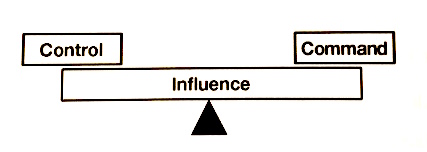
Within each of the four leadership domains he identifies two extremes that leaders must balance. To be effective, they must find the fulcrum between the two opposing tendencies, in finding the best, most effective response. In the domain of Communications, it is transmit vs receive; for Adaptability it is rigid vs flexible; for Focus it is selfish vs selfless; for Influence it is command vs control. In each of these domains, leaders must find the fulcrum to balance their personal style at the right point between these two “extremes” that is most effective to meet the demands of a particular situation.
I found the discussion of focus most interesting. It is important to include in the discussion of leadership how and why the leader must take care of him/herself, and not always be “selfless.” I was happy to see him repudiate the idealistic notion that leaders must always be selfless – always sacrifice themselves and their own needs on the alter of taking care of others. Leaders must also take care of themselves, in order to take care of their teams and others. In order to advance in one’s career and have a larger impact, the leader must pay close attention and occasionally make sacrifices to “selflessness” in order to advance. This is a useful discussion.
I found the distinction between “command” and “control” very valuable. He describes these as two ends of a spectrum of how we “influence” our team to work together to achieve what it wants. In the common vernacular, command-and-control are used together as a single concept associated with a military, top-down, directive style of leadership. Not so, says Mike. He says that the operative word in command is “why,” while in control, it is “how.” Below is a diagram from the book.
I felt that the chapter on communication had so much in common with the introvert-extrovert personality types in the MBTI that “introversion” and “extroversion” as basic personality types deserved a mention. But the content was quite good.
The idea of finding a “golden mean” between two extremes is an idea with a pedigree that goes back to Aristotle’s virtue ethics – where Aristotle described a “virtue” as the golden mean between excess and deficiency in a specific behavior -and whatever the virtuous golden mean might be, differed depending on the the individual and the context. Mike applies this idea to the virtue of good leadership.
Included in the book is a personal style assessment the Leadership Fulcrum Assessment available on his website www.bethefulcrum.com . Those who purchase the book get a code which makes the assessment free of charge. The assessment is ideally is taken before reading the book. but I took it afterward and found it interesting and valuable. The LFA is a self-assessment, and I and others think it also has great potential as a 360 instrument. Mike agrees and is continuing to develop it.
Leadership in Balance is a short book – just over 100 pages and I’d give it 5 stars for what I believe Mike intended – to provide insights, perspectives and a framework to serve as a basis for in depth discussion of leadership for rising and mid level leaders. I’d give it 4 stars for the insights it provides for more experienced leaders at more senior levels of organizations – still valuable, still insightful, still challenging, but probably most valuable for more junior and mid level leaders.
Key Take-Aways:
- It reinforced the importance of understanding one’s self and the value of personality and style “tests” to help one lead well. I’d add to this the importance of leaders seeking dispassionate feedback on their style and tendencies, in order to make better decisions in a particular situation. So few leaders are as self-aware of their tendencies, proclivities, strengths and weakness as they need to be. This book reinforces how important that is.
- It reinforced the “situational leadership” principle of adapting one’s response to the specifics of a situation. There is no one-size-fits-all approach to inspiring others and getting the most out of a team. Some principles work better, more often in more situations, but almost nothing (that I can think of) always works, always gets the best result, all the time, in all situations.
- There were a number of nuggets in the book that I will be able to use in my own work. For example, I mentioned his discussion of command and control. I relearned the parable of Napoleon’s corporal. I loved the quote from Jefferson: “In matters of style, swim with the current; in matters of principle, stand like a rock.” There are many more such nuggets in this book.


 Bob's Books
Pingback: Captain Class, by Sam Walker | Bob's Books