
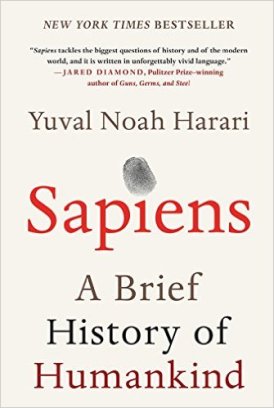
 Why this book: Sebastian Junger and Seth Godin strongly recommended it in Tim Ferris’s podcast interviews with them. Then my friend Jay read it, and also insisted that it is a ‘must-read.” So I had to move it to the head of the line – which I did by buying the audio and listening to it while driving. Twice through.
Summary in 3 Sentences: This book is a biological and anthropological analysis of the evolution of the human species. He briefly but engagingly covers pre-history, when there were multiple species of humans , and why it is believed that Homo-sapiens dominated and eliminated other humanoid species, and then gives an analysis of how human society, cultures and values have evolved to become our current civilizations. The book finishes with a wary look at the future of Homo-sapiens as the species as we now know, given the rapid development of genetic manipulations, and mechanical and computer based additions to augment human capabilities in bionic and cyborg-like components.
My Impressions: An incredible book, with a huge scope and message, with implications and insights that have changed the way I think about myself and the world. I listened to Sapiens on audio, and when I completed it, I started over from the beginning, and listened to it in its entirety again-there is SO MUCH there, that I wanted to hear it all again. Then I bought the hard-copy version of the book as well. I have just read the chapter on happiness, entitled “And they lived happily ever after,” and though I’ve heard it read on audio twice before, I still found it new and fresh. I plan to read several more of the chapters in print and expect the same reaction. I’ve found that reading print really is a different experience of assimilating “knowledge” and content. On my recommendation, my wife is currently reading it, as are my son and daughter.
In his Sapiens – A Brief History of Humankind, Harari has an agenda and a perspective, and though he clearly seeks to be intellectually honest and as close to objective as possible, he also is viewing our species through his a certain lens, with certain values – which he leaves the reader to deduce. He nearly always attempts to provide a fair representation of alternate perspectives than his own, but we are left in little doubt of his values and where he stands. Given the similarity of his lens and mine, that he and I are both fairly well educated (he much more so than I), middle class, Western males, with somewhat refined moral and “liberal” sensibilities, I find his perspective convincing. I use the term “liberal” in the sense of advocating maximum individual freedom, not its political sense.
——-a bit more detail—–
I got so much out of this book that it is hard to write a review/summary. Though there is little new or revolutionary in this book, how Harari tells the stories to explain his points and their implications truly make this a valuable and engaging read. Here are a few of the perspectives/insights that impressed me (page numbers refer to the 2015 hardback edition):
Genetically, we are hunter-gatherers. We evolved over nearly 2 million years to be hunter gatherers – and it was only about 30k years ago that we began cultivating agriculture and living in villages and cities. Then as a species, for thousands of years we were largely a mix of farmers living in small villages and small urban centers, until just a couple of hundred years ago, when the industrial revolution began a much more rapid urbanization. In the last 100 or so years, the environment in which most people live has changed dramatically, but we all still have a genetic code that evolved adapted primarily to a hunter-gatherer world. He explains the many implications of Homo sapiens having a genetic make-up which evolved to thrive in one context, is now somewhat maladapted to the environment in which most of us live. He suggests that “the transition first to agriculture and then to industry has condemned us to living unnatural lives that cannot give full expression to our inherent inclinations and instincts and therefor cannot satisfy our deepest yearnings.” 378
Homo Sapiens are environment changers and destroyers. We learn how wherever Homo sapiens have ever gone, going back tens of thousands of years, they have significantly altered the flora and fauna of the world they move into. The most dramatic example he offers was when Homo sapiens came to Australia some 45 thousand years ago. “The moment the first hunter-gatherer set foot on an Australian beach was the moment that Homo sapiens climbed to the top rung in the food chain on a particular landmass and thereafter became the deadliest species in the annals of planet Earth.” 64 He describes how within a few millennia after arriving in Australia, the large mammals disappeared – the giant koalas, the marsupial lions, 450 lb six foot tall kangaroos, giant wombats and lizards. These were major food sources for the newly arrived hunters, and these large mammals reproduced far too slowly to make up for their decimation by marauding hunters. He tells a similar story of how the arrival of Homo Sapiens on the American continents foretold the eventual extinction of the large mammals that roamed those land masses – mastodons, woolly mammoths, saber tooth tigers, and more. The wooly mammoth in Asia also thrived until its habitats were shared with increasing numbers of Homo Sapiens. What happened thousands of years later to passenger pigeons, and nearly happened to American Bison was ‘merely’ a continuation of a trend with our species.
Money, credit, trust. This is a fascinating chapter – how barter and trade evolved over a few thousand years into creating money as a means of commerce with a commonly agreed upon value, eventually backed by the power and authority of the state. Money alone has little practical value without trusting that others will value it, and be willing to exchange labor, services products for it, trusting that they can then use it to purchase products and services from others who also trust in its value. Take away that trust, take away people who are willing to trade goods and services for it, and it is merely pieces of paper or metal, of little value. Today most “money” is in the form of data stored in computers, traded by those who “trust” in the basic integrity and equitability of the system of exchange.
The evolution of credit begins pretty simply but has evolved into a much more complex system with promises, built on promises, built on more promises, kept track of first by ledgers and now by computers – again all based on trust, in a system of common values, and based on trust in an authority which will hold people and institutions accountable for honoring promises (credit) extended at the agreed upon value on the agreed upon terms. Take that trust and enforcement authority away, and our economic system collapses.
Myths upon which society is based. He points out how the main difference between Homo Sapiens and other intelligent mammals is our ability to discuss, believe in and build a social structure based on things that don’t actually “exist.” Like rules, laws, customs and social conventions. Like human rights. Like cultures, values and belief systems. These “exist” only in the minds and imaginations of people. Complex civilizations require vast numbers of people to believe in these myths, and to behave accordingly. He points out how these myths include moral obligations to people we don’t know, and will never know. As society has become more globalized over the last millennium, agreeing on common values (myths) has been essential for people of different cultures to trade, work and even live together. No other species exhibits this ability to coordinate activities among so many different members of the species. And this collaboration of large masses of people depends on belief in common mythologies – such as the importance of rule-of-law.
Religion, paganism, polytheism, manichean dualism, monotheism. There is a fascinating section on the evolution of religious beliefs over millennia. Early Homo sapiens clearly believed in forces outside their control that needed to be appeased. Belief in the power of rocks and mountains and nature evolved into the polytheism that we are familiar with in ancient Greek and Roman civilizations. In the middle East and eventually in the Roman empire there was a wide belief in a Manichaeans creed that life is a constant battle between forces of good and forces of evil. He points to how when a new religion comes into a region, it frequently absorbs and incorporates the beliefs of the old. When Christianity became widespread and eventually adopted as the state religion of the Roman empire, Christian monotheism absorbed much of the polytheistic practices that the local populations believed in by including the worship and honoring of saints. The widespread belief in Manichaeans dualism was absorbed by including the Devil and Evil into Christian ontology.
How we treat animals: Harari makes the point that over millennia Homo sapiens have met their own needs by exploiting animals, often cruelly. If we measure the success of a species by how well its genes have survived and multiplied, the most successful mammals are cattle and sheep, and of birds, chickens. But if we measure success by how well the species fulfills the purposes for which their genes have evolved, then these animals are indeed poor examples of “success.” Two centuries ago, there was very little outrage and concern for how slaves were treated and exploited to serve the needs of the more dominant of the Homo sapiens. Today there is little outrage or concern about how animals are treated and exploited – kept in tiny pens their whole lives, quickly fattened and slaughtered – to meet the demands of the market for meat protein. The movement toward free-range chickens and free-range and grass-fed cattle is the beginning of a recognition that if Homo sapiens have a moral obligation to other Homo sapiens, they may also have a moral obligation to other species.
“Over the last two centuries tens of billions of (laboratory monkeys, dairy cows, conveyor-belt chickens) have been subjected to a regime of industrial exploitation whose cruelty has no precedent in the annals of planet Earth. If we accept a mere tenth of what animal-rights activists are claiming, then modern industrial agriculture might well be the greatest crime in history.” 379
Happiness. The second to the last chapter in the book looks at the idea of happiness and asks the provocative question, “Have all of our advances and the progress of civilization made people happier?” And then he tackles the obvious question imbedded in that question: What do we mean by “happiness?” He notes that “The generally accepted definition of happiness is ‘subjective well-being’.” He laments that historians have neglected to look at how people’s happiness has “evolved” or changed, or devolved, over time. He asks, “…have the seventy or so turbulent millennia since the Cognitive Revolution made the world a better place to live? Was the late Neil Armstrong, whose footprint remains intact on the windless moon, happier than the nameless hunter-gatherer who 30,000 years ago left her handprint on a wall in Chauvet Cave? If not, what was the point of developing agriculture, cities, writing, coinage, empires science and industry.” 376 It is not a rhetorical question – he spends much of the chapter exploring the implications of this question. The chapter on happiness includes fascinating and provocative sections on measuring happiness, happiness through drugs or chemicals, the meaning of life, and self knowledge.
Future of Homo Sapiens: The final chapter entitled “The End of Homo Sapiens” is fascinating and disturbing. Harari provides example after example of how genetic engineering is a genie out of the bottle and advances in genetic mapping and genetic therapies are happening at mind-boggling rates. Science is so rapidly expanding the scope of human power and capabilities that most of us are barely aware of what is happening, nor do we have much of an inkling of where these new capabilities and knowledge will take us. Many are very concerned about the rapid advances in artificial intelligence, to the point that within a generation, we’ll have computers that are so close to being human that it will be difficult to tell the difference – but the computers will be much, much more “intelligent” and capable. Bionic limbs, cyborg-like humans are already a reality with exciting and concerning implications for the future. He speaks of the Gilgamesh project where biologists and geneticists believe that within a few generations, they will be able to defeat death as a natural outcome of the process of aging. The prospect of eugenics and genetic manipulation, of computers that are “conscious,” of defeating disease and death, these prospects opens many doors for exciting and terrifying outcomes. Stay tuned.
My minor quibble: Harari gives almost no attention to the possibility of a reality that science has yet to accept, much less embrace. In describing how how people and chimpanzees have been trained to operate artificial limbs with their minds – and in some cases in locations far apart from the individual, he doesn’t address the implications of such power of the mind. Nor does he refer to the many documented cases that science simply can’t explain because they can’t duplicate them – people having clear visions of events before they happen, children speaking languages they have never heard before, children and adults under hypnoses providing detailed descriptions of people, places, events that were completely outside their experience and even outside their lifespans. And of course there is more.
In the breadth of his look at Homo Sapiens, I believe unknowns and unknowables deserved mention. Colin Wilson, a skeptic, was asked to investigate strange occurrences with the intent of debunking them. Subsequently, after exploring and examining these unexplainable events and occurrences, he had his mind changed – and wrote a book entitled The Occult in which he describes a wide variety of documented events for which there is no scientific explanation. He doesn’t provide explanations, but notes that he is convinced that there is a dimension of reality that we clearly don’t (yet) understand. Scientists still have yet to explain Stonehenge, the Pyramids, Easter Island, and even some voodoo-like occurrences. Harari never alluded to any of these mysteries in Sapiens A Brief History of Humankind nor in his discussion of religion, happiness, life’s meaning. To not acknowledge nor address the unexplainable at all is a notable omission, especially considering that he went to great pains to present his arguments and perspective from an intellectually honest perspective.


 Bob's Books
Harari says: “Just 6 million years ago, a single female ape had two daughters. One became the ancestor of all chimpanzees, the other is our own grandmother.”
I have a question here ” when this grandmother of ours grew up who did she mate with to produce more humans?” Because clearly there was no other human being around.