
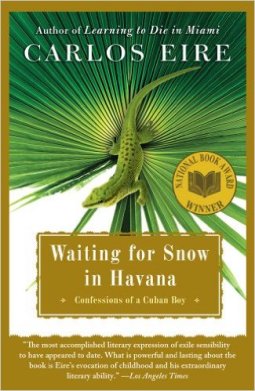
 Why this book: This was the KPBS 2016 One Book; One San Diego selection and also a National Book Award winner. My reading group (rightly) assumed it would be a good read. As a memoir, this selection was an exception – we normally choose fiction. But this book reads like great fiction, with the added advantage of being actually true.
Summary in 3 sentences: We view the world of Havana undergoing the chaos and trauma of Castro’s revolution through the eyes of young Carlos Eire- writing in first person, mostly between the ages 8 and 12 years old. He is a normal happy-go-lucky, occasionally naughty young boy, having fun with his friends, but he shares his fears and anxieties born of strict Catholic schooling and the violence of the Castro revolution, which upended the comfortable world he had grown up in. Eventually his family is torn asunder, he and his brother are sent to the states, and we get glimpses of the difficult life he lived as a young refugee in America.
My Impressions: Beautifully written – Carlos Eire is a poet at heart. As my wife was reading it, she recalled how Frank McCourt’s Angela’s Ashes, in (in a very different setting) evoked the mindset of a young boy viewing a crazy world of adults with some confusion – and perhaps more insight than he realized. Carlos Eire’s story indeed shares that brilliance with McCourt’s.
The story begins while his world is relatively “normal” in Havana, and devolves until everything is in disarray, the Castro revolution has shaken the foundations of all that made sense to him and the world he knew. He describes Castro’s Orwellian world of double speak and propaganda, and how he witnessed firing squads and the round up and imprisonment of political dissidents on TV or in person. Such events eventually became almost routine and unremarkable.
The story is told sequentially, though from early on in the book, we jump from Havana to a few years into the future in the United States where Carlos and his brother Tony were later passed from foster home to foster home after leaving Cuba. We get brief glimpses of the uprootedness, the fears, the challenges and uncertainty of their life as immigrants, but then, the story returns to his innocent perspective as a boy in Cuba, unaware of what awaited him.
The story is multi-dimensional. It is a coming of age story of a young boy in a chaotic and challenging environment; it is the story of the very painful disruption of Cuba in transition; it is the story of a family with some rather eccentric characters dealing with uncertainty and disruption; it is the story of the shock and loneliness of a young boy being sent away from all that he knew to live in the strange world of the United States.
But what is even more remarkable about this book is Eire’s writing – how he tells his story. Almost every chapter can stand alone as a beautifully written short story. His chapter 27, about his first experience falling in love as a young boy, is classic. His humor, his metaphors and imagery, his openness about his fears, anxieties, fantasies, and transgressions are remarkable. He originally intended to publish this book as a novel, because he was uncomfortable being so transparent about his life and fears. He was uncomfortable shining so much light into his own thoughts and anxieties, and his family’s life, circumstances, and foibles as a memoir, so he chose to publish it as a novel -to give himself some plausible deniability. I believe that his intent to publish it as a novel very much influenced the style of his writing – less that of a memoir, more that of a novel. But since it was all in fact his personal story, his remembrances, as accurate as he could recall, his publisher insisted that it be a memoir, and we are the richer for it. That is much of what makes this great literature.
Key Takeaways for me:
- I loved his writing – a memoir as literature. I was as amazed by his writing as I was by his story. This book reminded me of other memoirs I’ve read written by poets – Maya Angelou and Robert Service. Carlos Eire is a history professor at Yale, and though not a poet by profession, he is clearly a poet by temperament….
- How truly bad, brutal, and self-righteously power hungry Castro and his revolution were. I had of course heard some of this, but experiencing it vicariously through the eyes of one who experienced it directly, or was exposed to some of the worst of it indirectly, was eye-opening. I now have a better understanding of the depth of the Cuban-American hatred for Castro.
- The amazing resilience and fortitude of people coming to this country with nothing – how the Cuban people in Miami stepped up to take care of those who were able to get out and get them on their feet. And the discrimination of America of the 60s toward anyone who was not Anglo-Saxon. “Spic” was an epithet Eire got used to hearing about himself and other Hispanics.
I participated in a fascinating live Skype session at the Imperial Beach Library with Carlos Eire specifically to discuss this book. IF you’re interested in this book, or read it and liked it, I’d recommend watching/listening to an interview with with him on Youtube in which he shares many of the same insights and perspectives. The interview was conducted soon after Waiting for Snow in Havana was selected as the One Book, One San Diego book for 2016. It can be viewed here.
A few quotes from the book that struck me (page numbers from the paperback edition)
Good and evil dancing with each other so tightly, only one subatomic particle between them, while indifference looks on, as a chaperone, with her two lazy eyes, neither one of them capable of focusing….they dance so fast, good and evil, these two polar opposites. So tightly and furiously. You can’t dance with just one of these partners. If you cut into their dance, you end up with both, as a threesome. And if you fear cutting into the dance, and taking a spin with good and evil, you end up dancing with the cross-eyed, ugly chaperone. 70
How great, to be born to one of those families, and to have the children of similar families bring you presents and sing “Happy Birthday”in English as you blew out the candles on your excruciatingly well-decorated cake. 70
That was another very Cuban deal. Mothers stayed around for the party. None of this drop-off-the kid-thank-God-see-you-two-hours-later American kind of stuff. No. These mothers stayed for the whole party, keeping an eye on things and talking to one another. How well I remember those phalanxes of moms, and my own mother among them. 74
The marble walls were a golden yellowish hue and very shiny, as though polished with a vengeance. 137
Here are some of the ways in which my family thought you could catch pneumonia and die: Standing in front of an open window with wet hair. Going outdoors without a shirt on, except at the beach. Going outdoors in the daytime wearing just a T-shirt, except at the beach. Wearing a shirt without an undershirt. Wearing shorts between November and February. Going outdoors without a jacket between November and February, no matter what the temperature. Taking a shower with water that wasn’t warm enough, no matter what time of the year, even on the hottest days. Wearing shoes without socks. … catching a chill, under any circumstances was a death sentence. 139
What they didn’t know was that it would take only one brief plane ride to turn me from a white boy into a spic. 160
What I had come to loath the most was the unrelenting barrage of information on the Revolution and its programs. It was like nothing else I had ever experienced, this saturation bombing of the mind. 232
There is nothing in the world like the sound of sacred symbols being pulverized, little by little. 277


 Bob's Books