
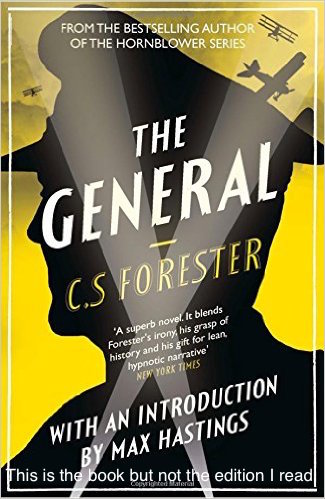
 Why this book: I had read it several years ago, and recommended it to my son, who read it, liked it, and wanted to talk about it during his visit. My friend Jay also wanted to read it and join our discussion. It was a great book to re-read. Though written in 1936, it was required reading when I was at the Naval War College in the mid 1990’s. Interestingly, Hitler also read it and recommended it to his Generals before WW2.
Summary in 3 sentences: The General is a novelized story of Herbert Curzon, a fictional British General during WW1 who exemplified the virtues of courage, selfless service, decisiveness, and loyalty to the values of his institution and his nation. His very strict compliance with traditional values, standards, and protocols, and indeed a good bit of blind luck led to his continued promotion into positions of greater and greater responsibility for the lives of tens of thousands of men n war. His extraordinary sense of duty motivated him to do very well what his country called upon him to do, but his personal life lacked heart and depth, and he was unable to acknowledge and adapt to changes in military science and warfare, and his units and ultimately his nation suffered enormously.
My Impressions: Though Forester claims he did not write The General as a leadership case study, nor with the intent of influencing history, it is indeed an excellent case study and did have an impact, which is why it was required reading while I was at the Naval War College. His protagonist Curzon epitomizes many of the leadership qualities that are idealized to this day in military and government institutions, as well as in private sector leadership courses and institutions. He exemplified the virtues of courage, honesty, decisiveness, leadership by example, selflessness, the good of the institution above one’s own or any individual’s convenience, the importance of tradition and protocols, the importance of leaders being visible and present to their organization- these are all important aspects of great leadership.
And yet his overly rational approach to duty stunted the virtue of compassion, and his lack of imagination could not envision or even acknowledge possibilities outside of the catechism of his 19th century military education and experience. He insisted on applying old solutions to new problems, doing more and more of the same, with greater and greater effort and discipline, expecting that simply greater effort would assure a better outcome. Forester offers the analogy of expending more and more energy and resources trying to remove a screw from a board, by simply applying one’s extensive experience removing nails. (see the specific quote below)
Forester’s The General reminds us that the traditional approaches to leadership are often not enough. While there is much to admire and emulate in Curzon’s discipline, courage, and selflessness, no discriminating reader wants to lead nor live like him. Within a great story in a fascinating historical context, The General makes clear that highly lauded character qualities do not necessarily make a great leader. This story offers an example of a person of great character failing as a leader. And, I might say ultimately, as a man.
And yet – while it may be easy to disparage Curzon by applying today’s insights and standards to his decisions and lack of imagination, that may not be fair. He was a product of his times, of his culture, of the British Army of the late Victorian era, which shaped, molded, and created him. He bought into and fully committed to the values and ideals of his institution, and they drove everything he did. His behavior, decisions and actions were endorsed and reinforced by the organizational ethos of the British Army of that era. This should be a warning to those of us who belong to strong and coherent cultures today.
This story reminds me of an article written by my good friend George Reed entitled “Character vs. Situational Imperatives as the Primary Driver of Unethical Conduct: Implications for the Study of Leadership” In this short piece, Dr Reed argues convincingly that situational factors – environment and culture, as opposed to “character” – play a much larger role in determining conduct and behavior than they are frequently given credit for. He makes the case that our behavior and our perception of right and wrong are more a function of the values and imperatives of our environment, than of that illusive quality called “character.”
Some of Forester’s insights and perspectives from The General:
Good judgment in one context often does not necessarily carry over into a different context.
Political acumen, and a refined understanding of power and influence are KEY to getting promotions and good assignments in the military, especially at the more senior ranks. Successful senior officers have a strong sense for cultivating influence – not only in military but also in political circles.
The social inviolability of class boundaries in Victorian England. The “officer” was not necessarily of the highest class, but served the highest classes and was expected to comport himself accordingly (still true?) Crossing class boundaries in friendship and marriage could be very costly. Membership in the highest classes was based on birth alone – and such democratic values as “merit” and character, available to anyone regardless of class or birth, were considered by the English elite to be less sophisticated criteria for judging individuals.
Victorian culture. The General offers fascinating insights into English upper class culture in the last years of the Victorian era and the British Empire.
Attrition Warfare. When the British Army continued to accrue hundreds of thousands of casualties, and continued to throw more bodies into the slaughter, and then asked for more men and resources, political leaders stepped in. I was reminded a bit of Vietnam. And perhaps of Iraq.
The role of wives, women, relatives of those in power and how gossip in their social circles could influence politics, even decisions about who gets which prestigious positions and assignments in the military.
Dating, love, romance, and marriage in Victorian England. Curzon’s courting, marriage to and relationship with his wife were very Victorian and traditional. Their relationship was cordial and close, but hardly intimate by today’s standards. We get insights into social and sexual mores of the time – and how these were already in transition in 1914.
Leadership required to lead large conventional military forces is very different from that which is effective in special operations. Rigid discipline is the norm, but it clearly stifles, if it doesn’t kill imagination and innovation.
The dark side of personal reputation and the value the military culture places on it. There were multiple times when Curzon’s concern for his personal reputation colored his judgment regarding what was right or best for the long term interests of the Army and England.
Shortcoming of the book (from my perspective): I felt sometimes as if Forester were “leading the witness,” so to speak. Several times he refers to Curzon’s lack of imagination, or calls him “simple minded” and refers to his “silly sword” toward the end of the book. It was clear from early on how Forester viewed his protagonist. The book would have been better without the author so explicitly injecting his own perspective and prejudices into the story, and left those judgments to the discerning reader.
Note 1: CS Forester is most famous for his Horatio Hornblower series about a young naval officer in the Napoleonic wars. He also wrote The African Queen – the book upon which the famous movie with Humphrey Bogart and Katherine Hepburn is based.
Note 2: My edition of The General has an excellent introduction written by Merrill Bartlett, Lt Col USMC at the US Naval Academy in the early 80s. Bartlett’s writings were still being used in the curriculum at the USNA when I served there 20 years later. In his introduction, Bartlett writes: “…Curzon is Forester’s caricature of the best and worst of (British Commanders of the era) : hide-bound, traditional, and utterly devoid of imagination, yet brave and honorable to a fault.”
————
Some interesting and representative quotes: (no page references since the edition I read has been out of print for decades)
…most of the great body of rules and precedents dealt not with the training of an army for war, but with keeping it inexpensive and out of the way in time of peace. The system was, moreover, adapted to the needs of an army recruited from the very young and the very stupid, officered by men of uniform ideas and training…
(Emily anticipating her honeymoon night) Emily kept her eyes on the page before her although she could read no word of it; she was making an effort now at this late hour to rally her self-control as became one of her blue blood and to go stoically through the ordeal before her without a sign of weakness, like a French aristocrat on the way to the guillotine.
Her Grace was supremely confident in her share of the universal opinion that it was far better to receive distinctions for being someone than for doing something.
In addition as a born intriguer, Mackenzie could not possibly credit Curzon with ordinary honesty, but considered him as just a fellow intriguer, an ally worth having and especially a potential enemy worth placating.
It was hard to believe that a wave of disciplined men could not sweep across that frail barrier, and as Curzon began to think of that he found himself believing that it would be better even that they should try and fail than moulder here in unsoldierly idleness – it would be the more appropriate, the more correct thing.
The Brigadier General, General Staff was dark and pale, but his face was stamped with the same truculent and imperious expression as his chief’s, as befitted a man whose word swayed the destinies of forty thousand men. There was the same cold eye, the same slight scowl between the eyebrows, the same thrust-forward jaw and cruel mouth. Yet despite Curzon’s more modest attitude as a newcomer, his face had just the same trade marks, curiously enough.
His anxiety regarding his division prevented him from delegating more of his authority than he was compelled to, and early morning and late night found him patiently reading court martial records and confidential reports on junior officers.
It was his duty to make the division efficient; that was why he slaved and toiled over the business. His desire for his own professional advancement, his anxiety to stand well in Emily’s eyes and in those of her family were undoubtedly acute, but they were not the motives which guided him. He had been given a job of work to do, and he did it to the best of his ability, although the desk work made him thin and irritable and spoilt his digestion and his eyesight, and although he could never find time now to have all the exercise for which he craved.
Accustomed only to nails, they had made one effort to pull out the screw by main force, and now that it had failed they were devising methods of applying more force still, of obtaining more efficient pincers, of using levers and fulcrums so that more men could bring their strength to bear. They could hardly be blamed for not guessing that by rotating the screw it would come out after the exertion of far less effort; it would be a notion so different from anything they had ever encountered that they would laugh at the man who suggested it.
The Generals round the table were not men who were easily discouraged -men of that sort did not last long in command in France. Now that the first shock of disappointment had been faced they were prepared to make a fresh effort, and to go on making those efforts as long as their strength lasted.
There was no love lost between the Regulars and the others who gayly styled themselves Irregulars. After a short trial it was found impossible for the two sections to mingle without friction in the social life of the Headquarters mess, and by an unspoken agreement the staff fell into two separate cliques, only coming together for the purpose of work.
Kitchener’s Army found its grave on the Somme, just as the old regular army had at Ypres.
Curzon worked with grim determination during those three months. There was always pressure to be applied to someone – transport officers who said that a thing could not be done, major generals who flinched from exposing their divisions to some fresh ordeal, artillery colonels who pleaded that their men were on the point of exhaustion. He did his duty with all his nerve and all his strength, as was his way, while the higher command looked on him with growing approval; he was a man after their own heart, who allowed no consideration to impede him in the execution of his orders.
He had been gifted with a temperament ideal for a soldier in the presence of the enemy, knowing no fear and careless of danger, and yet his duty now consisted in never encountering danger, in forcing responsibility on others, in desk work and paper work and telephone work which drained his vitality and sapped his health.
All a successful attack demanded was material and determination.
And he was lonely in his responsibility, too, although loneliness meant little to him. Save for Emily, he had gone friendless through the world among his innumerable acquaintances. He would sometimes, during the summer of 1918, have been desperately unhappy if he had stopped to think about happiness. But according to his simple code, a man who had attained the rank of Lieutenant General, was the son-in-law of a Duke, and had a loving wife, could not possibly be unhappy. There could be no reason for it. Unreasonable unhappiness was the weakness of poets, and others with long hair, not of soldiers, and so he believed himself to be happy as the British Army plunged forward into the slaughter of Passchendaele.


 Bob's Books