
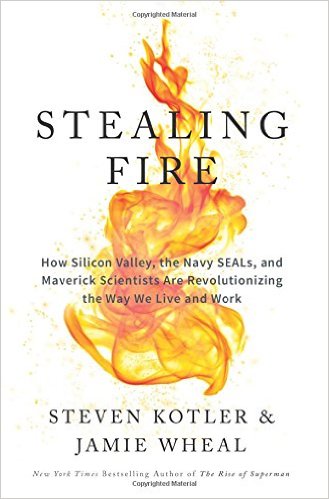
 Why this Book: Selected by my All American Leadership Reading Group.
Summary in 3 sentences: This book is a no-holds-barred look at our efforts to find “ecstasy” – that magical state where we are so engaged in an experience, that all of our senses are heightened – even supercharged – to the point that we forget ourselves. The authors look at everything from individual and team flow, to extreme and high risk sports, to super-charged sexuality, to psychedelic and mind altering drugs, to meditation and yoga, and even touches on what we might call “mystical experience” – all of which the authors claim are our efforts to “get out of our head.” The authors argue that this desire to get out of our head is our fourth natural impulse, behind water, food, and sex, but just like the other three, must be moderated to help sustain and improve life, or it can lead to ruin.
My impressions: This book is a fun as well as scientific joy ride through various ways humans choose to suspend their thinking minds. It is playful and irreverent while also being a well researched and scientific exploration of various ways by which we seek the the joy and ecstasy of “ecstasis” – the Greek word for “stepping beyond oneself” and (obviously) the etymological source of our word “ecstasy.” The title “Stealing Fire” refers to Prometheus in Greek Mythology stealing fire from the gods and sharing it with humans. Fire represented the knowledge, insights and capabilities previously possessed only by the gods, but necessary for humans to build civilization. Obviously, ecstasis is an experience that brings us closer to the gods, or to God. Zeus did not intend to give humans those powers, and so was not happy. He punished Prometheus by chaining him to a rock and having eagles eat his innards for eternity.
In Stealing Fire, the authors explore the rich rewards that come from the ecstasy of getting out of our heads. They share research that ties peak performance in sports and other endeavors to the ecstatic experience of suspending our analytical minds, drawing from Kotler’s previous work exploring the state of “flow” in his book The Rise of Superman. They discuss how conventional society has sought to limit and control our access to this experience, which can easily seduce us away from doing our chores. They identify the church, our views of the limitations of our bodies, and the state as primary forces restricting further exploration and experimentation of ecstasis.
Stealing Fire points to how we seek the experience of losing ourselves in a variety of ways, from the joy of being part of an enthusiastic crowd at a rock concert, a religious revival or political rally, to ecstatic sex, to hallucinogenic or other drugs, to computer games, to high risk activities. They even look at how the intense focus of combat can create a version of this ecstasis. They begin the book with stories from SEALs deployed to Afghanistan switching on as a group with an interconnected focus that can lead to peak performance in groups – that group flow that professional sports teams all know and try to engender when it counts.
Kottler and Wheal break Stealing Fire into three main parts: Part One: The Case for Ecstasis in which they make their case that this impulse is the source of innovation, creativity, and peak human performance. Part Two is The Four Forces of Ecstasis in which they look at 1. Psychology of our drives toward religious ecstasy, sexual ecstasy, Near Death Experiences, and more; 2. Neurobiology – how the brain creates the ecstatic experience, 3. Pharmacology – the use of psychedelics and other mind altering drugs as short cuts to ecstatic experience; and 4. Technology – how technological breakthroughs are facilitating greater access to ecstasis. In Part Three: The Road to Eleusis, they look at the various movements to legitimize these trends, especially the annual Burning Tree experience in Nevada.
In Stealing Fire we read about many of the various forms – licit and illicit – that the new search for ecstasis is taking. Those who are sticking to the old methods – alcohol, coffee, meditation/prayer, rock concerts and team sports – of escaping the chiding parent in our heads, may feel left out of the adventure. Indeed the book’s introduction concludes with, “ …this book is about that revolution.”
The authors conclude the book by advising that in seeking our own preferred pathway to ecstatic experience, we should consider the following formula: Value = Time x Reward/Risk. Your best path depends on how much time you have, how much risk you are willing to take, and how great a reward are you seeking. In any case, they are insistent that we stay grounded in the reality of the world as we know it, as we look for brief opportunities to understand it better ,by stepping out for a while.
A criticism: While I thought it interesting how the authors found a common drive behind the various routes to “ecstasis,” I believe there are distinctions that are significant that they didn’t address. I believe the experience of Team flow in a SEAL platoon, or a basketball team, or the use of hallucinogens, or the ecstatic experience of sex, or the complete focus of high-risk extreme sports, or the experience of satori or samadhi associated with religious enlightenment have differences that the authors didn’t address. The commonalities are interesting, but then, so are the differences.
————————————————————————————————————————————
Some representative quotes from Stealing Fire (page numbers from the 2017 hardback edition)
So in the same way that the biological mechanisms underpinning certain non-ordinary states are remarkably consistent, our experience of these states are, too…..we find four signature characteristics underneath: Selflessness, Timelessness, Effortlessness, and Richness, or STER for short. 36
When you think about the billion-dollar industries that underpin the Altered States Economy, isn’t that what they’re built for? To shut off the self. To give us a few moments of relief from the voice in our heads..… Or more specifically, the inner critic we all come with: our inner Woody Allen, that nagging, defeatist, always-on voice in our heads. You’re too fat. Too skinny. Too smart to be working this job. Too scared to do anything about it. A relentless drumbeat that rings in our ears. 37
The benefits of selflessness go beyond silencing our inner critic. When free from the confines of our normal identity, we are able to look at life, and the often repetitive stories we tell about it, with fresh eyes. Come Monday morning, we may still clamber back into the monkey suites of our everyday roles – parent, spouse, employee, boss, neighbor – but by then, we know they’re just costumes with zippers. 38
With these developments, psychedelics, have begun moving from recreational diversion to performance enhancing supplement. 50
During ecstasis, our sense of being an individual “I” gets replaced by a feeling of being a collective “we.” 68
Communitas is the term University of Chicago anthropologist Victor Turner used to describe this ecstatic sense of unity….But it’s a double-edged sword. When we lose ourselves and merge with the group, we are in danger of losing too much of ourselves. 68
As Buddhist scholar Alan Watts puy it, “Western scientists have an underlying assumption that normal is absolutely as good as it gets and that the exceptional is only for saints, and it is something that cannot be cultivated.”….But many of the same interventions that can help us get our heads above water can just as effectively be devoted to raising our heads above the clouds. 90
So while ecstatic states (which are brief and transitory) aren’t the same as developmental stages (which are stable and long lasting,) it appears that having more of the fomer can, under the right conditions, help accelerate the latter. In short, altered states can lead to altered traits. 93
When we can consistently see more of “what is really happening,” we can liberate ourselves from the limitations of our psychology. We can put our egos to better use, using them to modulate our neurobiology and with it, our experience. We can train our brains to find our minds. 114
Researchers have been pondering this for a while now, and have concluded that intoxication does play a powerful evolutionary role – “de-patterning.”
And these newly discovered mechanisms (fMRI) shed more light on two of the fundamental characteristics of ecstasis: selflessness, and richness. Earlier in the book, we explored how the deactivation of key parts of the brain, what’s called transient hypofrontality, is largely responsible for selflessness. 125
But say what you will about pharmacology being a cheat code to the mystical, there’s no question it works. 128
Ecstasis only arises when the attention is fully focused in the present moment. 136
And whether you’re judging by the growth of our meet-ups, the millions of dollars hitting this market, or the technology that’s already available, lots of us are really interested in spiritual innovation…”Consciousness-hacking technology is going to become as dynamic, available, and ubiquitous as cell phones.” 148
“We learned that when you take a bunch of really bright, diverse people, explains Rosenthal, “and let them share a dynamic immersive experience, you get powerful results. Lifelong friendships were formed. It removed the tedious, transactional nature of networking. 170 (Note: This is the point of our NOLS Executive Leadership Expeditions)
By realizing that non-ordinary states are more than just a recreational diversion and can, in fact, heighten trust, amplify cooperation, and accelerate breakthroughs, a new generation of entrepreneurs, philanthropists and activists is fundamentally disrupting business as usual. 174
At the tail end of the twentieth century, we started moving from the selling of ideas, a so-called information economy, toward the selling of feelings, or what author Alvin Toffler called the “experience economy.” …the next step: the move from an experience economy to what author Joe Pine calls the “transformation economy.” In this market place, what we’re being sold is who we might become….195
Open-sourcing ecstasis remains one of the best counterbalances to private and public coercion. And once we do take these freely shared ideas and use them to unlock non-ordinary states for ourselves, what do we find? A self-authenticating experience of selflessness, timelessness, effortlessness, and richness. In short, all the ingredients required for a rational mysticism. 200
“Most people overestimate what they can do in one year, ” Bill Gates once said, “and underestimate what they can do in ten.” 205
In 2014, Ryan Holiday released a bestselling book on exactly this subject, The Obstacle is the Way. It offered an update to the Roman Stoic Marcus Aurelieus’s claim that “the impediment to action advances action. What stand in the way become the way.” And this is certainly true of the ecstatic way. All that “effortless effort” takes a lot of work. …And no matter how tempting it is: Don’t become a Bliss Junkie. 206
Invariably, in those same conversations, someone always asks “but what’s the best way to get into the zone?” To which we respond: it depends. It depends on your tolerance for risk, and how far over the edge you’re willing to hang. It depends on your sense of urgency, and whether your goals can be reached in minutes or decades. And it depends on how reliably your preferred approach delivers actionable information and insight….Value = Time x Reward/Risk 211
“the road of excess leads to the palace of wisdom,” William Blake once wrote. 216
There’s one final caveat worth keeping in mind. Namely, there’s no escaping the human condition. We’re born, we die, and figuring out the in-between can be brutal. As Hemingway reminds us, “the world breaks everyone.” 216
And this may offer the greatest hope of all. We no longer have to rely on someone stealing fire for us….Finally, we can kindle that flame ourselves. 222


 Bob's Books
Pingback: Super Consciousness, by Colin Wilson | Bob's Books
Pingback: Stealing Fire | Readings