
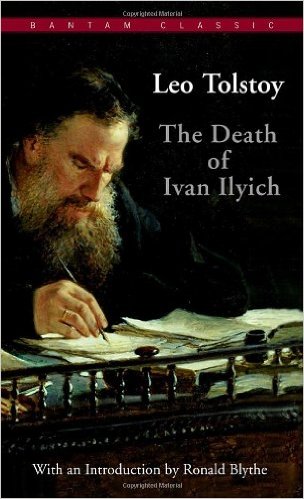
 Why this book: Recommended by my son, and then selected as an optional add-on book to Lincoln in the Bardo, my reading group’s selection for our bimonthly reading. Ivan Ilyich is short – less than 100 pages.
Summary in 4 sentences: The book takes place in Russia in the second half of the 19th century. After a happy uneventful childhood followed by law school, Ivan Ilyich was contentedly becoming an important figure in his community as an attorney and then judge when he became ill of mysterious causes. In the second half of this short book, Ivan Ilyich struggles with his illness, slowly gives up hope of recovery, and we experience his frustrations and painful realization that he is truly alone in his suffering as he faces death. In his last weeks and days, he resents the injustice of becoming fatally ill, since he had lived just as he was supposed to, following the well-trodden path to success – and he finally realizes that so much that had previously been important to him was a sham.
My impressions: Interesting that our reading group selected this book along with Lincoln in the Bardo, given that both books deal explicitly with death and dying. Thinking, talking, writing about death is very much about how we live – and this book indeed is not only about how Ivan Ilyich lives his last months, but how he had lived up to that point, before he fully realized that indeed death also applied to him. The book is about an unreflective man facing the reality of his own mortality – and how finally accepting his mortality changes his values and how he viewed his life.
The book begins with Ivan Ilyich being already dead, his former colleagues talking about him, visiting his widow, attending the viewing and the funeral. His “friends” and colleagues view his illness and death from a very self-centered perspective – though Ivan Ilyich’s death may be sad, they are mostly concerned with how it affects their immediate concerns, the inconvenience of it all, how it may open up some opportunities for them. Tolstoy is at his best getting at the truth of how people feel and think – the hypocrisy and prevarications in how people live and behave with each other. This quality of his writing characterized War and Peace and Anna Karenina, the other two books of his that I have read.
After the opening scene, we are introduced to Ivan Ilyich and his life, and we learn about his happy childhood, how he was a good student, attended law school, and then about his successful career as an attorney and jurist, and eventually becoming a judge. We learn of his courtship and marriage, having children, and then how his marriage stagnates. He then puts more energy into his work, and takes satisfaction in his rising stature within his community. It is a quick overview of a conventional life, lived in accordance with conventional values of the day – not unlike our values today. As he reaches his 40s, his family life is not particularly satisfying, but his priority is on his career and his reputation in his community, which continue on a positive glide path as a result of Ivan Ilyich having done everything in accordance with the accepted conventions of the day. Then he becomes ill.
In the second part of the book he confronts his illness – initially it as a mere inconvenience, and he believes he will get past it and get on with his life. But he doesn’t get better, in fact gets worse, and he as to deal with conflicting medical advice from indifferent doctors, and he begins to become concerned. From his family and “friends” he perceives feigned concern. Tolstoy takes us inside the perspectives of his family and friends and we see that their concern is primarily for how Ivan Ilyich’s illness will affect them and their lives.
Most telling is how Ivan Ilyich notices and reacts to the insincerity of attempts to help and comfort him. He despises those who visit him out of obligation rather than out of real concern. He does establish a bond with his son – a young boy who is confused and too young to be self-interested in his fathers death. And he also bonds with one of his servants who is a friendly and good natured young man who is happy to help him with no apparent concern for what he might get out of it.
But in Ivan Ilyich’s story we see karma at work. As a judge, he made judgments that determined the fate of those who were brought before him, with little real concern for them as human beings – rather dispensing the state’s justice and enforcing the laws impartially, only with the state’s interests and his own career in mind. He showed no particular interest in whether “real” justice was being served, nor was he particularly interested in the individual stories and lives of those whose fate he decided. The doctors he visited treated him with a similar aloof indifference to his personal suffering. Just as he had focused primarily the legal issues when deciding the fate of those brought before him as judge, his doctors focussed on his illness as an interesting puzzle to solve, a dilemma, a challenge, but with little regard for his personal suffering.
As his suffering increased, he isolated himself more and more, while more people came to see him as he was clearly close to death. He looked back on his life and wished he’d realized earlier that so much of what he had considered important meant nothing now. He knows he is about to die and begins detaching from his suffering and his life. The book concludes with, “He drew in a breath, broke off in the middle of it, stretched himself out, and died.”
The first part of the book reminded me a bit of Sinclair Lewis’s Babbitt, the protagonist of which is also an unreflective man following the formula for conventional success in one’s community. In Babbitt however, our anti-hero never really realizes why things simply don’t seem to turn out right for him; Ivan Ilyich is forced to confront his own existential crisis – with no time left to make amends. Funny how I keep stumbling on this theme. I just finished Hemingway’s Snows of Kilimanjaro – a short story in which the protagonist, a Hemingway-esque character, confronts, accepts and then experiences his own death.
The introduction to the Bantam Classic edition I read is an amazing essay by Ronald Blythe on the theme of “death in literature” and how this book fits into Tolstoy’s life and work. I recommend waiting until reading Ivan Ilyich the book before reading the introduction – it meant so much more after reading Tolstoy’s novel.


 Bob's Books