
 Why this Book: Selected by the All American Leadership reading group as our pick to discuss for June 2017.
Summary in 3 Sentences: Bill George adds his own experience into the mix of stories and insights from over 125 key business leaders in the US, some in their 70s and some as young as in their 20s, who he and Peter Sims had interviewed and researched. The message and focus is on “authentic” leadership, based on self-knowledge and passion driven commitment to a purpose bigger than self and career. These are almost cliched ideas in 2017, but the points are well made, reinforced with many compelling stories and first person accounts of leaders who have struggled and succeeded.
My Impressions: This book reinforced points I’ve read in many other leadership books – so there wasn’t much “new” in it. Of course, it was written 10 years ago, and there have been hundreds of leadership books written since then making many of the same points, a few of which I’ve read. The strength of the book is in the illustrative stories. Bill George and Peter Sims interviewed and/or researched over 125 leaders for this book and many of their compelling and sometimes truly memorable stories are included, which help reinforce the points of the book.
A couple of other things make this book stand out.
I like how they begin with an emphasis on the leaders’s personal life story as key to his/her leadership, a point which they reinforce later when they discuss how leaders must select a “style,’ that is most appropriate not only to their experience, but also to the situation. The uniqueness of one’s life story should determine one’s “authentic” style.
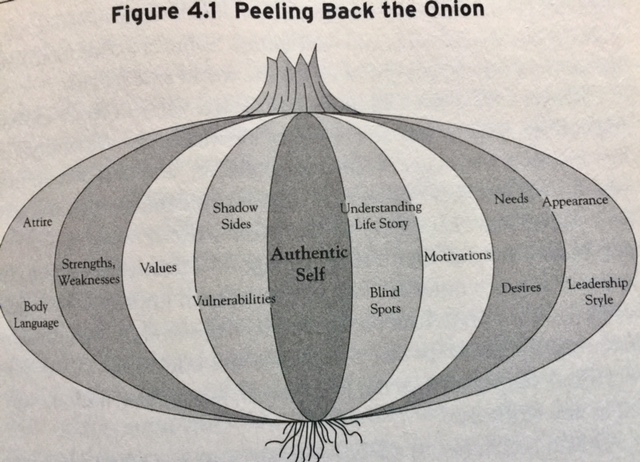
Related to that, the book emphasizes the importance of self-knowledge and self- awareness, as necessary to “discover your authentic leadership” (from the cover) and becoming a mature leader. He used the following graphic to to help describe his idea of the “authentic self” as central to who we are:
The Leadership Exercises that were offered for each chapter in Appendix C at the end of the book were excellent, and included some probing and provocative questions. While I did look at the questions, and recognized them as thoughtful and very worthwhile, I did not spend time thinking about or writing responses to the questions posed. Doing these exercises however would be a very worthwhile investment in time – particularly toward the goal of inspiring thinking, and self-knowledge. I could imagine a leadership course going chapter by chapter through this book, and requiring the participants to write down their own answers to the probing questions in Appendix C, and then share and discuss them with each other.
I thought many of the graphic representations were a real strength. I include several below with the quotes I offer, which will help me (and perhaps you) with a quick review of the contents of the book – of course without the strength of the stories.
Possible Weakness: Throughout the book, the authors write about the importance of a leader being “authentic.” I recalled how in Leadership BS (my review here) Jeffrey Pfeffer challenges this concept, noting that an important part of leadership is in role playing, appropriate to the demands of the situation. The idea of the leader finding the balance between playing the role expected of a leader, and wearing his/her feelings on their sleeve was not addressed. In True North, Bill George points out how being open about one’s shortcomings can yield positive and more trusting relationships with colleagues, teammates, or subordinates. On the other hand, in his section on building one’s personal support team, he alludes to how we need a friend, mentor, partner, spouse with whom we can REALLY be vulnerable and authentic. The issue of “authenticity” is more interesting and complex than he describes. And in Waking Up (my review here) Sam Harris emphasizes how and why he believes that there is no “authentic self” at the center of the onion – that our “self” is really made up of the sum of all those outer layers.
————
Some quotes: Below are some quotes I found representative of the message of the book. I’ve included a few of the excellent graphics. (page numbers from the 2007 Hardback edition.)
To lead others, you must know what you are doing, have deep curiosity, and develop keen judgment.. Competence counts. xvii
True North is the internal compass that guides you successfully through life. It represents who you are as a human being at your deepest level. It is your orienting point 0- your fixed point in spinning world that help you stay on track as a leader. Your True North is based on what is most important to you, as your most cherished values, your passions and motivations, the sources of satisfaction in your life. xxiii

Leaders are highly complex human beings, people who have distinctive qualities that cannot be sufficiently described by lists of traits or characteristics. Leaders are defined by their unique life stories and the way they frame their stories to discover their passions and the purpose of their leadership. xxvii
Yet by acknowledging their shortcomings and admitting their errors, (authentic leaders) connect with people and empower them. xxxi
Five dimensions of authentic leaders:
- Pursuing purpose with passion;
- practicing solid values;
- leading with heart;
- establishing enduring relationships;
- demonstrating self-discipline. xxxi
The test of authentic leaders’ values is not what they say, but the values they practice under pressure. xxxii
Asked what motivates them to lead, authentic leaders consistently say they find their motivation through understanding their own stories….What emerges from these stories is that virtually all the leaders interviewed found their passion to lead through the uniqueness of their life stories….not by being born leaders….not by believing they had the characteristics, traits, or style of a leader… Not by trying to emulate great leaders. 8
Many people with painful stories see themselves as victims, feeling the world has dealt them a bad hand. Or they lack the introspection to see the connection between their life experiences and the goals they are pursuing now. Some get so caught up in chasing the world’s esteem that they never become genuine leaders… The different with authentic leaders lies in the way they frame their stories. 14
Novelist John Barth once said, “The story of your life is not your life. It is your story.” In other words, it is your story that matters, not the fact of your life. 15
Vanguard CEO Jack Brennan believes that the worst thing people can do is manage their careers with a career map: “The dissatisfied people I have known and those who experienced ethical or legal failures all had a clear career plan….If all you’re interested in is advancing your career, you’ll be dissatisfied at the end of the day.” 15-16
…The leaders journey followed the new span of life and subdivides into three periods, each of roughly thirty years. …Phase I is labeled: “Preparing for Leadership.” Phase II, from thirty to sixty years of age, is the “Leading” phase, in which leaders take on successive roles until they complete their peak leadership experience…Finally, Phase III is for “Giving Back”… 17
“(Phase I)) is your opportunity to rub up against the world.” 17
Two thousand years ago Roman statesman Marcus Cicero declared that “old age is to be resisted.” 24
There is nothing wrong with desiring these outward symbols as long as they are combined with a deeper desire to serve something greater than oneself. 28
The other side of fear of failure is an insatiable craving for success. …along the way, success can go to their heads and they develop a sense of entitlement…they are prone to pushing the limits and thinking that they can get away with it. 30
..authintic leadership is about empowering others on their journeys. The shift is from “I” to “We.” ….If our supporters are merely following our lead, then their efforts are limited to our vision and our directions about what needs to be done. 44
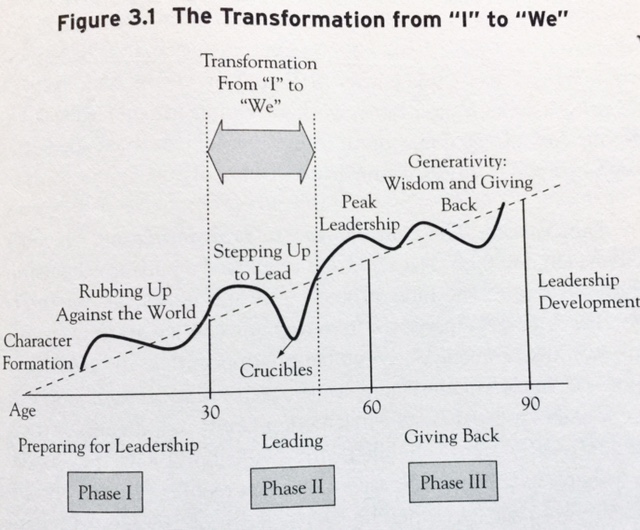
Only when leaders stop focusing on their personal ego needs are they able to develop other leaders….A lightbulb goes on as they recognize the unlimited potential of empowered leaders working together toward a shared purpose. 45
When you face your own mortality, as Mike Sweeney did, your priorities and your True North become crystal clear. The same is true when someone close to you passes away. 58
Too many leaders believe that by being the smartest person in the room, they can use their intellect to carry the day….Wells Fargo’s Dick Kovacevich argues that high IQ can actually be an impediment to leadership. “Above the 99th percentile of intelligence, there is an inverse correlation between leadership and intelligence,” he says…Leaders with an exceptionally hight IQ get too intellectually involved and have trouble being tolerant of others. 68-69
Stanford’s Joel Peterson calls feedback “the breakfast of champions.” 77
When leaders accept who they are and release the need to be on someone else’s fast track, they can be comfortable in their own skin. 79-80
One fear all of us have to confront is whether others will accept us if we show our vulnerability. We fear being rejected if we admit our mistakes. Will others take advantage of our weaknesses? Will they think less of us? As hard as we try to deny them, these questions continually nag when we are feeling most vulnerable. 80
Piper said he never would have opened up like that had he not found himself in the middle of a crisis. “As a result, I’ve learned the power of being vulnerable. Most leaders’s are afraid to be vulnerable. They think, ‘I’m supposed to be strong and have all the answers.'” 81
Self awareness is only half the challenge. You still have to accept yourself….The key to self-acceptance is to love yourself unconditionally…(which) requires self compassion. 82
Leadership principles are values translated into action. 86
After defining your leadership principles, you need a clear understanding of your ethical boundaries. 86
…you do not know what your true values are until they are tested under pressure. 87
As we search for our True North, it is important to acknowledge how easy it is to get pulled off course. The pressures to perform, the ingrained fear of failure, and the rewards for success can cause us to deviate from our values. By knowing our ethical boundaries and testing our values under pressure, we are able to get back on track. 102
Alice Woodwark, McKinsey: “If you’re chasing the rabbit around the course, you’re not running toward anything meaningful.” 103
There are two types of motivations – extrinsic and intrinsic. Extrinsic motivations, such as getting good grades, winning athletic competitions, or making money are measured by the external world….Intrinsic motivations, on the other hand, are derived from your sense of the meaning of your life – your True North. 106

Many leaders turned down higher-paying jobs in early career decisions in order to pursue roles they would enjoy. 110
The key to developing as an authentic leaders is not eschewing your extrinsic motivations but balancing them with intrinsic motivations. 112
But what some people fail to recognize, especially aspiring leaders, is the importance of the two way relationship with their mentors. Lasting relationships must flow both ways. 122
To have great mentors, Warren Bennis tells young leaders, they have to recruit them. 124
Dillon’s story illustrates the importance of having mentors who challenge rather than just support you. 126
Personal support groups are one of the most powerful ways of gaining wisdom and advice that will help you grow as a leader. The most effective groups are made up of peers who meet on a regular basis and talk about what is important in their lives. 128
Getting back on track alone is very difficult. That is when you most need your support team. 131
Life humbles you. 137
Warren Bennis does not like the word balance. “Balance is an engineering term that means you put the little weights on each side, and if you’re really a good person, you’ll come out equal. We have to be aware that we swing back and forth. It is choices all the time, not balance.”
Ultimately, our life stories become an expression of the choices we make. 138

For some of us, it takes many years to find the purpose of our leadership – and the right place to devote our passions. 155
Joel Peterson believes that many people are cause-driven and don’t start out thinking about being leaders. “They have so much passion for the cause that they naturally become the leader. When they are pulled to something that matters a great deal, leadership followed their passion.” 160
Narayana Murthy: “You cannot sustain long-term shareholder value unless you create sustainable value for your customers, while assuring fairness to all stakeholders: customers, employees, investors, vendor partners, governments and society.” 167
To bring out the best from teammates, authentic leaders must develop trusting relationships based on mutual respect. There is no substitute. Like loyalty, respect provides a basis for empowerment, but it must be earned. Here are some of the things leaders do to gain the respect of their colleagues:
- Treating others as equals.
- Being a good listener
- Learning from people
- Sharing stories.
Woody Allen once remarked, “Eighty percent of success is showing up.” 177
Often, the most empowering response is to challenge people’s ideas, to ask why they are doing something a particular way, and to help them sharpen their ideas through dialogue. 179
Curtis Carlson: “Monday through Friday are about staying even with the competition. Saturday is when you get ahead.” 181
(Marilyn Carlson) Nelson decided to reinvent Carlson as a company that cared for customers by creating the most caring environment for its employees. 183
Once you empower people to lead around a shared purpose, you are well positioned to achieve superior result through your organization. 185
Using your power is directly linked to your style, as you convey power through style. 186
You also need to adapt your leadership style to the capabilities of your teammates and their readiness to accept greater power and responsibility. For example, if your teammates need clear direction they may not be ready to respond to a consensus style. Conversely, creative or independent thinkers will not respond positively to a directive style. 186
If you simply adopt an organization’ normative style or try to emulate someone else’s style, your lack of authenticity will show through. Under pressure and stress, leaders tend to revert to their least attractive styles – from being highly directive or passive aggressive to completely withdrawn. That is why you should find a leadership style that inauthentic to you and continue to refine it. 191


 Bob's Books