
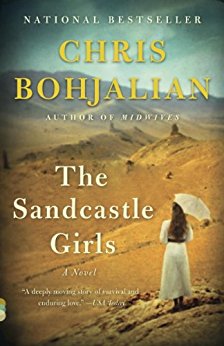
 Why this book: Selected by my literature reading group, because it had been selected as the NPR 2017 One Book, One San Diego selection. Over the years we have tried to read the One Book, One San Diego selections and have never been disappointed.
Summary in 3 sentences: It is a novel built around the Armenian genocide of 1915-17 – often referred to as the genocide that nobody knows about – which the Turks undertook to rid their land of the largely Christian Armenian population during World War I. The novel is structured around two main stories running in parallel, taking place nearly 100 years apart: The narrator is a woman of American- Armenian descent in present day America, tells her story of seeking to uncover the mysteries surrounding how her grandparents who met in Syria while assisting refugees from Armenia. The second story runs parallel to the first in alternating chapters and sections of chapter – and is indeed the compelling history of her grandparents: a young American woman doing philanthropic work in Syria in 1915, and the Armenian engineer she falls in love with. It is a book about love, empathy, courage, and self-sacrifice amidst brutality and horror taking place in a setting in which ultimately half million people were murdered or starved to death.
My impressions: It is very well written – Bohjalian’s 14th novel – and he is excellent at his craft. He weaves the stories of multiple characters together to smoothly create a mosaic of experiences that makes a fascinating cross-generational picture of this horrible example of man’s inhumanity to man. And most of the victims in this story are women and children.
The story goes back and forth from present day Boston, written in first person from the perspective of Laura Petrosian a young American woman who grew up hearing bits and pieces of stories from and about her grandparents, knowing that there was much unsaid, much they were unwilling to talk about. In her investigation she researches the time and place, finds old letters written by her grandparents, and bit by bit pieces together the evidence to learn how her grandparents met and what they experienced. The story goes back and forth between her life in present day America and the world of Aleppo, Syria in 1915 and the story of how the very different trajectories of her grandparents’ lives came together. Aleppo was to mostly die of starvation, and maltreatment. Aleppo was a main stopping off point where Armenian refugees mostly women and children were being herded by Turkish soldiers and then subsequently driven into the desert to die. Here Laura’s American grandmother, and herArmenian grandfather met.
Ultimately Laura uncovers a secret that helps explain some of why her grandparents were so circumspect in talking about that period.
There are multiple parallel stories:
- The story of Laura Petrosian, married mother of two in modern day America, living the middle class life that most of us are familiar with, but captivated by the details she is uncovering about the lives of her grandparents, how they met and survived amidst the horrors of a genocide many of us know little or nothing about.
- The story of Elizabeth Endicott – Laura’s grandmother – as a young idealistic American woman from a wealthy Bostonian family who goes to Syria to try to provide assistance to Armenian refugees prior to the US entering WWI. While there, she falls in love with Armun Petrosian
- Armun Petrosian an Armenian refugee, who as an engineer was able to escape the prison or execution by providing key engineering expertise for the Germans who were allied to the Turks in WW1. He is struggling to come to terms with the losses of his family to the Turkish “cleansing” – his brothers fighting the Turks, or in the case of his wife and daughter, simply slaughtered by them. He falls in love with Elizabeth, but his and Elizabeth’s paths diverge, before they come together again.
- Two German military engineers who were in Syria to assist their allies the Turks, but who are appalled by the treatment of the Armenian refugees. They were also friends and the employers of Armun Petrosian
- Nevart, a middle aged and formerly well-to-do Armenian refugee who Elizabeth is able to rescue from the almost certain death of the refugee camps and bring to live in the embassy. Nevart had taken a young girl Houtan under her wing and was committed to protecting her as best she could from the fate of most of the refugees.
- Hatoun -the young girl who Nevart was caring for who survived the death march into Syria after watching her mother killed. Houtan was psychologically traumatized by the experience, would barely speak, her behavior was erratic, and did not trust anyone.
- Ryan Martin, the US consul in Aleppo who is appalled by what he is seeing, appalled that his country is not doing more to stop the genocide, and is determined to somehow get word back to the United States about what is happening. He feels helpless as he is stymied at every turn by the Turkish and Syrian authorities in his efforts to inform his country, or mitigate the suffering he is seeing.
All of these individuals have key roles in the story and their lives converge, then diverge, then converge again. Their stories make up a mosaic which provides a picture of some of the tragedy and heroism in this little known but horrible time and place in history. It is also the story of a comfortable middle-class woman exploring her roots and realizing some of the heroism that had made her relatively secure lifestyle possible.
When we discussed this book in our reading group, all of us were glad we had read the book – it was well written, a fascinating story and informed us of events about which we had little previous knowledge. Most said that the plethora of characters did not allow the author to give them the depth we felt they deserved. Many of us agreed we’d have preferred the book to have been longer to make the key characters fully three dimensional. And one of our group noted that he would have wanted some background as to why the Turks were so adamant about ridding their country of Armenians? What were the sources of this genocide ? What was the cultural backstory behind this ethnic cleansing?
An interesting and good read. Another good One Book, One San Diego selection.


 Bob's Books