
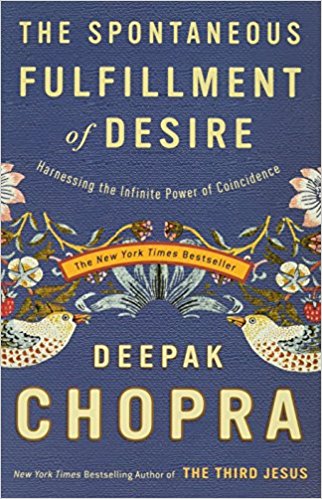
 Why this book: My good friends Jay, Emily and I have often spoken of synchronicity – the strange “coincidences” that seem to shape our lives, which somehow brought us three together. We have often spoken of synchronicity as if it were an accepted force of nature – almost like gravity. Jay found this book and strongly recommended to augment our discussion – Emily read it and agreed that it is worth the read. That was good enough for me.
Summary in 3 Sentences: This book covers a lot of territory, beginning with the nature of reality, discusses coincidence and synchronicity, the nature of the soul, how our intention and desires impact our lives and the universe, addresses personal and universal archetypes, as well as the role of meditation and mantras. He goes from describing an “Eastern” mystical view of the nature of reality, to how we can align our lives and minds to live in greater harmony with that reality. He concludes with a series of exercises to help us do that.
My Impressions (part 1) I have been familiar with Deepak Chopra for many years, but this is the first of his many books that I’ve read. My sense was that Chopra was writing this book to his already loyal audience, since he made statements about reality and the universe that seemed to assume that his readers already understand, and are ready to share his vision. While I appreciate Chopra’s mystical view of man’s place in the universe, I’m not ready to declare that it is a self-evident given. So I struggled a bit with his language which referred to things such as “pure soul” or the “universal consciousness” about which I’m not so sure.
This is a perennial challenge for mystics – to describe a vision of reality in language that has evolved in a very different understanding of reality. Like trying to explain to a blind man, what it’s like to see, or to a deaf person, what it’s like to hear.
Book Summary: Chopra’s book explores the implications of coincidence and synchronicity. He expands the concept of synchronicity to something greater – what he calls “synchrodestiny” – which is for Chopra the connection between the synchronicity that occurs naturally in our lives, to our life’s purpose. Synchronistic coincidences he argues, are indicators of a connections between people, events and our destiny that exist on a plane of reality that we can tap into through meditation and spiritual practice.
He begins the book by describing three domains of reality: 1. The Physical domain that we experience in our day-to-day lives; 2. the Quantum domain, which he says is information and energy, which can’t be experienced through our five senses; and 3. the Nonlocal domain which he identifies with universal consciousness that operates beyond space and time. Our connection to this “nonlocal domain” is what much of the book is about, and it is in this domain that the spiritual and synchronistic connections take place.
He talks about what he calls our “nonlocal mind” which is that part of us that connects to the nonlocal domain of reality. He distinguishes between the local “I” – the “I” which most of us identify with daily – and the nonlocal “I” which connects to the nonlocal domain. He says that our nonlocal mind “organizes all the details (in our lives) synchronistically.” He says our local and nonlocal “I”s are often not in alignment and don’t work well together, and that getting them in alignment is a key objective of the spiritual journey. I think this “nonlocal” mind shares a lot with what we normally consider our subconscious mind, but Chopra gives it a lot more significance, as the pathway to our connection to what he refers to as “universal consciousness” and the “nonlocal domain” of reality.
The below two paragraphs summarize some of Chopra’s key points in the language he uses:
“This is the ultimate truth of synchrodestiny – that the sum total of the universe is conspiring to create your personal destiny. To do so it uses ‘acausal nonlocal connections” (124)….”What we experience as everyday reality is merely a shadow play. Behind the curtain there is a soul, living and dynamic and immortal, beyond the reach of space and time. By acting from that level, we can consciously influence our destiny. This happens through the synchronization of seemingly acausal relationships to mold a destiny – hence synchodestiy. In synchrodestiny, we consciously participate in the creation of our lives by understanding the world that is beyond our senses, the world of the soul.” p128-129
“You and I and the universe are the same…Even our thoughts, our wishes, our desires, our dreams are not technically our thoughts, wishes, desires, or dreams. They are manifestations of the total universe. And when you realize that the intentions and desires that arise in you are the very intentions of the universe, you can relinquish your desire for control and let the miraculous life you were born to lead unfold, in all its unimaginable magnificence…Once you understand this premise, you will understand the sutra of the first principle of synchrodestiny: the core of my being is the ultimate reality, the root and ground of the universe, the source of all that exists.” p182
Those two paragraph gives you an idea of Chopra’s message and style. It is indeed a lot to “understand.”
He has a chapter on archetypes – a concept developed by Carl Jung, and I am familiar with additional work done on archetypes by Joseph Campbell. He suggests that each of us has an archetype that we have subconsciously chosen as a model for our lives and decisions, and that we should should seek to identify that archetype and use it to our advantage. “The activation of an archetype releases its patterning forces that allow us to become more of what we already are destined to be.” p150
Regarding “synchronicity,” he makes the point that coincidences are NOT coincidences – they are indicators of connections and forces that exist in the nonlocal domain, but which we may not see. These coincidences are actually messages to us – if we will be open to receiving them – telling us something about our lives and our destiny. “More coincidences provide more clues to guide our behavior…These clues point out the direction to take our lives.” p143
On relationships, he says, “Relationship is one of the most effective ways to access unity consciousness because we’re always in relationships.” p188 To describe spiritual experience, he says, “When you’re in love, for example, romantically and deeply in love, you have a sense of timelessness….You’re transforming, changing, but without trepidation; you feel a sense of wonder. This is a spiritual experience.” p189
He concludes the book with a set of seven principles which he suggests be the focus of daily meditations, a different one to be done daily for 7 days, and then repeated. Each principle also has several exercises to be done during one’s meditation, and a number of sutra statements to be meditated on each day. The sutra statements reinforce the principle of that day’s meditation.
First Principle: You are a Ripple in the Fabric of the Cosmos. Example Sutra statements: Imagine that you are connected to everything that exists. Imagine that you are eternal.
Second Principle: Through the Mirror of Relationships I Discover My Nonlocal Self. Example Sutra statements: Imagine that everybody is a reflection of yourself. Imagine that you are the qualities you most admire in others.
Third Principle: Master Your Inner Self: Example Sutra statements: Imagine that you are centered and totally at peace. Imagine that in your presence, all hostility is overcome by a profound peace. Imagine that you are detached from the outcome.
Fourth Principle: Intent Weaves the Tapestry of the Universe. Example Sutra statements: Imagine that your intention can bring joy and laughter to those who are in sorrow. Imagine that you can bring hope to those who are feeling helpless. Imagine that your thoughts affect the natural forces of the universe, that you can bring rain and sunshine, clouds and rainbows.
Fifth Principle: Harness Your Emotional Turbulence. Example Sutra statements: Imagine that you are free from blaming, free from feeling blame and guilt. Imagine that you can choose any emotional feeling you want to experience. Imagine that you can set any goal you want to achieve and actually achieve it.
Sixth Principle: Celebrate the Dance of the Cosmos. Example Sutra statements: Imagine that you are strong, decisive, courageous, articulate, and powerful. Imagine that you can be both masculine and feminine if you choose. Imagine that you are beautiful, sexual, intuitive, nurturing, and affectionate.
Seventh Principle: Accessing the Conspiracy of Improbabilities. Example Sutra statements: Imagine that you move in rhythm with the impulses of a conscious universe Imagine that every time you seek something, the universe provides clues in the form of coincidences. Imagine that there is meaning and purpose to everything that happens and everything you do.
My Impression (part 2) I struggle with the broad assumption Chopra makes about the nature of reality, but I do think there is something valuable in his message. I wrote a short piece about my own questions about the nature of reality several years ago entitled “The Unseen Order of Things or Unscrewing the Inscrutable.” I think there is a metaphorical baby in the bathwater of Spontaneous Fulfillment of Desire, and I want to hold on to the baby before I throw out the bathwater. Though I don’t have Chopra’s seeming certainty about the nature of reality, I do believe that:
1. Our minds and thoughts CAN affect reality and can help shape the future in ways that we don’t fully understand;
2. Coincidences, or “synchronicity,” or what Chopra calls “acausal connections,” may well be evidence that seemingly unrelated events are connected in ways that our linear cause-effect mindsets simply don’t understand. And that it is probably worth our while to pay attention to them!
3. Our consciousness is connected to other people and events in ways we don’t understand, and being positive and open to that possibility, can spiritually serve us well.
4. I agree with Chopra’s advocacy of disciplined meditation and self- reflection, stilling the mind to let what is below the surface – whether we call it our unconscious or our “nonlocal” mind – to float to the surface of our awareness.
5. I also believe in the value and power of positive mantras or sutras, planting seeds of belief and possibilities in one’s consciousness, as Chopra advocates in his seven principles for seven days protocol.
6. I also accept that the materialist version of reality may also be “true” – that there is only the one domain of reality – the physical one. I’m willing to accept the possibility that the views of Sam Harris (Waking Up)and Yuval Harrari (Sapiens) may be more true than false. I’m willing to accept the possible truth in their view that spiritual/mystical connections between us and other living things and the universe may only be wishful thinking and an illusion, borne of biochemical processes.
Could both Harris AND Chopra be right? Two blind men on different parts of the elephant? Or are their views mutually exclusive?
If you are interested in an Eastern, mystical view of the significance of synchronistic coincidences, this book will do it for you. You may be surprised out just HOW significant these coincidences may well be, and how these coincidences, just like everything else, are connected to – everything else.


 Bob's Books