
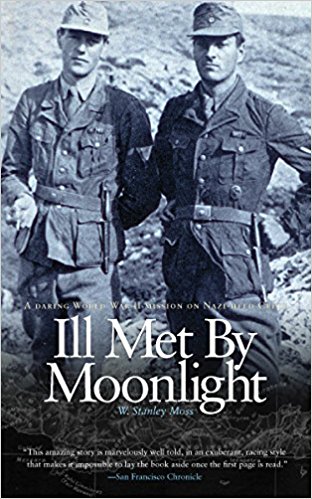
 Why this book: I had read Natural Born Heroes a health and fitness book, which interestingly enough, is built around the operation in Crete during WWII described in this book. I also just read Zorba the Greek which takes place in Crete in the early part of the 20th century. Since Ill Met by Moonlight takes place in Crete, focuses largely on Crete, and I had had this book for several years, I figured that NOW is the time to read it!
Summary in 3 Sentences: This is the first person account of one of the two British officers who led one of the most daring and successful allied commando operations in WWII – the kidnapping of Major General Kreipe who was in charge of the Army Division occupying Crete for Nazi Germany. The book is primarily the diary of 1st Lt W. Stanley “Billy” Moss, written during his time on Crete while he was preparing for, then conducting the operation, and the brief aftermath – providing a chronology and description not only of events, but also of his feelings and impressions. It is full of close calls, vivid descriptions of the Cretan partisans and villagers they worked with, and of their movement through the very rough terrain of Crete to get the kidnapped German General off the island to Cairo.
My Impressions: This is a vivid first person account about a still-famous commando operation written as diary entries while it was happening by one of the key actors. The author, Billy Moss shares his thoughts, feelings and impressions as a young British SOE officer co-leading this operation. It is beautifully written – stunningly so for a 22 year old. Though it is a diary, it is written as though he intended to publish it – almost as if a young Hemingway were leading the operation and writing about it as it occurred, but written without Hemingway’s bravado and self-aggrandizement. Moss shares his anger, frustrations and anxieties while dealing with some of the cultural barriers he faced working with his Cretan partisans, as well as the love and admiration he eventually developed for them. The success of the operation depended very much on their loyalty, stalwart support, toughness and ingenuity.
Published seven years after the war, he notes in his introduction that he left his diary entries unamended or edited – in order to retain the authentic sense of how he felt as he was engaged in the operation – but he does offer italicized after-the-fact perspectives and a few footnotes that add to understanding the context of the operation. The book is short and moves quickly. It is also a wonderful companion to Natural Born Heroes, and added a very useful dimension to the picture of Cretan villagers that Kazantzakis painted in Zorba.
The story was somewhat reminiscent of my own experience as a young SEAL officer training and conducting exercises in Europe in the 70s and 80s, preparing to potentially work with partisans in the next war, and even forty years after the end of WW2, our training and procedures were based largely on WW2 operations such as this. I recognized in this story the language and cultural barriers, the necessity to come to agreement with partisans on tactics, having to put one’s life in the hands of people one hardly knows and over whom one has no authority, having to agree on when, where, and how much risk to assume. In this book we see constant, necessary and dangerous interactions with the local populace.
Moss and his Cretan partisans, with the German General in tow, were able to evade German patrols for several weeks, but they suffered a lot – many long, long nights of hiking through very rough terrain, often going without food, days and nights sleeping without cover, in rain and cold, lots of uncertainty about next steps and about what was next – requiring patience and faith in those who were supporting them. And there were also moments of fun, periods of relaxation and camaraderie, and occasional moments when there was an almost spiritual contentment. In one case he writes, “Last night was beautiful, the sky filled with stars and the Milky Way looking like a scarf of sequins.” They were in a relatively safe hide-out, were able to sing quietly together, drink wine, and discuss life and literature, and “the war seemed a very long way off.”
They often worked closely with and depended on Cretan brigands, thieves and criminals who shared their hatred of the Germans, and who were expert at evading capture from authorities in rough terrain. They were constantly improvising and changing their plans, based on little and often unreliable information. Whereas their group included several trusted partisans who stayed with them for nearly the entire operation, different locals joined them and left them as they were passed from one group of guerrillas to the next, while moving across Crete, staying barely one step ahead of the Germans.
Their hostage, the German General Kreipe, was older, not nearly as fit as they were, and was slightly injured, and having him as part of the group presented its own challenges. They developed an ambiguous relationship with him, partly as a comrade sharing their hardships and suffering, but also as a senior officer and Prisoner of War who they were required by the Laws of Armed Conflict to take care of and treat with dignity. He was in fact, their “precious cargo” but he did slow them down, which put them at risk. He was sometimes Stoic in his suffering, other times complaining and difficult. The group also included at various times Russians who had escaped the Nazi work camps on Crete, and had linked up with the partisans who delivered them to the British officers. The Russians became great friends of the Brits and the Cretans, with the exception of one – a Bolshevik zealot who saw the Brits as much an enemy as the Germans.
Ill Met by Moonlight is quite an adventure and a quick fun read, all the more remarkable because it is true. There are several other first person accounts of this operation but it appears this book is considered authoritative, and was made into a movie in Britain, in the later 1950s. I was continually amazed at the language of the young British officer Moss – indicative of a very thorough education in the classics. I had several times to go to Google to look up references which were unfamiliar to me – a couple which come to mind were references to the ‘hosts of Media” and to the “Krak des Chevaliers.”
After reading the book, I went on-line to find out more about W. Stanley “Billy” Moss and read that this was only one of a number of very intense and successful commando operations which he either led or participated in in WW2. He later wrote another book entitled War of the Shadows which recounts his later operations in Crete, and afterward in Macedonia, and India. His subsequent life after WW2 was also one full of travel to remote places and amazing adventures. But his life was short – his seems to have been a classic case of burning out rather than fading away, as he died at age 44 in Kingston, Jamaica. I was unable to find an explanation for his early death, but the epilogue to Natural Born Heroes, seemed to indicate that heavy use of alcohol may have played a role. As much as the story itself, I enjoyed the man who wrote it and I intend to read War of Shadows to get to know him better.


 Bob's Books
Pingback: A War of Shadows, by W. Stanley Moss | Bob's Books