
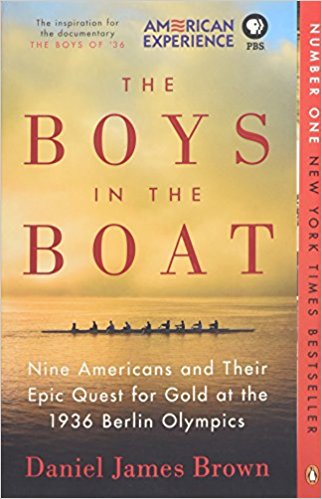
Why this book: I lead a volunteer reading group for young men who are early in the pipeline to become SEALs or SWCCs (Special Warfare Combatant-craft Crewmen). Though it’s longer than most of the books we read (~375pp) they picked this book for us to read and discuss as a group – as it seemed to touch on themes related to the profession they are entering. Over the last several years, a number of people had strongly recommended this book to me, so I welcomed the opportunity.
Summary in 3 sentences: The basic story is how a bunch of working class young men from the University of Washington who had never rowed crew before defeated all other US teams and then to go on to win the 1936 Olympics in Berlin. The story is inspiring, but what makes this book so wonderful is how beautifully the author describes the context – about life in America for the working and out-of-work poor during the depression, about how Nazi Germany used the Berlin Olympics as a propaganda tool to soften criticism of its anti-Semitic policies, about the world of collegiate crew – at the time, one of the most popular sports in America. We closely follow the life and experiences of one member of the crew, and through his perspective and experiences, we learn the science and art of crew racing – the discipline, the pain, the beauty and joy of becoming part of a great team.
My Impressions: This book deserves its great reputation. I loved it. It started a little slow as most great books do, and then built momentum, with great story telling and wonderful style. We all know the end of the story – but I loved reading about how they got there.
It is a very well-told rags-to-reaches story – but about a team, not an individual. I really enjoyed how the author put us into the world of depression-era America, and we sensed the huge gap between the well-to-do and the huge numbers of very poor in America doing that difficult period. The description of life in Seattle and America during the depression was wonderfully told and was a highlight of the book. And we learned about inter-collegiate varsity athletics in that era, especially 8-man crew, and the many difficult decisions a coach has to make. And we learned much about Hitler’s Nazi Germany and the context in which this epic Olympic crew competition took place.
It’s a story of loggers, fishermen, farmers, hard-scrabble young men who had to fight economic hardship and depression-era prejudices against going to colleges, who had to work, scrimp, go without – even food – to stay in college. And of course it’s hard not to enjoy reading how these young men from poor and working class backgrounds beat the well-heeled youth in the more elite schools, whose college educations were financed by their affluent families, and for whom rowing crew was just part of their ticket punching on their way to their rightful positions among the elites of the East Coast.
Much of the story was also about the rivalry between the University of Washington and University of California. Berkeley, then the dominant West Coast crew team. It was interesting to learn that Robert MacNamara and Gregory Peck later rowed crew for Cal.
Boys in the Boat follows the life and experiences of one particular member of the crew – Joe Rantz. We begin during his childhood when some hard luck in an anemic economy pushed Joe’s family from middle class to indigence, in ways that would be hard to imagine today. As a 10 year old boy, young Joe was forced out of his house and family by his stepmother and had to make ends meet on his own. Joe became very independent, learned to deal with hurt and disappointment, to survive on his own wits, to make things happen. He developed a remarkable sense of self-sufficiency, which he later had to learn to let go of, in order to be part of a great team.
We also got to know two other fascinating characters: U of W Coach Al Ulbrickson and crew-boat (or “shell”) builder George Pocock. Coach Ulbrickson was the stern, reserved, unemotional but very competent coach who drove and inspired the team. I was fascinated by how he realized he had a potential gold-medal Olympic crew several years out, and how he intentionally created tension, turmoil and uncertainty within his team to see how they would react, and to help him find the best crew – the combination of talent , heart and chemistry with the best chance to go to the Olympics and win. And he did.
George Pocock built crew shells in the attic of the U of Washington boat house, and his shells were the best in America. But he was also the soul and philosopher of the team. Originally from England, Pocock had an almost spiritual relationship to boats and rowing. When not building crew shells, he quietly observed and subtly influenced the coach and the team. He simply watched and noted, and rarely offered advice, but when he did, it was spot on. As the team matured, the coach and members of the team went more and more to Pocock for his insights. George Pocock was the one who saw the potential in young Joe Rantz and helped him transition from being merely a very strong rower, to a great crew teammate.
For me, a key take-away of Boys in the Boat was the discussion throughout the book of the concept of “swing” – what in crew jargon we today call Group or Team Flow. It is the holy grail in crew – and in any team sport – when everyone on the team has abandoned themselves to the team and its goal. It is ephemeral – it comes and goes, like personal flow, but when it all comes together, it is magical. The best teams get it when everything is on the line. I think of the Chicago Cubs in the last game of the World Series in 2016.
When I discussed this book with the young men who want to be SEALs, we discussed how hard it is to create and hold on to Group Flow, and what might the process be to create the conditions for it. Shared hardship and shared sacrifice over time help identify those who are able to give themselves up to the goals of the team – when conditions are most uncomfortable, and the natural tendency would be for every man to look out primarily for himself. When people hang together and share hardship, and share sacrifice, either they develop mutual trust, or the group disintegrates. In a great group, everyone is committed to the team’s success, not their individual success. Group Flow demands trust – no one holds back, because everyone knows the others aren’t holding back. When a group is in “flow” there is nothing more important to a member of the group than to do their part and more, and that others in the group know that they are giving their all. Everyone in the group abandons themselves to the team and its goal. When all have this view – magic can happen.
Whether you’ve read the book, intend to read the book, or won’t read the book, I recommend the PBS documentary The Boys of ’36. It’s about an hour long and is available on Netflix. It tells the story succinctly and well. It includes many photos and videos of the characters in this book and some of the races, and includes interviews with author Daniel Brown, and others who have written about or have significant knowledge of how this crew became the best 8 man crew in the world.
Some memorable lines I marked as I read the book (page numbers from the paperback copy)
The coach selecting his crew “The trick was to find which few of them had the potential for raw power, the nearly super-human stamina, the indomitable willpower, and the intellectual capacity necessary to master the details of technique. And which of them, coupled improbably with all those other qualities, had the most important one: the ability to disregard his own ambitions, to throw his ego over the gunwales, to leave it swirling in the wake of his shell, and to pull, not just for himself, not just for glory, but for the other boys in the boat.” P 23
The making of a great team “The boys in the Clipper (the name of their boat) had been winnowed down by punishing competition, and in the winnowing a kind of common character had issued forth: they were all skilled, they were all tough, they were all fiercely determined, but they were also all good-hearted. Every one of them had come from humble origins or been humbled by the ravages of the hard times in which they had grown up. Each in his own way, they had all learned that nothing could be taken for granted in life, that for all their strength and good looks and youth, forces were at work in the world that were greater than they. The challenges they had faced together had taught them humility – the need to subsume their individual egos for the sake of the boat as a whole – and humility was the common gateway through which they were able now to come together and begin to do what they had not been able to do before.” p 241
Mental toughness and winning. “To defeat an adversary who was your equal, maybe even your superior, it wasn’t necessarily enough just to give your all from start to finish. You had to master your opponent mentally. When the critical moment in a close race was upon you, you had to know something he did not –that down in your core you still had something in reserve, something you had not yet shown, something that once revealed would make him doubt himself, make him falter just when it counted the most. Like so much in life, crew was partly about confidence, partly about knowing your own heart.” P 106
Swing, or Group Flow “There is a thing that sometimes happens in rowing that is hard to achieve and hard to define. Many crews, even winning crews, never really find it. Others find it but can’t sustain is. It’s called “swing.” It only happens when all eight oarsmen are rowing in such perfect unison that no single action by anyone is out of synch with those of all the others…..Only then will the boat continue to run, unchecked, fluidly and gracefully between pulls of the oars. Only then will it feel as if the boat is part of each of them, moving as if on its own. Only then does pain entirely gives way to exultation. Rowing then becomes a kind of perfect language. Poetry, that’s what a good swing feels like.” P161
It’s not the individual. It’s the team “The sport offers so many opportunities for suffering and so few opportunities for glory that only the most tenaciously self-reliant and self –motivated are likely to succeed at it. And yet, at the same time – and this is key – no other sport demands and rewards the complete abandonment of the self the way that rowing does. Great crews may have men or women of exceptional talent or strength; they may have outstanding coxswains or stroke oars, or bowmen; but they have no stars. The team effort – the perfectly synchronized flow of muscle, oars, boat, and water; the single, whole, unified, and beautiful symphony that a crew in motion becomes – is all that matters. Not the individual, not the self.” P 179
The importance of diversity in a great team. “And capitalizing on diversity is perhaps even more important when it comes to the characters of the oarsmen. A crew composed entirely of eight amped-up, overtly aggressive oarsmen will often degenerate into a dysfunctional brawl in a boat or exhaust itself in the first leg of a long race. Similarly, a boatload of quiet but strong introverts may never find the common core of fiery resolve that causes the boat to explode past its competitors when all seems lost. Good crews are good blends of personalities: someone to lead the charge, someone to hold something in reserve; someone to pick a fight, someone to make peace; someone to think things through, someone to charge ahead without thinking.” P179
The power of trust “(Pocock) told Joe to be careful not to miss his chance. He reminded him that he’d already learned to row past pain, past exhaustion, past the voice that told him it couldn’t be done…he concluded with a remark that Joe would never forget. ‘Joe, when you really start trusting those other boys, you will feel a power at work within you that is far beyond anything you’ve ever imagined. Sometimes, you will feel as if you have rowed right off the planet and are rowing among the stars.’”p235
Trusting is a challenge for the independent man “For Joe, who had spent the last six years doggedly making his own way in the world, who had forged his identity on stoic self-reliance, nothing was more frightening than allowing hmslf to depend on others. People let you down. People leave you behind. Depending on people, trusting them –it’s what gets you hurt.” P 237
On total trust at the key moment “… Joe realized with startling clarity that there was nothing more he could do to win the race, beyond what he was already doing. Except for one thing. He could finally abandon all doubt, trust absolutely without reservation that he and the boy in front of him and the boys behind him would all do precisely what they needed to do at precisely the instant they needed to do it. He had known in that instant that there could be no hesitation, no shred of indecision. He had had no choice but to throw himself into each stroke as if he were throwing himself off of a cliff into a void, with unquestioned faith that the others would be there to save him from catching the whole weight of the shell on his blade….he had done it.. he had hurled himself blindly into his future, not just believing but knowing that the other boys would be there for him, all of them, moment by precious moment. “ p355


 Bob's Books
Pingback: Book Review: The Boys in the Boat by Daniel James Brown (5/5) | Taking On a World of Words