
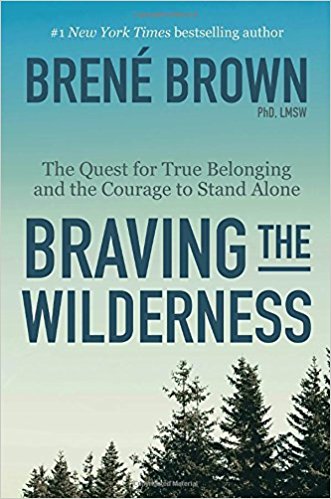
 Why this book: It was selected by the All American Leadership Faculty Reading group I belong to.
Summary in 4 sentences: The subtitle to this book is “The Quest for True Belonging and the Courage to Stand Alone” which sums up the main theme of this book. Brene Brown takes a “deep dive” into our need to feel connected to other people and social groups, and something greater than ourselves. She also explores the seeming contradictory need to stand apart from our chosen group(s) for what we believe in, when the group is going in different directions. This standing alone is the metaphorical “wilderness” – and it takes courage to be truly authentic, to leave the comfort of the group to go there, often alone, in order to live with honesty, courage and integrity.
My Impressions: Brene Brown begins with her own experiences as a child desperately wanting to “belong” and be a member of a group, and her emotional disappointments when that didn’t work out. In this book she explores this very human social impulse while also exploring its opposite – the need to stand apart from a group and be independent – to NOT be part of a group. As she says in the title, “The Quest for True Belonging and the Courage to Stand Alone.” This book explores that contradiction and what it means to truly belong.
She refers several times in the book to a quote by Maya Angelou:
You are only free when you realize you belong no place – you belong every place – no place at all. The price is high. The reward is great.
For a long time, this quote baffled her – she was so drawn to the need to belong, the idea of not belonging being a positive was anathema. But as she got older, she found that she had a voice, opinions, and an identity apart from any group, and that to feel fulfilled, she had to express herself, often with perspectives that her group did not agree with. She came to understand and agree with Maya Angelou’s “you belong every place, – no place at all.” Often, it is best to stand is apart from the group – when what you believe and stand for is different from what the group stands for. And she identifies this standing alone, with no or little social support, as “the wilderness.” In much of this book, Brown talks about the high price of standing alone, but also the great rewards…
“True Belonging” she says in her book is a belonging that leaves room for people to feel free to express their differences. True Belonging is built on the many things those in a group have in common, and accepts that there is room for disagreement and differences. “Fitting in” on the other hand, is compromising oneself in order to “fit.” It is taking the need to belong to an excess, in which one is willing to compromise one’s personal values and integrity on the alter of belonging and social approval. She goes to great pains to distinguish True Belonging from “fitting in.”
True belonging is not passive…..It’s not fitting in or pretending, or selling out because it’s safer. It’s a practice that requires us to be vulnerable, get uncomfortable, and learn how to be present with people without sacrificing who we are. We want true belonging, but it takes tremendous courage to knowingly walk into hard moments. p 37
TRUST is a key ingredient in True Belonging. If we are willing to make ourselves vulnerable in a group we belong to truly, then there has to be a strong element of trust. She uses a definition from Charles Feltman of trust, as “choosing to risk making something you value vulnerable to another person’s actions,” and distrust as feeling unsafe making oneself, or something one values vulnerable. And she goes on to offer ingredients of what is included in trusting others, and what trusting oneself looks like.
She also notes how it is a natural tendency in a complex society to categorize people and sort them into boxes with convenient labels. She calls this “sorting.” This makes people easy to deal with, but also denies them their humanity and uniqueness. It is a lazy step that we need to be aware of and avoid.
She breaks True Belonging into four elements, and each of these elements gets a chapter. These are the four elements and chapters:
- People are Hard to Hate Close Up. Move In. In this chapter she talks about our common basic humanity that is denied when we hate. Hate is part of a dehumanization process that she notes is insidious and to which we are all vulnerable. She looks at ways to “navigate conflicts or differences of opinion in a way that deepens mutual understanding, even if two people disagree.” Getting to know, and looking for commonality with people we hate, or disagree with us strongly, helps us to humanize them, and to eventually find (some) common ground. This humanizes us, and reduces unnecessary friction in our efforts to find True Belonging.
- Speak Truth to Bullshit. Be Civil. She distinguishes BS from lying and says that BS is worse – it doesn’t even respect that there is an untruth being told. BS is a tool most of us to one degree or another use when “working from a place of fear, acute emotion, and lack of knowledge.” We make stuff up to make ourselves look better than we are, or to avoid dealing with unpleasant or inconvenient truths. To the bullshitter, “The truth doesn’t matter, what I think matters.” Or how you perceive me and my version of the truth matters more than the truth. And part of what makes BS so problematic is that, “The amount of energy needed to refute bullshit is an order of magnitude bigger than to produce it.”
Civility is dealing with people in a way that respects them and avoids disrespect, seeking common ground as a starting point. This chapter also gets into the courage to speak truth to power – which also demands standing alone “in the wilderness,” since so few will do it. When we give unpleasant truths to power, people move away from us, and there can be considerable risk. (I don’t believe she explores this adequately – see comments below.)
- Hold Hands. With Strangers. My favorite chapter in the book. She points out how certain events, music, common beliefs and even tragedies seem to break down all barriers between people, and create a sense of connection and community that we all recognize and revere. She gives numerous examples, and highlights these brief encounters with our common humanity as having more meaning than we often give them credit for. These experiences have been called “collective assembly.” Think of the city of Philadelphia after the 4 Feb Super Bowl!
Then she identifies and refutes what she calls “common enemy intimacy” – the apparent intimacy borne of having a common enemy or foe. This is a fake connection – feels good for the moment but has no real substance and is based on anger, hate, jealousy, envy, dehumanization, or other negative emotions. Common enemy intimacy can be intoxicating, but leaves a hangover.
In response to the tsunami of social media “connections,” she points out how face-to-face connections are imperative in a True Belonging culture. She points out that touching, eye-contact, other forms of in-close contact lower cortisol, and increase dopamine (and oxytocin!) “Social media are great for developing community, but true belonging, real connection and real empathy require meeting real people in a real space in real time.” p141
I will add that there is a spectrum of connectedness. Going beyond even face-to-face connection is in-person shared hardship, shared sacrifice, 24/7, over an extended period. This can be physical, emotional, or mental/intellectual hardship. This is how and why military combat units often achieve the level of True Belonging that she seeks, and which so many veterans miss when they leave the military. We also achieve a pretty authentic level of True Belonging on NOLS expeditions. (I am indebted to Rick Rochelle for this insight.)
- Strong Back, Soft Front, Wild Heart. She makes these almost a progression, though I sense they could evolve in parallel. First we become strong enough to deal with the assaults on our dignity and values as we develop the courage to stand alone for what we believe, and what is right. The strong back permits the “soft front” to be vulnerable and caring – to be willing to let ourselves be hurt or disappointed or demeaned when we reach out to others or make ourselves vulnerable. When that happens, we rely on our strong back to carry on. The “wild heart” is that part of us which is free and willing to break with conformity and orthodoxy. She emphasizes gratitude as the key to joy – and gratitude is a key value of those with a strong back, soft front, wild heart. “The goal is to get to the place where we can think, I am aware of what’s happening, the part I play, and how I can make it better, and that doesn’t mean I have to deny the joy in my life.“
In this chapter, I really liked how she refers to the loneliness of the metaphorical walk to the wilderness, but once one gets there, and makes oneself at home there, one finds that “The wilderness is where all the creatives and prophets and system-buckers and risk takers have always lived, and it is stunningly vibrant. The walk out there is hard, but the authenticity out there is life.” p152 (Bob’s comment: And there can be some real big egos out there as well!)
ADDITIONAL COMMENTS:
- Whistle Blowers? I felt that she could have used whistle blowers as a prime example of standing alone and Braving the Wilderness. She must have chosen not to. These people KNOW that they will be ostracized, lose their jobs, and become very isolated for their courage. Whistle blowers often know that their job and livelihood may be the high price (in the words of Maya Angelou,) and the reward may only be a sense of moral rectitude. Whistle blowers really put her Braving the Wilderness metaphor into perspective. It really takes courage for whistle blowers to go into the wilderness, up against corporate America, to stand alone against a well-armed adversary. Or in the Navy SEAL vernacular, it’s like heading into a gunfight wielding only a knife.
- Moral Courage? I felt that “standing alone” was very much about what we used to teach in ethics classes as “moral courage.” This is very much related to the whistle blower issue I raise above. Having the courage to stand up for and be willing to sacrifice for values that are important to you. This is a huge topic that is relevant in so many arenas. She missed an opportunity to explore it just a bit more. I believe she gave it short shrift.
- Pick your battles. Following this last point, there are times when it is foolish to take one’s stand against the crowd, depending on the issue and the stakes. In a book I used to use in my Business Ethics class – Defining Moments, Joe Badaracco makes the point that in order to have influence in an organization, in order to have a greater positive and long-term impact, one has to pick one’s battles. One also has to know HOW to take a stand, while also protecting oneself, one’s other values and other stakeholders in the organization. Knowing when, how, and for what to step out and stand alone is a very important political skill in judgment that is necessary to achieve influence and make a positive difference in any organization. Every politician knows this – the good ones and the bad ones.
- Very much a woman’s approach. This is not a criticism, just an observation. There were times I felt that she was a woman writing largely for women, or very sensitive men, which I am not. (I’m sure women are very familiar with this feeling, when reading books written by men.) Though I really liked her insights and recommendations, sometimes I felt like I had to translate her message into terms that would work for the insensitive macho dude that I am. For example at one point I asked myself if she really felt that we have to justify feeling joy, when there is so much pain in the world? The Nietzschean in me doesn’t buy it. Feel empathy, be sympathetic, but for God’s sake don’t feel guilty! She notes that “A wild heart is awake to the pain in the world, but does not diminish its own pain” p157 She is clearly an intelligent, thoughtful and sensitive woman and I like her. But her approach was a bit more sensitive than this Navy SEAL was comfortable with. (Note: My good friend Yolla suggested that my objection is not to Brown’s “woman’s” approach, but perhaps to Brown’s “feminine” approach. This is a reasonable distinction, since there are certainly women who would share my perspective.)
- Other related theories. Not a shortcoming, just an observation. In our AAL discussion of this book, we identified two other well known theories that have a bearing on the issue of if/when/how to stand up for one’s values against the crowd. One is Kohlberg’s theory of moral development, in which he claims that most people derive their values from their culture and their social groups , and only a very few evolve to where they believe and act on what they have reasoned is right – and are willing to accept the consequences of standing alone against the crowd for these beliefs. This is the highest level of moral evolution – and Gandhi, Martin Luther King, Lincoln were all assassinated – which highlights the courage and risk of going into the wilderness.
The other theory is Maslow’s hierarchy of needs, and her stand-alone-for-True Belonging person appears to have risen to the highest self-actualizing stage, whereas “belonging” – or in this sense, “fitting in,” is well down that hierarchy. Brown is pushing us to climb Maslow’s ladder to the top. (I am indebted to Jack Altshuler for this insight.)
An interesting book and we had a lively and interesting discussion. Highly recommended for a professional reading group.


 Bob's Books