
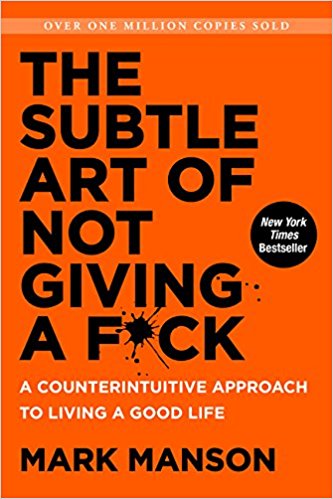
 Why this book: It was given to me as a gift by a very good friend. I was intrigued and so gave it a try. I was surprised at how good it is!
Summary in 3 Sentences: I have described this book as the wisdom of the ages, packaged in the snarky, irreverent language of popular culture that makes it fun, accessible and meaningful to Gen Xers and Yers, and old guys like me. The chapter titles tell you its a bit more serious than its title would indicate, but the stories are funny, personal, filled with profanity and bawdy vignettes that will keep young-at-heart people amused and engaged. But the point of the book is powerful – in order to live well in this society, no matter how young, cool, and urbane one might be, there are certain perspectives and rules that are important to understand, and knowing when, and for what one should “give a f*ck” is very important.
My impressions: Loved the book! Started it with low expectations but was soon amazed at how profound it was – but told with bawdy humor, a conversational style, and sympathy for the challenges of being a young adult in today’s America. Mark Manson has done and seen a lot in his thirty-something years – and much of it was in the school of hard knocks. And he shares with us some funny, self-deprecating stories about how learned his hard lessons.
He offers some hard and unpleasant truths that a lot of millennials and Gen Xers are too busy having fun, too focused on the trivialities of today’s problems to readily recognize and act on. But his approach should reach them – and some old timers as well. He offers these very serious truths in fun language and supported by engaging vignettes – mostly from his own experience – that make his insights and wisdom very accessible. I’ve told my friends that many of his Truths are reflections of Aristotle, Stoicism, Existentialism, Buddhism and other more esoteric philosophies, but apart from a brief story from Buddhism, these philosophies are never mentioned. Which is a plus, for the audience he seeks to reach.
It’s as if this millennial guy goes out into today’s world, does whatever feels good, gets knocked around, has his own identity crisis, tries to figure out what he’s learned from this school of hard knocks, and discovers in today’s context what wise people have been saying for millennia. And he shares it with us in today’s vernacular and cultural context. The chapter titles give an indication that this is indeed a more serious book: You Are Not Special; The Value of Suffering; You’re Wrong About Everything; Failure is the Way Forward; ….And Then You Die.
But the secret sauce of this book is how he imparts the wisdom of the ages, through his crazy stories, his snarky, irreverent, and occasionally bawdy humor, and his engaging style of writing.
IF you happen to want more of what I got out of Mark Manson’s “…Not giving a F*ck,” I wrote the below chapter summaries. I wrote them for my benefit – to review and grab hold of some of the key insights in each chapter, and to be there for me to review later. And I happen to be on vacation as I write this, and so I have the time (this is the kind stuff I like to do on vacation!) But here they are, for any reader’s benefit, if you’re interested and want to take the time:
Chapter 1. Don’t Try. This chapter introduces the book, and makes the point that often, the more we strive for success, the more elusive success becomes. Because many people want it to come easily and define success as having something, rather than doing something, a goal, rather than a process. He makes the point that it is an illusion to think we can achieve happiness without negative experiences. “Everything worthwhile in life is won through surmounting the associated negative experience.” “The desire for more positive experiences is itself a negative experience. And, paradoxically, the acceptance of one’s negative experience is itself a positive experience.” He talks about choosing what to give a fuck about, noting that fucks not given (about things that don’t really matter) can be a very important part of success and happiness. He introduces the idea of the “feedback loop from hell” – worrying about worrying, feeling guilty about feeling guilty, feeling bad about feeling bad.
Chapter 2. Happiness Is a Problem. This chapter starts out with the story of Gautama Buddha, told in the cool-guy vernacular of the 21st century, to open the door to the Buddha’s insight that life is suffering and happiness is a problem. “Happiness is not a solvable equation. Dissatisfaction and unease are inherent parts of human nature and necessary components to creating consistent happiness.” “Suffering is biologically useful. It is nature’s preferred agent for inspiring change.” “Happiness comes from solving problems…Happiness is a constant work-in-progress, because solving problems is a constant work-in-progress – the solution to today’s problem will lay the foundation for tomorrow’s problems. True happiness occurs only when you find the problems you enjoy having and enjoy solving.” “Solve problems; be happy.”
In this chapter he lights into the culture of denial and victimhood, and tells us to “Choose your struggle.” He asks a profound question: “What pain do you want in your life? What are you willing to struggle for? Because that seems to be a greater determinant of how our lives turn out.” “Happiness requires struggle.”
Chapter 3. You are Not Special. He ridicules the “high self-esteem” movement that tries to make kids feel special and good about their lack of achievement. Such kids often develop into adults who feel entitled to happiness, and an overwhelming need to feel good about themselves. “It turns out that adversity and failure are actually useful and even necessary for developing strong-minded and successful adults.” “The true measure of self-worth is not how a person feels about her positive experiences, but rather how she feels about her negative experiences.”
I loved the section he entitles “the tyranny of exceptionalism,” which highlights how we equate success in life to fame and high achievement. He points out that we are too often told to believe that we are each exceptional and deserve greatness! But he points out that most of us are in fact, average or below average in most things, and once we learn to accept that, we can enjoy the simple pleasures in life and relieve ourselves of the burden of feeling like a failure because we didn’t make a billion dollars, or become a super-star, or a famous celebrity.
Chapter 4.The Value of Suffering. He begins this chapter with the story of the Japanese soldier who would not surrender and continued to wage war for the empire from the jungles of the Philippines until he was convinced to “surrender” in 1972. An amazing tale of suffering. He introduces the concept of the “self-awareness onion” in this chapter, noting that it begins with knowing how you feel, and what makes you feel that way, then an ability to ask why you feel that way, and then an ability to identify the values, priorities and standards that are the basis of your emotions. He notes that most people do this poorly, and simply choose to blame others and external circumstances for their disappointments. Then they get back to simply chasing the next high, and the one after that, never generating true happiness.
He concludes the chapter with “When we have poor values – that is, poor standards we set for ourselves and others – we are essentially giving fucks about things that don’t matter, things that in fact make our life worse….”This in a nutshell, is what “self-improvement” is really about: prioritizing better values, choosing better things to give a fuck about. Because when you give better fucks, you get better problems. And when you get better problems, you get a better life.”
Chapter 5. You are Always Choosing. Great line in this chapter: “There is a simple realization from which all personal improvement and growth emerges. This is the realization that we, individually, are responsible for everything in our lives, no matter the external circumstances.” Consistent with his snarky way of making his points, Manson states, “Even if you get run over by a clown car and pissed on by a busload of schoolchildren, it’s still your responsibility to interpret the meaning of the event and choose a response….The point is, we are always choosing, whether we recognize it or not. Always.”
He distinguishes between being responsible for a problem and being at fault for a problem. “We are responsible for experiences that aren’t our fault all the time. This is part of life…Fault is past tense. Responsibility is present tense.” I love the way he expresses this classic existentialist AND Stoic approach to life. “Many people may be to blame for your unhappiness, but nobody is ever responsible for your unhappiness but you.”
In this chapter he takes on “Victimhood Chic” in which the media, social media, and public charities reward victims with ever-growing outpourings of emotional and other support. People who want free attention and love and support need merely portray themselves as victims of…whatever. So “People get addicted to feeling offended all the time because it gives them a high; being self-righteous and morally superior feels good.”
He concludes with this simple advice: “You are always choosing, in every moment of every day, what to give a fuck about, so change is as simple as choosing to give a fuck about something else.”
Chapter 6. You’re Wrong About Everything (But so am I) This is a great chapter. In it, Manson offers his version of (Carol Dweck’s) Growth Mindset and then reinforces his point by reminding us to take responsibility for ourselves. “Well, I’m always wrong about everything, over and over and over again, and that’s why my life improves….Growth is an endlessly iterative process….When we learn something new, we don’t go from “wrong” to “right.” Rather we go from wrong to slightly less wrong.” He goes on to say, “Certainty is the enemy of growth..Instead of striving for certainty, we should be in constant search of doubt: doubt about our own beliefs, doubt about our own feelings, doubt about what the future may hold for us, unless we get out there and create it for ourselves….Being wrong opens us up to the possibility of change.” I would say being willing to admit to, and accept being wrong…
He warns us not to trust our memories and how we perceive what has happened to us, and what we have learned from it. “…perhaps the answer is to trust ourselves less…If we’re all wrong, all the time, then isn’t self-skepticism and the rigorous challenging of our own beliefs and assumptions the only logical route to progress?” “Uncertainty is the root of all progress and growth. We cannot learn anything without first not knowing something.” And he includes being uncertain of our own values and life priorities – which opens the door to questioning, examining, and then improving them.
He concludes this great chapter with “I try to live with few rules, but one that I’ve adopted over the years is this: if it’s down to me being screwed up, or everybody else being screwed up, it is far, far, far more likely that I’m the one who’s screwed up….That’s simple reality: if it feels like it’s you versus the world, chances are it’s really just you versus yourself.”
Chapter 7. Failure is the Way Forward. Manson reiterates a well-known truth that many do not really understand. Again, I’m familiar with this approach from my work with Carol Dweck’s Mindset which makes the same point that in order to grow and get better at anything, failure is necessary. “Improvement at anything is based on thousands of tiny failures, and the magnitude of your success is based on how many times you’ve failed at something….Avoiding failure is something we learn at some later point in life.” “Life is about not knowing, and doing something anyway. All of life is like this.” He has a section entitled the “do something” principle which says “Don’t just sit there. Do something. The answers will follow.” and “Action isn’t just the effect of motivation; it’s also the cause of it.” Remember the old saw: Inspiration+motivation ->Desirable results? He reshuffles that into: Action ->inspiration -> motivation. He concludes with the following: “If we follow the “do something” principle, failure feels unimportant. When the standard of success becomes merely acting – when any result is regarded as progress and important, when inspiration is seen as a reward rather than a prerequisite – we propel ourselves ahead. We feel free to fail, and that failure moves us forward.” (Note- this is obviously written for people who fail to act out of fear of failure, or simply lethargy. There is also a lot to be said about careful planning, which is also a form of action.)
Chapter 8. The Importance of Saying No. In this chapter he makes the point that being happy means eventually learning that less can be more. This is where he talks about NOT giving F*cks – figuratively and literally, since he does address excessive sex and “cheating” in this chapter as well. “As with most excesses in life, you have to drown yourself in them to realize that they don’t make you happy.” On Trust: “Without conflict, there can be no trust. Conflict exists to show us who is there for us unconditionally and who is just there for the benefits.”
We learn about having to limit our own freedom and he introduces the paradox of choice. “Basically, the more options we’re given, the less satisfied we become with whatever we choose, because we’re aware of all the other options we’re potentially forfeiting.” He addresses what is a touchy subject for millennials – commitment. He has a section entitled “Freedom through Commitment” in which he makes the point that commitment – really giving a f*ck about something or someone – necessarily narrows our focus and energy, but can yield us so much more. “…The rejection of alternatives liberates us – rejection of what does not align with our most important values, with our chosen metrics, rejection of the constant pursuit of breadth without depth….But depth is where the gold is buried.”
Chapter 9. …And Then You Die This is a great concluding chapter, again, like the question of commitment, addressing a subject many millennials choose to look away from. And he puts a positive spin on it. “Yet, in a bizarre, backwards way, death is the light by which the shadow of all of life’s meaning is measured. Without death, everything would feel inconsequential, all experience arbitrary, all metrics and values suddenly zero.” This reminds me of the quote from the movie Troy in which Brad Pitt (Achilles) says, “The gods envy us. They envy us because we’re mortal, because any moment may be our last. Everything is more beautiful because we’re doomed. You will never be lovelier than you are now. We will never be here again.” He has a section in this chapter he calls, “The Sunny side of Death” in which he offers a different perspective on what terrifies most of us.
He quotes Ernest Becker in referring to what he calls our “immortality projects” by which we seek to live on – in our legacy, our various projects, art, the things we build to last. All of civilization he claims, is an immortality project. There is a dark side to immortality projects as well, in that war and conquest, and crazy egomaniacal projects are also immortality projects. Once we become comfortable with the idea of our own death, we can pick values that are not burdened by the “illogical quest for immortality.” Getting that glimpse of something greater and unknowable than ourselves is part of what death offers us.
A sense of entitlement distracts us from the realization that we are a “mere side process of some great unintelligible production.” Manson points out how feeling entitled takes our view away from the wonder and the unknowable. “The gravity of entitlement sucks all attention inward, toward ourselves causing us to feel as though we are at the center of all of the problems in the universe…..” He quotes Charles Bukowski, “We’re all going to die, all of us. What a circus! That alone should make us love each other but it doesn’t. We are terrorized and flattened by life’s trivialities; we are eaten up by nothing.”
He concludes this chapter, and the book on the edge of a cliff overlooking the ocean, feeling very glad to be alive, and quietly, calmly waiting for his friends to join him.


 Bob's Books