
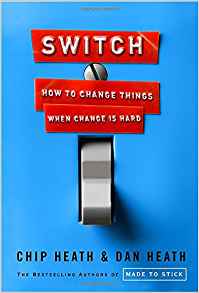
 Why this book: Selected by TWO reading groups I am part of: All American Leadership’s Open Reading Group and Naval Special Warfare Center’s Commodore’s Reading Group.
Summary in 3 Sentences: Chip and Dan Heath look at the impediments to change – in organizations, but also in each of us as individuals, and they provide straightforward insights from their research to help leaders change the culture of their organization by changing people’s behavior. To bring about lasting change, the leader must engage the people in their organization in three dimensions: The Head (reason &rationality), The Heart (feeling & desire), and The Environment (the context in which decisions are made) – though the Heaths use a different metaphor for each of these. The authors offer numerous compelling examples and case studies to make their case, and the book is written to be enjoyable, impactful and relatively easy and straightforward to read.
My Impressions: Bottom Line Up Front: I didn’t read any ideas in this book that I hadn’t seen elsewhere, but the authors did a brilliant job bringing together a broad array of insights into human behavior into a coherent easy to understand whole. I’ve already strongly recommended this book to several leaders I know who are trying to positively influence the cultures in the organizations they lead. Ideally this book would be read by several people in the leadership team of an organization, and used as a common framework to consider steps that might make a positive difference in their organization.
The Heath brothers use a metaphor they borrowed from the book The Happiness Hypothesis, which models our decisions based on the analogy of an elephant, its rider and the path the elephant and rider are travelling. The rider represents reason and rationality, which needs to know and understand the why, the how, and the variables in a decision. The informed rider then guides the elephant, which represents our feelings, emotions, and inclinations. Appropriately enough, the elephant (emotions) is much bigger and stronger than the rider (reason & rationality.) The path on which the rider and the elephant are traveling represents the context in which we are acting. The book makes the point that the nature of the path often drives decisions that the rider chooses, and whether the elephant will choose to comply, or not.
Each of these aspects of our decision making gets a full section of the book, and each section is subdivided into three chapters: The section entitled “Direct the Driver” includes “Find the Bright Spots,” “Script the Critical Moves,” and “Point to the Destination.” The section entitled “Motivate the Elephant” includes “Find the Feeling,” “Shrink the Change,” and “Grow your People.” The final section, “Shape the Path” includes: ”Tweak the Environment,” ”Build Habits,” and “Rally the Herd.”
Switch makes the point that way too many leaders try to institute changes by primarily speaking to “the rider” – the intellect – that is, by offering reasons and justifications for what needs to change, believing that is all people need in order to act. These leaders ignore the reality that people’s decisions and actions over the long run are primarily driven by emotional motivations. Most of us put energy into what engages our emotions and desires, much more so than simply doing what someone has convinced us we ought to do. The Heath brothers don’t discount the need to explain why and provide direction and specific goals that make sense – in fact they insist this is necessary. But it isn’t enough to make a long term difference.
Direct the Rider (clarify the situation and do what makes sense) There is a fair amount of Simon Sinek in this section – in how they identify the need to explain why, and give direction, clarify goals. They also make the point that general goals are ineffective – leaders need to script very specific actions that will become the basis for change. The chapter on finding the bright spots, asks the simple question: “What’s working now and how can we do more of it?” And it suggests that leaders find and exploit an organization’s “positive deviants” – those who are doing well in spite of all the issues that need to be changed or fixed. Echoes of Appreciative Inquiry and Now Discovery your Strengths.
Motivate the Elephant (Engage the heart and feeling) This section did well in reinforcing a point that most of us know – that to institute change, leaders must engage peoples hearts and emotions – and without that, explanations, rationality and dispassionate understanding won’t create much momentum. I thought the chapters “Shrink the Change” and “Grow Your People” were excellent in their practical wisdom. Shrink the change gives multiple examples of creating big change with small steps. Grow your people gives multiple examples of inspiring people to do much more than they believe they are capabler of.
Shape the Path (tweaking the environment) In the final section he explores how research shows that people’s behavior is largely driven by what their environment encourages and rewards. This insight I keep seeing again and again – and the Heath brothers refer to the Fundamental Attribution Problem that blames bad behavior on bad character, rather assigning any responsibility to an environment that often (intentionally or unintentionally) incentivizes and facilitates bad behavior. Part of me resists this dodging of personal accountability, but I have come to recognize the reality that most people – including yours truly – are much more likely to do “the right thing” or behave in a manner that supports larger objectives in an environment which encourages the desired behavior. If I’m hungry, and all there is to eat are donuts and sweet rolls, and no fruit or vegetables, I’ll eat donuts and sweet rolls. But just put out fruit and vegetables, and I’ll eat F&V. Give me both, and I’ll usually eat the F&V (but not always!) “Shape the Path” shares insights from the book Nudge which offers many examples of how leaders have changed the environment to help people make good decisions they may not make on their own.
I really liked this book in its simple and well-articulated combining of insights from a variety of sources into practical guidance. A companion book, that reinforces from a somewhat different direction many of the insights in Switch is Daniel Coyle’s The Culture Code.
———————————-
Below are some of the insights and quotes I found most interesting (page numbers from the 2010 hardcover edition):
To change behavior, you’ve got to direct the Rider, motivate the Elephant, and shape the Path. If you an do all three at once, dramatic change can happen, even if you don’t have lots of power or resources behind you. 19
Will power is a limited resource. Making decisions, especially important or difficult decisions use up that limited reservoir of strength of will. 50
Decision Paralysis – the more options we have, even good ones, the more exhausted we get. Choice no longer liberates, it can debilitate. The so-what: Make important decisions when we’re fresh; protect key decision makers from decisions they don’t need to make, in order to preserve that reservoir of decision making energy for the important stuff. 50-51
Ambiguity and Uncertainty can also paralyze. These can be enemies of change – since in the face of ambiguity and uncertainty, we usually take the most familiar path – the path of least resistence – which almost always is the status quo. 52-53
I loved the abbreviation “TBU” True But Useless – information that merely confuses an issue and doesn’t help find a solution. 28
Knowledge alone does not change behavior. 30
Solutions-focused therapy– doesn’t focus on what got us here. It focuses on what we need to do to change. These therapists use the Miracle Question – “Suppose you go to bed tonight and sleep well. Sometime in the middle of the night, while you were sleeping, a miracle happens and all of the troubles that brought you here were resolved. When you wake up, what’s the first small sign you’d see that would make you think, “Well, something good must have happened?” What would that look like, and what do we need to do to take that small step toward getting to a solution? 34-36
Exception Question – when was the last time things were working for you – what was happening? What did that look and feel like? How did you behave? 38
Any successful change requires the translation of ambiguous goals into concrete behaviors. In short, to make a switch, you need to script the critical moves. 54
That’s why scripting is important- you’ve got to think about the specific behavior that you’d want to see in a tough moment. 56
Until you can ladder your way down from a change idea to a specific behavior, you’re not ready to lead a switch. 63
(They) succeeded by formulating solutions that were strikingly smaller than the problems they were intended to solve 71
SMART goals presume the emotion; they don’t generate it. 82
Destination postcards – pictures of a future that hard work can make possible – can be incredibly inspiring. 85
If you’re worried about the possibility of rationalizations… you need to squeeze ambiguity from your goal. You need a black-and-white goal..an all-or-nothing goal… (which) leaves nowhere to hide 86-87
When you’re at the beginning, don’t obsess about the middle, because the middle is going to look different once you get there. Just look for a strong beginning and a strong ending and get moving. 93
(from The Heart of Change) In highly successful change efforts, people find ways to help others see the problems or solutions in ways that influence emotions, not just thought. 105
Trying to fight inertia and indifference with analytical arguments is like tossing a fire extinguisher to someone who’s drowning. The solution doesn’t match the problem. 107
When people fail to change, it’s not usually because of an understanding problem. …We know there’s a difference between knowing how to act and being motivated to act. 112
We’re all lousy self-evaluators….. (over-estimating our capabilities) is known as positive illusion. Positive Illusions pose an enormous problem with regard to change. 114-115
Attila the Accountant was meticulous about following the rules to a fault. 115
Negative emotions tend to have a “narrowing effect” on our thoughts.
Positive emotions are designed to broaden and build our repertoire of thoughts and actions. Joy for example, makes us want to play. 122
People find it more motivating to be partly finished with a longer journey than to be at the starting gate of a shorter one….One way to motivate action is to make people feel as though they’re already closer to the finish line than they might have thought. 127
The sense of progress is critical, because the Elephant in us is easily demoralized. It’s easily spooked….It needs reassurance, even for the very first step of the journey. 129
Starting an unpleasant task is always worse than continuing it. 131
Another way to shrink change is to think of small wins. 136
When you engineer early successes, what you’re really doing is engineering hope. Hope is precious to a change effort. It’s Elephant fuel. 141
You want to select small wins that have two traits: (1) They’re meaningful. (2) They’re “within immediate reach.” 145
When people make choices, they tend to rely on one of two basic models of decision making: the consequences model or the identity model. 153
We’re not just born with an identity; we adopt identities throughout our lives. 153-54
Any change effort that violates someone’s identity is likely doomed to failure. 154
Their little-yes seemed to pave the way for the big-yes. 159
…he may become in his own eyes, the kind of person who does this sort of thing..who takes action on things he believes in, who cooperates with good causes. 160
It shows us that peole are receptive to developing new identities, that identities “grow” from small beginnings. 161
Everything is hard before it is easy. 166
To create and sustain change, you’ve got to act more like a coach and less like a scorekeeper. 168
IDEO designers sketched out a project mood chart that predicts how people will feel at different phases of a project. It’s a U-shaped curve with a peak of positive emotion , labeled “hope,” at the beginning, and a second peak of positive emotion, labeled “confidence,” at the end. In between the two peaks is a negative emotional valley labeled “insight.”168
They are creating the expectation of failure …because what comes next is hardship and toil and frustration. 169
You can shrink the change, or grow your people (or, preferably, both). 176
What looks like a person problem is often a situation problem. 180
…people have a systematic tendency to ignore the situational forces that shape other people’s behavior… this deep rooted tendency is the “Fundamental Attribution Error.” The error lies in our inclination to attributer people’s behavior to the way they are rather than to the situation they are in. 180 (Bob’s note: It is obviously some of both, depending on the individual, how strong their character, beliefs, values vs environmental and contextual pressure.)
Tweaking the environment is about making the right behavior a little bit easier and the wrong behaviors a little bit harder. 183
If you change the path, you’ll change the behavior. 185
You know you’ve got a smart solution when everyone hates it and it still works – and in fact works so well that people’s hate turns to enthusiasm. 190
What looks like a “character problem” is often correctible when you change the environment. 202
Why are habits so important? They are, in essence, behavioral autopilot. They allow lots of good behaviors to happen without the Rider taking charge. Remember that the Rider’s sefl-control is exhaustible, so it’s a huge plus if some positive things can happen “free” on autopilot 207
An “action trigger” (is when) you’ve made a decision to execute a certain action when you encounter a certain situational trigger. (Bob’s note: much combat training is about creating automatic action triggers.)
Preloading a decision… is passing the control of our behavior on to the environment… protecting goals from tempting distractions, bad habits, or competing goals. 210
How to shape the Path… two strategies: (1) tweaking the environment and (2) building habits. There’s a tool that perfectly combines these two strategies.. the humble checklist. 220
Check lists can help people avoid blind spots in a complex environment. 221
It’s easier to persevere on a long journey when you’re traveling with a herd. 224
In ambiguous situations…people look to others for cues about how to interpret the event. 226
In situations where your herd has embraced the right behavior, publicize it. 229
Change was coming into conflict with culture, and let’s face it, a new rule is no match for a culture. 244
Researchers who study social movements call situations like this “free spaces” – small scale meetings where reformers can gather and ready themselves for collective action, without being observed by members of the dominant group. 246
If you want to change the culture of your organization, you’ve got to get the reformers together. They need a free space….(and) Counterintuitively, you’ve got to let your organization have an identity conflict. 247
Animal trainers rarely use punishment these days… instead they set a behavioral destination and then use “approximations,” meaning that there reward each tiny step toward the destination. 251
Change isn’t an event; it’s a process. 253
Inertia may be a formidable opponent in the early going of your sewitch, at some point inertia will shift from resisting change to supporting it. Small changes can snowball to big changes. 255


 Bob's Books