
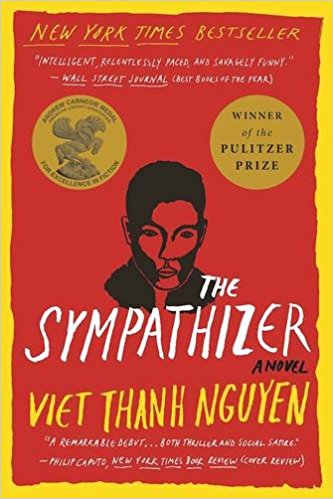
 Why this book: Selected by my literature reading group, based on a strong recommendation from a friend of mine, and its Pulitzer Prize for fiction, 2016. My literature group is on a roll with great Pulitzer Prize-winning fiction.
Summary in 3 Sentences: Written in the first person, from the perspective of the very intelligent and observant aide-de-camp of a Vietnamese General, it begins with the chaos surrounding the fall of Saigon, and then moves to arriving in the US as refugees and beginning a new life. But our protagonist is all the time an agent for the communist regime, with divided loyalties – to his mentor, the General, his friends and those who support him in the US, as well as to his commitment to the ideals of the communist revolution and his masters who remained in Vietnam. This book is much more than a spy novel – it is an insightful and biting look at both US and Vietnamese culture, about split identity, conflicting values, about loyalty and fanaticism, duty and friendship, violence and redemption, and concludes with a surprise that opens the door to a great discussion – what just happened?
My Impressions: This book deserves its accolades. I can’t think of any modern writing that has impressed me more. At the bottom of this review, I offer a number of insights, expressions and turns of phrase that impressed me with their originality.
The beginning of the book is set in the chaos, and panic of the final days of Saigon, and we experience some of the desperation and sense of betrayal that people felt who had supported and fought with the US but were left behind, often to be tortured and slaughtered, by the victors in that war. The first person account is remarkable – the language is remarkable, the sense of chaos is remarkable.
Soon we are in the United States and we experience the disorientation of the refugee for whom the world has changed, the rules have changed, and his/her own sense of identity and possibilities have changed. The earth is figuratively moving beneath their feet as they struggle to find their balance. Naturally the refugees stick together and support each other, and also revert to practices that are inappropriate to our culture -like killing people who you believe have betrayed you.
A number of times throughout the book, we are led to believe that the story we are reading is being written or related to a commandant – someone who has control over our protagonist, who is telling his story. These references to an authority are intermittent and not explained – until the end of the book.
The protagonist openly and unashamedly shares his challenges as a single man dealing with a healthy sexual appetite and attraction to women, but not often finding fulfillment of this biological drive. Heterosexual men will be able to relate to much of what he shares of his private thoughts and activities, which will make some women uncomfortable or even incredulous. This is not a key part of the story, but so much of what the author shares in the book is about the human, and not just the Vietnamese experience. We men are not used to such candor in literature about such things – and I found his honesty both amusing and refreshing.
What I found most fascinating about the book was the author’s descriptions of American culture – his amazing, almost poetic use of metaphor and language. These perspectives are from an intelligent and articulate observer, and his insights were sharp and on target Yes – more negative than positive, but these insights were from a disenfranchised refugee struggling to find his way.
He explores the dark side of human nature – and there are some disturbingly violent scenes in the book – which help him make the point of how depraved, violent and insensitive to suffering people can become when narrowly focused on their own goals. Cultures can become that way too – as we clearly see in both Vietnamese and American cultures.
There is also a whole section of the book in which he becomes an advisor to a movie based on Apocalypse Now – based on Conrad’s Heart of Darkness. It is a scathing while at the same time admiring critique of Hollywood and Francis Ford Coppola.
There are so many sub-themes in this book, it is hard to list them. The book is very much about cultural and personal identity – their many layers and how they are inter-twined – and can even be in tension with each other. The value of loyalty is also a key theme – to causes, to countries, to friends and family, to values and principles and also, how these loyalties can be in conflict with each other. The book actually begins with our protagonist expressing the challenge of being able to see complex issues from (at least) two sides. He (and his loyalty) seems always to be torn between the multiple perspectives on an issue -each of which he understood, and for which he had sympathy.
The ending of the book is a surprise – and it is intense. I will not spoil it for anyone who intends to read the book, but let me simply say that our protagonist does return to Vietnam. And at that point the identity issue takes a turn in a very different direction. It becomes less about an insightful and articulate refugee seeking to find his place in both his Vietnamese community and American culture, but more about his human identity, beyond the various masks he had worn to that point. More about ultimate values and purposes.
The Sympathizer is a very powerful book. It offers biting satire of American culture, while also offering poignant insights about the experience of state-less and disenfranchised refugees living in America, about how suffering can open the door to a greater truth that transcends so much of what preoccupies most people in their daily lives. A worthy recipient of the Pulitzer.
Notable quotes – page numbers refer to the Grove press paper back edition of 2015. Some of these impressed me for their insights, others simply for their very clever and colorful use of language and metaphor or analogy.
Nothing, the General muttered, is ever so expensive as what is offered for free. 4
Even if they found themselves in Heaven, our country men would find occasion to remark that it was not as warm as Hell. 24
America, land of supermarkets and superhighways, of supersonic jets and Superman, of super carriers and the Super Bowl!…although every country thought itself superior in its own way, was there ever a country that coined so many “super” terms from the general bank of its narcissism, was not only super-confident but also truly super-powerful, that would not be satisfied until it locked every nation of the world into a full nelson and made it cry Uncle Sam? 29
I had an abiding respect for the professionalism of career prostitutes, who wore their dishonesty more openly than lawyers, both of whom bill by the hour. 37
(referring to a government bureaucrat:) A mid-ranking apparatchik in the Ministry of the Interior, he was neither too tall nor too short, too thin nor too wide, too pale nor too dark, too smart nor too dumb. Some species of sub-undersecretary, he probably had neither dreams nor nightmares, his own interior as hollow as his office. p 42
(referring to the picture of Diem being shot) Its subtext was as subtle as Al Capone: Do not fuck with the Untied States of America. 46
He had an elaborate Oriental rug on his wall, in lieu, I suppose, of an actual Oriental. 62
…he reclined in an overstuffed leather club chair that enfolded him like the generous lap of a black mammy. I was equally enveloped in the chair’s twin, sucked backward by the slope and softness of the leather, my arms on the rests like Lincoln on his memorial throne. p 63
So it was that we soaped ourselves in sadness and we rinsed ourselves with hope. 71
I had been resigned to the consolation of man’s best friend, i.e., self pleasure, and certainly did not possess the wherewithal to consort with prostitutes. 76
…He swallowed his pill of Catholicism seriously. He was more embarrassed and discreet about sex than about things I thought more difficult, like killing people, which pretty much defined the history of Catholicism, where sex of the homo, hetero, or pedaristic variety supposedly never happened, hidden underneath the Vatican’s cassocks. …It’s hypocrisy that stinks, not sex. 77
This seed of sexual rebellion one day matured into my political revolution, disregarding all my father’s sermons about how onanism inevitably led to blindness, hairy palms, and impotence (he forgot to mention subversion.) If I was going to Hell, so be it! Having made my peace with sinning against myself, sometimes on an hourly basis, it was only due time before I sinned with others. 78
Like a shark who must keep swimming to live, a politician – which was what the General had become – had to keep his lips constantly moving. 90
So the list went, a fair percentage collecting both welfare and dust, moldering in the stale air of subsidized apartments as their testes shriveled day by day, consumed by the metastasizing cancer called assimilation and susceptible to the hypochondria of exile. 91
…his honorable grandfather was insufferable, as most men of utter conviction are. 93
…The need to defend God, country, honor, ideology, or comrades – even if, in the last instance, all he really is protecting is that most tender part of himself, the hidden, wrinkled purse carried by every man. 98
Hardly any male travel writer, journalist, or casual observer of our country life could restrain himself from writing about the young girls who rode their bicycles to and from school in those fluttering white ao dai, butterflies that every Western man dreamed of pinning to his collection. 114
Madam would sit (her daughter) down and …lecture her on the importance of maintaining her virginity and of cultivating the “three Submissions and Four Virtues” – a phrase that calls to mind the title of a highbrow erotic novel. The mere mention of her endangered or putatively lost virginity provided ample wood for the cookstove of my imagination, a fire I stoked in the privacy of my room. 115
Hollywood’s high priests understood innately the observation of Milton’s Satan, that it was better to rule in Hell than to serve in Heaven, better to be a villain, loser, or anti-hero than a virtuous extra, as long as one commanded the bright lights of center stage. 134
Most actors spent more time with their masks off than on, whereas in my case, it was the reverse. 136
….the land where the pursuit of happiness was guaranteed in writing…a guarantee to be allowed to pursue the jackpot of happiness? Merely an opportunity to buy a lottery ticket? Someone would surely win millions, but millions would surely pay for it. 142-43
Isn’t it funny that in a society that values freedom above all things, things that are free are not valued? 146
(referring to landing in the Philippines) …(I was) mugged by the full force humidity of a tropical climate. It’s like getting licked from throat to balls by my dog every time I go outside…149
Some of us confidently declared that all high-end fashion models did was have sex with each other. If we were high-end fashion models, so the reasoning went, with whom would we rather have sex, men like us or women like them? 160
…his fate was sealed with superglue. 165
The look in his eyes…which I assumed to be some saintly mix of exotic pain and painful ecstasy. 171
Hollywood functioned as the launcher of the intercontinental ballistic missile of Americanization. 172
…the hours dribbled away like saliva from a mental patient’s mouth…184
…that warm, sweet glow of affordable blended scotch really did help, as comforting as a homely wife who understands her man’s every need. 185
I laugh, even though inside me the little dog of my soul was sitting at attention, nose and ears turned to the wind…185
I was finally left with nothing but myself and my thoughts, devious cabdrivers that took me where I did not want to go. 186
They (most Americans) believe in a universe of divine justice where the human race is guilty of sin, but they also believe in a secular justice where human beings are presumed innocent. You can’t have both. You know how Americans deal with it? They pretend they are eternally innocent no matter how many times they lose their innocence. The problem is that those who insist on their innocence believe anything they do is just. At least we who believe in our own guilt know what dark things we can do. 190
But amnesia was as American as apple pie, and it was much preferred by Americans over both humble pie and the fraught foods of foreign intruders. 195
Resentment was an antidote to gloominess, as it was for sadness, melancholy, despair etc. 199
…his paisley tie as fat as Elvis Presley 200
…lying was a skill and a habit not easily forgotten. This was true also for the representative, whose kindred tricky spirit I recognized. In negotiations, as in interrogations, a lie was not only acceptable but also expected. 203
We would all be in Hell if convicted for our thoughts. 205
I had hit him where it hurt, in the solar plexus of his conscience, where everyone who was an idealist was vulnerable. Disarming an idealist was easy. One only needed to ask why the idealist was not on the front line of the particular battle he had chosen. 215
Army surplus C-rations, which looked almost exactly the same entering the human body as they did exiting it. 221
Napoleon said men will die for bits of ribbon pinned to thier chests, but the General understands that even more men will die for a man who remembered their names, as he did theirs…all anyone ever wants is to be recognized and remembered. 222
Life is a suicide mission. 222
Usually Bon used words like a sniper, but this was a spray of machine-gun fire 223
If something is worth dying for, then you’ve got a reason to live….they now had something to live for if not to die for…
That was the subversive’s dilemma. Rather than flaunt ourselves in the sexually dubious costumes of superheroes, we hid beneath cloaks of invisibility . 225
Wars never die, I said. They just go to sleep. 225
…the bottle of scotch. Like me, it was half empty and half full. 231
After love, was sadness not the most common noun in our lyrical repertoire? Did we salivate for sadness, or had we only learned to enjoy what we were forced to eat? These questions required either Camus, or cognac, and as Camus was not available I ordered cognac. 234
The hardest thing to do in talking to a woman was taking the first step, but the most important thing to do was not to think….being rejected was better than not having the chance to be rejected at all. Thus it was that I approached girls, and now women, with such Zen negation of all doubt and fear that Buddha would approve. 239
My first three principles in talking to a woman: do not ask permission; do not say hello; and do not let her speak first. 240
While I was critical of many things when it came to so-called Western civilization, cleavage was not one of them. 241
Principle Five: statements, not questions were less likely to lead to no. 242
What makes us human is that we’re the only creatures on this planet that can fuck ourselves. 245
Americans saw unhappiness as a moral failure and thought crime. 254
We were the greatest anthropologists ever of the American people, which the American people never know, because our field notes were written in our own language in letters and postcards dispatched to our countries of origin. 258
I wanted to replicate the oldest dialectic of all with her, the thesis of Adam and the antithesis of Eve that led to the synthesis of us, the rotten apple of humanity, fallen so far from God’s tree. 269
I thought with regret about all the things I would miss about America: the TV dinner; air-conditioning; a well-regulted traffic system that people actually followed;…..(and this paragraph goes on for nearly half a page listing things he would miss about America) 280
Your problem isn’t that you think too much; your problem is letting everyone know what you’re thinking. 281
We plucked off the leeches adhering to us with the stubbornness of bad memories. 304
The entire forest shimmered with the antics of death the comedian, and life the straight man, a duo that would never break up. To live was to be haunted by the inevitably of one’s own decay, and to be dead was to be haunted by the memory of living. 305
Well, I said, gathering the tattered coat of my wits about me, I believe the unexamined life is not worth living. 311
I had developed feline feelings of both dependency and resentment. 317
What my time in the cave taught me was that the ultimate life and death struggle is with ourselves. 321
Eating (my mother’s) portion, I swallowed not just the food but the salt and pepper of love and anger, spices stronger and harsher than the sugar of sympathy. 327
I understand nothing! – Then you have understood almost everything, the voice said. 333
Certain things can be learned only through the feeling of excruciation. 335
Don’t you see how everything in need of confession is already known? You indeed did nothing. That is the crime that you must acknowledge and to which you must confess. 337
…a Cold War chess match played in air-conditioned rooms by white men wearing suits and lies. 361
What was it that I got? The joke. Nothing was the punch line, and if part of me was rather hurt at being punched – by nothing, no less! – the other part of me thought it was hilarious. 370
What had I intuited at last? Namely this: while nothing is more precious than independence and freedom, nothing is also more precious than independence and freedom. 375


 Bob's Books