
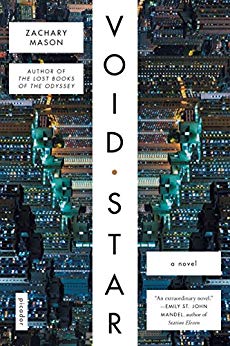
 Why this book: Selected by my literature reading group because of its focus on AI – a topic many of us are interested in.
Summary in 4 sentences: The story takes place about 150 years in the future, and follows three main and several supporting characters from very different social groups in a dystopian world that Mason predicts will evolve out of current movements to integrate biological humans with computers and artificial intelligence. Several of the characters have memory implants that can access the internet, and as we follow them in the story, we see the power and the challenges of this new capability. As the story evolves, we meet a “business leader” who is seeking to consolidate immense power through a very powerful network of AI servers. The memory implant of one of our main characters is key to his ambitions, and the book evolves into a struggle between the business leader and our female protagonist for control of the world’s most powerful AI.
My Impressions: This is a complex and different book – not easy to get into, nor easy to follow. But it poses some interesting questions about the direction our culture and civilization may be heading, as capabilities of Artificial Intelligence increase at rates we can hardly imagine. The writing style is a bit cold and impersonal, and the characters are not particularly well developed nor easy to connect or empathize with. But the story itself, and its vision of the future force the reader to confront possible implications of current developments in AI. Some of these developments are exciting, but many are of concern.
Throughout the book, I was asking myself, “Is the world that Void Star describes credible?” I believe so – to a certain degree. And at the conclusion of the book I was left with a lot more questions than answers about the world Mason was envisioning.
The story is set in the un-determined time in the future – sometime in 22nd or perhaps 23rd century (I figure about 150 years from now) – envisioning a future when great power is very much a function of control over Artificial Intelligence servers and the systems they control. At this point, the human race has already begun the transition of merging human biological and computer power with cyborg-like computer chips implanted in the brains of those few individuals with the connections and money to afford them. Early steps in this direction are already happening in the labs of some of our most advanced research institutes. Void Star takes the implications of these developments in a direction that many believe is indeed where we are heading.
The memory implants that Void Star envisions can network with other AI systems and even other humans, through wireless or even ethernet connections, and if one has one of these memory implants, one’s personal memories and essentially one’s identity, can be hacked and even stolen digitally. In this world, as it increasingly is in ours today, privacy is a function of the security of networks, but today’s privacy challenges and concerns pale in comparison to those in the world of Void Star.
We follow three main characters in Void Star, as the book builds to a major AI event in the future which affects the entire world. The chapters are short, and often rather cryptic. Each chapter deals with one of the three main characters, and the chapters alternate between these three. This stylistic tool made it difficult for me to follow, and even to get to know each of the characters. The characters are very different and their lives are separate and unconnected, though as we expect, they do eventually converge, but in ways I’m not certain I understood, much less could explain.
In following the lives of these three characters we get glimpses of the world Mason envisions a century or two into the future. There are some predictable changes and improvements, such as faster transportation, the ubiquity of self-driving cars, and easy access to the “cloud” of information. Global warming has caused the oceans to rise to where today’s great coastal cities are flooded. New York City, Singapore, and many others resemble Venice as networks of canals, and many coastal cities have been abandoned. For those who can afford it, advances in biomedicine have dramatically extended not only the years one can expect to live, but also the years of productive, youthful energy and working life. As the well-off classes have taken advantage of these advances in technology, health, and computational power, the gulf between the haves and have-nots in the world has widened, to where the privileged live in walled cities, and the poor and underprivileged are consigned to certain neighborhoods or territories where they live in violent and unregulated anarchy.
I did however regularly see what I considered “anachronisms” – experiences and features in that world that are familiar to us in the early 21stcentury, but which I can hardly imagine in this dystopia he describes in the 22nd or 23rd century. For example, everyone is focussed on their phones. The laptop is the main connector to the web. WiFi is not always available. At the end, one character’s daughter runs off with a guy to help run a car rental agency near the airport. These seem to be convenient markers for the 21st century reader to feel like we understand at least some of the experience of our characters. There are many such anachronisms in the book, which I found amusing, and wondered if they were a joke, or perhaps reflected a lack of imagination, or perhaps an unwillingness to envision in greater detail this future world.
One concept I found fascinating is how in this AI-centric world, one’s identity is very much tied to one’s memory, and with an implanted chip, memory can be recorded, shared, downloaded, even stolen. Our main character had two sources for her memories – her biological memory and her computer chip memory and her conscious awareness could go back and forth. We also saw characters who internalized the memories of others. This idea of merging different people’s identities by merging their memories is fascinating.
Also one’s mortality is also tied to memory. If all of one’s memories – feelings, impressions, insights can be retained when the body dies, is one really dead? This is a question Mason leaves hanging at the end, as he insinuates that self-awareness – consciousness – can continue with this intact memory that is retained after the body no longer exists.
As the book culminates, I indeed got confused as to what was “real” and what was someone’s imagination, or what was virtual reality or enhanced reality, generated by an AI. It reminded me of some of the “magical realism” novels I’ve read, such as One Hundred Years of Solitude by Garcia Marquez, or The Ocean at the End of the Lane by Neil Gaiman.
The issue/question of our mortality is a sub theme throughout the book. Several of the characters have dramatically extended their lives and their youthful capabilities – looking, acting, functioning like people decades or even a century younger than their chronological age. As the book concludes one of our characters seems to have defeated death from biological causes, but is paranoid about dying as a result of an accident or at the hands of a sinister force. Rather than enjoying this everlasting biological life, this character lives in fear, and assumes no risk of accident or malevolence that might end their eternal life.
I also wonder whether one of the scenes at the conclusion of the book was a metaphor for a choice humans have to make – to continue down the path of increasing mathematical predictability of humans by merging us more with computers, or giving precedence to our irrational, “human” sides – heart, feeling, fear, joy, emotions. There were only a few glimpses of such ultimately non-rational, human sides of our characters in this book.
Mason hardly mentions the role of the state in regulating AI or any of the challenges of this future world. I wonder if this omission is intentional – pointing to the continued weakening of governments as regulatory powers in the face of increasing power of private entities, especially those with access to great computer power and powerful AIs.
For a different view of how current trends may turn out, I listened to a podcast discussion between Sam Harris and Kevin Kelly in which Kevin Kelly shared a more positive vision of the future than Mason does in Void Star. Kelly envisions a global “organism” – a super-connection between people and their computers. We struggle to imagine what this would be like – but Kelly reminds us that not long ago, we couldn’t imagine our current global economy or the development of extensive and global on-line shopping. Kelly calls this future interconnected phenomenon a “super-organism.” He believes that there will be multitudes – thousands and millions of AIs in this super network.
Void Star is a challenging book – not an easy read, but it definitely stretches the imagination of the reader. One has to be ready for that challenge before undertaking the challenge of reading this book. But if you’re ready for it, it can be very rewarding.


 Bob's Books
Pingback: The Space Between Worlds, by Micaiah Johnson | Bob's Books