
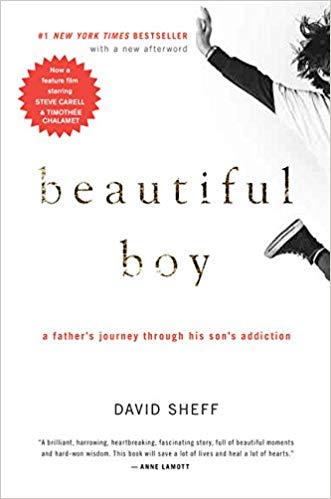
 Why this book: Recommended to me by my son Brad . He thought it might help me better understand my other son, his brother Patrick. It was a good recommendation.
Summary in 4 Sentences: This is the very personal first person account of a father’s intense and painful struggle to deal with his son’s addiction. The author’s son Nic appeared to be on track to be an over-achieving young man – intelligent, articulate, creative, athletic, charming and witty – he was the son almost any parent would be very proud of. The author shares his own pain and struggle as his son became a meth addict, displaying all the horrifying pathologies one imagines with that, as the author tries to come to terms with how that could have happened, what he can possibly do to help get his son back on track.
My Impressions: Powerful and beautifully written. David Sheff shares his very personal story, about his nearly a decade long effort to process and deal with his son’s addiction. We get to know not only David, but his immediate family as they try to live normal fulfilling lives, with the specter of one of their family being meth-addicted to methamphetamines, going back and forth from being the young man they know and love, to the near-psychosis of meth addiction. Nic – the “beautiful boy” – is indeed a charming, talented and remarkable young man – a joy to his father, siblings and friends. Until he gets caught in the undertow of addiction. And then he becomes a slave to his addition, willing to lie, cheat, steal, hurt the ones he loves – to get his next high. It is painful to read, but enlightening, and sobering.
There is so much pain in this book – but it is compellingly written by David Sheff, a professional journalist who knows how to write a searingly personal story about his own, his son’s, and his family’s struggles. In his efforts to help his son, and to help him understand his own and his son’s predicament, he leaves few stones unturned in his research into the psychology of drug addiction and the various pathways to recovery.
The book begins describing the author’s journey – his early marriage and divorce, shared custody of his son, subsequent marriage to his current wife with whom he had two more children. He shared custody of Nic with is mother; Nic lived with his father in a small town north of San Francisco during the school year, and with his mother in LA during the summers. Nic seemed to be doing everything right – with school activities, good grades, friends, surfing, sports, school theater – all the things proud parents love to brag about a high- achieving son. At about age 10 his father discovered marijuana in his day pack, confronted his son, spoke to school counselors about it. No big deal. Kids experimenting. It’s everywhere. Don’t over-react. Having grown up in the 60s and 70s, Sheff himself had been through that and wasn’t overly concerned.
But with Nic as with a certain percentage of people, marijuana was a beginning and indeed a gateway drug – leading to alcohol binges, then other drugs and eventually by the time he was ready for college, methamphetamines.
Beautiful Boy describes the roller coaster ride that Sheff’s family had in trying to track, manage, and help Nic as he careened down the self-destructive path of meth addiction. In and out of rehab. Disappearing for days and weeks at a time. His father frantic and obsessed with worry and fear that he would die. And he nearly did.
We learn about the pathology of addiction. And the damage it does to the families of the addicted. The author initially resisted Al-Anon but became a regular, needing the comfort, support and understanding that he could only get from others who were suffering as family members of an addict He also required his own therapy. He called, read, visited anything/anyone he could find who might help him understand and better deal with his son’s addiction. Sometimes he was overcome by guilt and struggled to accept the Al-anon three C’s: You didn’t Cause it; You can’t Control it; You can’t Cure it. All while trying to mitigate the impact that Nic’s addiction would have on his other children, who adored their older brother.
Beautiful Boy begins with Nic’s childhood but focuses primarily on about 6 years of Nic’s addiction, from about age 17 to about 23. And throughout it is David Sheff’s very personal journey, alternating between guilt, fear, anger, resentment, and finally acceptance. Interspersed throughout the story are vignettes reflecting the pleasures of being a parent, the joys of daily life within the family, family adventures which are so simple and yet so real. Outings with his wife and two other; with Nic when he’s sober. A happy family – with one member who is severely addicted to drugs.
A few key points that I believe David Sheff wants us to take out of his personal story:
- Addiction is indeed a disease. It is much more a disease than a character flaw.
- Relapse is part of recovery. Nearly all recovering addicts relapse multiple times before they recover….or die.
- The suffering they cause other people is only part of the story. The addicts themselves are suffering – the drugs are a response to pain, which is made worse by the guilt and self-hate for the pain their addiction and behavior inflicts on their families and friends.
- There is no well respected clearing house to provide guidance for parents/loved ones trying to find a program to assist a family member addict. There are many, many approaches, some good, some not so good, some very expensive, some less so, but underfunded. He felt like he was in a maze.
- Our treatment and rehabilitation programs in the United States are woefully inadequate to the need.
- Never give up – but it is never clear what will actually be a turning point in an addict committing to rehab for the long term.
- Many, many parents are losing their children. Nic finally does find his way out. David Sheff considers himself,8 his family – and Nic – very lucky.
A quote from the book (p 179):
But I remind myself: Nic is not Nic when he is using. Throughout this ordeal I strive to understand this force that has shanghaied my son’s brain, and I sometimes wonder if his recidivism is a moral failing or a character flaw. I sometimes also blame the treatment programs. And then I blame myself. I go back and forth. But I always come back to this:
- If Nic were not ill he would not lie.
- If Nic were not ill he would not steal.
- If Nic were not ill he would not terrorize his family.
- He wouldn’t not forsake his friends, his mother, Karen, Jasper, and Daisy, and he would not forsake me. He would not. He has a disease, but addiction is the most baffling of all diseases, unique in the blame, shame, and humiliation that accompany it.
I was strongly encouraged to read this book to help me understand my own son’s struggles. My son isn’t struggling nearly as much as Nic – and his issues are different, but this book was very helpful to me. I’d recommend it to anyone who has a close friend or family member who is struggling with any sort of addiction, or to anyone who desires insights into the very personal effects of drug addiction, not only on the family, but also on the addict.


 Bob's Books
Pingback: Review #2 – Abbys Blog