
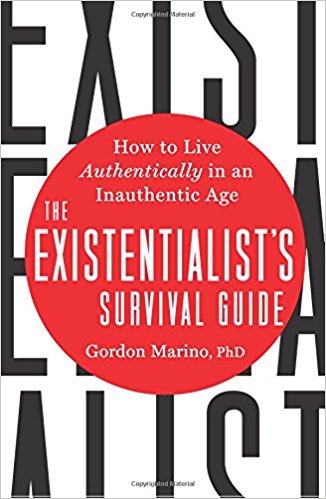
 Why this book: Suggested by a senior Naval Officer to my good friend and naval officer extraordinaire Emily, who suggested it to me. I have been interested in existentialism since my college days and the philosophers who are referenced in this book as “existentialist” have been great resources to me in helping me to flesh out my own personal philosophy.
Summary in 3 sentences: Gordon Marino is a philosophy professor who once was an accomplished athlete in football and boxing, and has stayed engaged in the sports world as a writer and commentator. But his path from rebellious athlete to philosophy professor took him through some very dark places, and in this book he examines, with the sensibilities of a wise old philosopher, how existentialist philosophers have helped him deal with such life challenges as Anxiety, Depression and Despair, Death, Faith, Morality, and Love – the titles of the chapters of this very insightful and well-written book. Marino is a Kierkegaard scholar, and Kierkegaard is the major influence on his thinking, but he brings in Nietzsche, Sartre, Camus, Dostoyevski and others in his very personal look at how existentialism can help us “survive” – maintain a sense of self and identity in today’s fast moving consumer-oriented culture.
My Impressions: A very personal look at how existentialism can be not just a strange philosophy for nerdy maladjusted philosophers, but a useful philosophy for the rest of us – or at least those of us who think about how crazy – or to use the term favored by the French existentialists – “absurd” life can be.
Existentialism is a very profound search for “meaning” in a world which doesn’t make sense. Through the 7 topics he addresses in this book Gordon Marino introduces us to how a number of the world’s more renowned existentialist philosophers address this fundamental meaning question. It is a “survival guide” for those who may at times feel lost, or awash in chaos, trivialities, dysfunction, fruitless pursuits, and unhappiness. And he ventures to say that such feelings affect (or should affect) us all from time to time, and when they do, the insights of the existentialist philosophers can be of value to us.
Viktor Frankl’s Man’s Search for Meaning provided his insights based on his experience in the hell of the Nazi concentration camps. Marino’s Existentialist Survival Guide is also quite personal, and much more so than Frankl, calls on the insights of other philosophers to guide him and us. As a philosophy professor and Kierkegaard scholar, we spend a lot of time with Kierkegaard, but he calls on the ideas of others as well, to include Nietzsche, Camus, Sartre, Dostoyevsky. Some he notes have conflicting views, and Nietzsche in particular, doesn’t always agree with Kierkegaard’s passionate Christianity
He conveniently breaks his book down into chapters that focus on the the issues of many of modern-day existential crises. He has chapters on anxiety, depression and despair, death, authenticity, faith, morality and love. I found it valuable to go back through the book, re-read my underlines for my own future review, and I include many of them below for the edification of whatever reader may be interested.
This book is not for everyone, but I found it enlightening and a pleasure to read. And I have found it enlightening to go back through it and review the wisdom it contains.
——-
Quotes – some of my favorites, broken out by chapter titles. Page numbers refer to the hardback version printed in 2018:
Chapter 1: Anxiety:
Without distinguishing between anxiety and fear, the rationalist Spinoza wrote, “Fear arises from a weakness of mind, and therefore does not appertain to the use of reason.” 42
Kierkegaard describes anxiety as “the dizziness of freedom.” …Looking over the lip of a thousand foot drop, our stomachs quiver , we experience anxiety, not because we are in danger of falling but because we feel that we have the freedom to leap. 44
Unlike other moods and emotions, anxiety is something that can inhabit us without betraying its presence. Kierkegaard sighs: Deepest within every person there is nonetheless an anxiety about being alone in the world, forgotten by God, overlooked among the millions and millions in this enormous household. …46
Get it all figured out and there is always something else to be anxious about. Anxiety is about the future, and, because of this, it impedes our ability to live in the moment. 47
One of the mistaken ways we respond to the dizzying feeling is to attempt to steady ourselves by converting existential anxiety into a revolving worry about this or that finite concern. 53
Kierkegaard: With faith you understand the one thing that you should be anxious about, namely, your relationship to God, and with that anxiety, all your other sources of anxiety become relativized. 54
Kierkegaard is adamant that courage comes when one fear/anxiety drives out antother. 55
Chapter 2 Depression and Despair
Among other things, depression is a disturbance in the way that we talk to ourselves. 58
A Buddhist teacher once told me that all the self-improvement regimes were tinged with violence, since they all presupposed a lack of self acceptance, that you are not good enough to start with. 63
Kierkegaard shed fresh light on a long lost distinction between depression and despair, between a psychological and a spiritual disorder….the difference between a disruption in the way we feel, and a sickness in our very being. 63-64
To paraphrase the author of The Sickness unto Death (Kierkegaard), happiness is despair’s greatest hiding place, which is to say that happiness is not the right touchstone for spiritual well-being. 68
Kierkegaard attests that depression develops into despair – into a spiritual malady – only when we let ourselves be defined by our depression and, in our hopelessness, toss in the towel on our moral and spiritual aspirations. That surrender is despair, not depression. 76
Depression is not despair, but depression can certainly lay down the tracks to despair. Circumventing despair requires keeping a third eye on your inner life. It requires keeping a part of yourself outside the inner morass of bilious moods. 79
Chapter 3: Death
The Tolstoy of Ivan Ilyich wanted his readers to understand that, with its lack of authenticity and brotherly love, modern life is spiritual death. 92
Personal meaning is the bulls-eye of existentialist investigation; in this case, it helps answer the “What does it mean that I will die?” 96
“Eat , drink, and be merry” is another gambit, which Kierkegaard casts as a hysterical “cowardly lining to life.” 97
One day and again, who knows when, all will be over. You won’t be able to change a sentence of the story of your life. 99
Today, and in Kierkegaard’s time, people long to die in their sleep, that is, to die without experiencing death; if not in their sleep then a quick death, one that affords the least amount of time, the minimal awareness that while life moves on for everyone else, it is over for you. 100
Nietzsche once quipped, “You only live once…if then.” 101
Speaking for both Kierkegaard and Heidegger, Barrett adds, “Yet if we do not turn away in panic, this vision of our radical finitude brings its own liberation.” 102
At the risk of being pedantic, the Kierkegaardian understanding of death might be this: don’t be careless with the people you walk through life with. Don’t have arguments and leave them unsettled. 10
The bracing awareness of death, coupled with the angst that it brings, grabs us by the wrist and pulls us out of the crowd. 117
Philosopher Mike Martin: Unconfronted, death is dreadful. It generates vague fears and anxieties that drive us away from authenticity and toward immersion in conventionality and everyday pleasures…In fully acknowledging death we are pressured to unify our lives. 117
Chapter 4: Authenticity
Literary characters like Holden Caulfield and Willy Loman, like Ivan Ilyich long before them, hinted at an undercurrent of fear about become a cookie cutter of a human being, a crowd person, the kind of individual who was defined by externals. 108
…the once urgent issue of authenticity seems to have been lost to selfies, social media branding, and managing your profile on LinkedIn and Facebook, as though everyone has become their own unabashed publicist. It is not who you are, but who you seem to be! 108
Is the litmus test of authenticity the gap between who we feel we are and who we present ourselves to be? “Above all,” Camus wrote in his Notebooks, “in order to be, never try to seem.” This advice is easier written than followed. 112
With a delicious metaphor, Nietzsche announces, “Truth is a mobile army of metaphors.” 115
To reiterate a common theme, we are relational entities. We exist in relation to ourselves, in relation to others and to our surroundings, and for some of us, we deliver or try to trust that we exist in relation to God. 115
When Nietzsche implores, “become who you are,” like Heidegger, he is prodding us to create ourselves. For Nietzsche, Sartre, and Heidegger, we are a witch’s brew of culture, feelings, experiences, and evaluations, and we create ourselves out of this melange, as though our lives were an artwork. 118
We make our views our own not by hitting “like” on Facebook but by passionately relating ourselves to those ideas and expressing them in the medium of action. 119
I ought to consider the possibility that my convictions about kindness are a story I tell myself about myself that may not be as close to my heart as I would like to imagine. 121
Relational creatures that we are, it could be that become our own person is only possible vis-a-vis strong bonds to something outside of ourselves. For Kierkegaard, it is God….122
Such an admission would hav involved stripping myself of my armor and accepting a degree of vulnerability. 123
However we define it, authenticity does not seem to be something we can work at, save in the sense that we can make strides to avoid inauthenticity. 123
Chapter 5: Faith
Do we lose our faith or push it away? 128
For Camus, the conflict between our need for meaning and a meaningless world is the absurd. Camus’s existential prescription is that we accept the futility of our innermost desires and remain faithful to the recognition of the absurd. 133
Consciousness of the aabsurd is supposed to remove the sting from the absurd. The gospel according to Camus teaches that the dnizens of death row, which mens all of us, should be freed from the fetters of worries about figuring out the best kind of life. The cosmos is chaos. There is no right way to live: “one life is as good as another” and just as meaningless.” 134
Camus’s muse, Nietzsche, warned that when you look into the abyss too long, the abyss looks back and through you. 134
Viktor Frankl, a survivor of Auschwitz and founder of logo therapy, lived by Nietzsche’s adage, “If you can find a why, you can find a how.” 136
Though dead for 150 plus years, Kierkegaard was a therapist of mine. Much of his therapy took the form of spurring me in the direction of taking faith more seriously. 138
Kierkegaard’s Fear and Trembling indirectly reveals that religion cannot be reduced to the ethical, since there was no ethical justification for what Abraham was poised to do. 142
Since the movement of faith and, ultimately its object are paradoxical, faith cannot be comprehended, which is tantamount to saying , that if faith has any validity, it cannot be unpacked in terms of reason; it cannot be understood as a set of stories for edification or as a kind of philosophy for dummies. 143
In more ways than ten, Kierkegaard acknowledges that faith involves a collision with understanding. He was clear that neither the ontological nor any other form of argument will turn the water of unbelief into the wine of faith. 144.
Without offense, there would be no need for faith; there would be no need for anything other than knowledge. 145
Today, we worship autonomy. Years ago, obedience was a quality that was always included among the virtues. No longer. If we find anything offensive today, it is the notion of being told what to do or who to be. 145
In his The Sickness unto Death, Kierkegaard, the high priest of existentialism and choice, asserted that where there is no authority there is no obedience, and where there is no obedience, there is no seriousness. 145
With regard to faith and everything else Kierkegaardian, the accent is on passion and action. 149
In Postscript, Kierkegaard proclaims, “where there is certainty, there is no faith.” or again, where there is certainty, there is no risk, and “where there is no risk, there is no faith.” 150
Indeed one of the criticisms that Nietzsche leveled against Christianity was that it cultivated a suspicion about anything and everything connected with abundant pleasure. 151
The need for God for Kierkegaard is unlike other needs in that it does not reveal a lack. The need for God is a human being’s highest perfection. 153
For not-so-holy fools like the present author, it seems perfectly fitting to pray to a God you don’t believe in for faith in God. Dostoyevsky taught that the worry about faith is faith, and Kierkegaard, who likened prayer to listening to God, remarked, “Prayer does not change God, but it changes him who prays.” 154
I have come to think of faith as trust, the kind you might have in a friend or loved one. where knowledge and a lack of certainty are the rule, trust would seem the most appropriate term. 154.
Chapter 6: Morality
The love that philosophy refers to is not a love of knowledge but a love of wisdom, an understanding of how to live a moral and good life. 158
Nietzsche, the philosopher with the hammer, banged out his own unhinging questions: What is the value of our values? Or again, are our values adding value to our lives or are they making us sickly. .. Nietzsche declares the the grand moral theories of most philosophers are essentially self-portraits. 168
A sickly individual, Nietzsche had an ideal self that was an extrapolation from the desire for health and vigor that always escaped him. .. Health was the god term for Nietzsche and the scale for his re-evaluation of values. 168-9
Nietzsche described humanity as slipping toward a wariness that, a la “the last man,” aches for nothing more than “pitiable comfortableness” – a pair of slippers, a flat screen television and some action movies. … Nietzsche regarded today’ everyman/everywoman as slouching toward becoming huge bourgeois Babbitt whom, in contrast to his Superman or Übermensch, he baptized “the Last Man.” 170-171
Lessons drawn from Aristotle and Nietzsche. Both taught that character is sculpted by how we cope with our fears. 173
Today the young and the privileged get very little practice in sparring with their angst. 174
Most philosophers (Socrates, Kant, Schopenhauer) bid us to go to war against our instincts – overriding our inclinations. In contrast, Nietzsche tries to reunite us with our instincts, no matter how base or unshaven they prove to be. 175
One of Nietzsche’s gripes about Christianity, the old moralists, and the ascetic idea was that they inculcated a distrust of anything that smacked of the ecstatic or, or as he termed it, the “Dionysian.” It is an ice-cube down the back…. 175
Nietzsche wanted us to own a side of ourselves that we lock in the basement. 176
Nietzsche does not prescribe self-forgiveness, but something even more radical. Healthy consciousness requires forgetfulness. As Nietzsche describes it, you don’t need to be able to forgive; you need to be able to forget both the transgressions of others and your own missteps. 177-178
Forgetfulness is a form of spiritual digestion essential to spiritual well-being. We need to resist becoming moral stamp collectors. We need to be strong enough to let things go. 178
Like Nietzsche, Kierkegaard was a free spirit who found the cleverness and relentless, narrow-minded pragmatism of bourgeoisies society repugnant. 179
Remember Kierkegaard claims that happiness is despair’s greatest hiding place. Nietzsche would’ve had a belly laugh or perhaps wretched at the idea that we ought to have third thoughts about those rare moments when we feel joyful and at home in ourselves. 180
Kierkegaard reminds us that to become who you are, namely, a child of God, you must “die to this world,” an age-old notion that would have given Nietzsche another of his debilitating migraines. 180
Kierkegaard: The more time you put between yourself and an action, the more likely you are to convince yourself that the right thing to do is the easy thing to do. 186
Morally speaking, the temptation is not just to take the path of least resistance but to convince ourselves that the path of least resistance is the righteous path. 187
Careerism, the comfort and sense of belonging that success yields provides one of he most powerful impetuses for convincing ourselves to look the other way when a scarified is demanded. 188
Nietzsche: Remorse is case of “adding to the first act of stupidity, a second. ”
For Kierkegaard, prayer does not change God – it changes, it develops the person praying. Perhaps it is the same with regret. I can’t rewind and expunge my past actions, but perhaps I change who I am in my act of remorse. 193
Sartre urges us to recognize that our radical freedom breeds anxiety and that we have a proclivity to try to escape the angst in bad faith by denying our freedom. 193
If Nietzsche were to offer a homily it would include the suggestion that rather than torture ourselves and others, we ought to learn to let transgressions go and be attentive to emotions and power interests that stealthily infuse our moral sensibilities. 193
Kierkegaard instruct that the main obstacle to leading a righteous life is our predisposition to hoodwinking ourselves by talking ourselves out of doing the right things when it requires sacrifices that diminish our happiness and satisfaction. 194
Chapter 7: Love
The Greeks distinguish between eros (erotic love)) agape (selfless, sacrificial,) and philos (friendship, brotherly love.) 196
How to give, find, and accept love? What do Kierkegaard and Dostoyevsky have to teach us ton this triad of existential questions.? 197
Today we take about a pandemic of narcissism, symptomized by the likes of selfies and self-promoting messages on Facebook. 197
As (Sartre’s play No Exit) closes, the murderer Garcin gets the idea and exclaims “Hell is other people” because life is an endless struggle to establish yourself as a subject among others trying to do the same. 198
At one level, The Fall (by Camus) is a reflection on the problem of guilt in a world in which there is no longer any possibility of forgiveness. 201
If love is caring about someone else as you care about yourself, how many of us can rise to the task? When fortune smiles on my friends, I effuse, “I’m so happy for you,” but few and far between are the times when I can actually share in someone else’s joy. 202
Kierkegaard articulate the austere idea that preferential love, loving someone fo the qualities they posses – a curvaceous figure, a razor-sharp intellect, wit, or whatever – or because they are blood related is at bottom an expression of self-love. You love them either as an extension of yourself or because they fulfill some deep-seated desires. Preferential love comes easy to anyone with even a dab of humanity. 207
In opposition to sSartre, Camus, and Nietzsche, Kierkegaard believes that we are duty bound to presuppose an essential ability to love in everyone, not only in people we feel simpatico toward but also in those whom we cut across the street to avoid. 207
Kierkegaard maintained that we are so attached to comparisons and our differences that we take them into the cemetery, with the big shots getting large monuments and maybe even a small chain-link fence to keep the hoi polloi out of their eternal resting place. 209
One of the cavils that I have with Kierkegaard’s otherwise rich, illuminating interpretation of love is that he may’ve given a cold shoulder to the feeling aspects of love. Kierkegaard describes love as a duity, a passion, a need, but tenderness is certainly not foremost in his analysis. Any account that excludes tenderness is lacking 210
According to Plato’s Diotoma (in the Symposium) we begin spellbound by the beauty of the physical form, then, if and when we mature, we are attracted first to the loveliness of the virtuous soul, and then to the beauty of laws that nurture souls. 212
(Marino devotes a whole section in his chapter on Love to Dostoyevsky’s Notes from the Underground as a study in moral self-degradation.)
Perhaps as a way of defending ourselves against our own doubts and inner voices, many of us hanker for admiration. We yearn to be desired , valued. We want to be loved as the people we aspire and perhaps imagine ourselves to be, not the flesh-and-blood fallible creates that we are. 222
Kierkegaard taught that Jesus’s love commandment, namely, love thy neighbor as thyself, first and foremost requires proper self-love. This non-narcicssist caring relationship to the self is remote from the vanity and self-obsession that we tend to equate with self-love. 224
Earlier in this chapter, I mined Kierkegaard’s insight that the duty and work of love is to presuppose love – not just the love in others, but perhaps above all, the love in ourselves. Had he done that work, Dostoyevsky’s Underground Man might have been able to let Liza hold and comfort him. He might have ceased being the Underground Man. 225
EPILOGUE:
‘But how many of us are similarly able to appreciate Dostoyevsky’s insight that because we need to feel in control, accepting love for who we are (as opposed to wanting to be loved for our accomplishments or looks) is one of the most daunting stumbling blocks to true intimacy? 228
From Kierkegaard to Camus, the existentialists are profoundly aware that life is an incomparable gift, albeit a gift that is also a challenge. 228
Aristotle contended that life is too complex to come up with a universal moral rule book to cover every situation. 229
Anxiety is not simply a disrupting affect accompanied by sweaty palms and an increased pulse rate. It is a feeling with a message, one with an important cognitive component. 229
An abstract understanding of your mortality is a distant cry from a personal grasp of what it means that there will come a time when there will be no more time, when “all is over.” 232
Kierkegaard maintained that thinking of yourself as dead is good medicine. Earnest reflection on the meaning of our inevitable death, Kierkegaard promises, will allow every moment to become more valuable and endow finite issues with new and more powerful significance. 233
Tolstoy also intimated that the ubiquitous denial of death was partially responsible for the inauthentic personal relations of modern society. 233
Like Kant, Kierkegaard assumes that anyone aiming to lead a moral life would have to walk through the fire of times when doing the right thing will incinerate their prospects for happiness. 234
Nietzsche: for anything to be termed “good” it had to at least appear to involve an element of self-sacrifice. For example, I can’t just charge forward and insist that I want to be the best; I have to adorn my ambitions in altruistic motives. 236
Nietzsche can make us attentive to the subterranean power interests possibly lurking behind our so-called better angels. 236
Kierkegaard: the choice between the sacred and the profane is not one that reason can make. 237
Kierkegaard: faith is not so much a matter of belief as it is a matter of how you relate to your unbelief…..faith and doubt are not opposites because both are expressions of passionate concern. 239
The how-to in the book is one of how to lead an authentic life in an inauthentic world. 240


 Bob's Books
Bob, thanks for posting! I’ll have to pick this one up, the review you wrote looks fantastic. Very interesting about the death chapter. I’ll add this to the kindle.
There’s a LOT in this book, and it’s not a hard read -a bit more in depth and philosophical than Hiking with Nietzsche. But I need to go back regularly and reread the quotes I posted – even as I went thru the book and typed those in, they had different significance to me than when I first read them. Glad you enjoyed the post – the book is better! Bob