
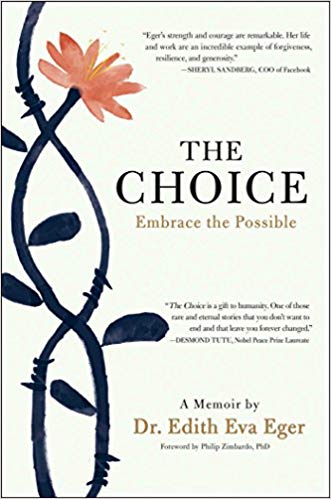
 Why this book: Recommended to me by my friend Peter Rea and then a couple of weeks later by my friend Letizia Amadini-Lane. Dr Eger is a holocaust survivor who tells an amazing story of survival – and she is alive and well and living in Southern California.
Summary in 4 Sentences: This is Dr Edith Eger’s story – partly a memoir of an incredible life, but also a philosophy of recovery and empowerment that grew out of the horrors of her time in Auschwitz. As a young girl in a middle class Jewish family in Hungary, she and her family were rounded up and sent to Auschwitz. Her family was split up on arrival and she never saw her parents again, but she and her sister helped each other to survive – barely. The book details the horrors of her time in Auschwitz and then goes on to cover how her life evolved over the next 7 and a half decades – the challenges and rewards of being an immigrant in America and how she struggled and overcame the trauma of Auschwitz to become a powerful voice in psychotherapy and dealing with Post-Traumatic Stress.
My impressions: This is a powerful book. It begins with a glimpse at life in a happy Jewish family in Hungary, but with the storm clouds of World War II and increasing anti-Semitism threatening. She shares her story of the horrors of the concentration camp and then of her long recovery. Physically she recovered in a year or so; psychologically she is still recovering – the trauma and Post-Traumatic Stress was that severe. It is a story of psychological recovery, of immigrant life in America, of redemption and forgiveness and of her message to all who have suffered and struggle to come to terms with their suffering. It is not only powerful, it is a great and engrossing read. I couldn’t put it down. She tells her story and shares her message in beautiful, compelling and straightforward prose.
Part 1 – Prison. The first part of the book is about her childhood and her time in the concentration camp. Dr Edie was an active young girl in school and dance, and other activities in Kosice, Hungary and she recounts her confusion as subtle anti-Semitism became more overt and eventually “legitimized” and institutionalized as the Nazis came to power in Hungary. Then her family was forced out of their home in the middle of the night, with no notice, by the Nazi government, allowed just a few suitcases, and sent to a holding area, from which they were transported in trains to Auschwitz.
There what had been a bad situation got progressively worse, and she tells story after story of the horrors she encountered to include her encounters with the infamous Dr Mengele. She quickly realized that her mother and probably her father had been killed shortly after arriving. She and her sister Magda took great risks to stick together and to support each other. As teenage girls, it was their decision to try to survive together, or perish together, and that decision became harder and harder to hold on to. Somehow together, they survived the successive “selections” – those evens at which the Nazis selected those who would live and those who would go to the gas chambers.
The end of this ordeal came when her camp was liberated by American soldiers. Edith and her sister Magda had become so weak, injured and incapacitated, and were so near death that they had been consigned to a pile of dead bodies. Edith recalls being barely conscious, between life and death. This part of the book concludes with the unforgettable story of how an American GI yelled to the pile of bodies “Are there any living here? Raise your hand if you are alive.” She was too weak to answer. As he begins to walk away she is barely able to move her hand, and he returns and pulls her and Magda from the pile of the dead. She concludes that part of her story with “We have survived the final selection. We are alive. We are together. We are free.”
Part 2 – Escape. In this part of the book, she recounts the joyful and painful months immediately following her liberation from the concentration camp, her recovery, her repatriation to Hungary and eventually to her home town and adapting to a new world. She meets and is courted by her husband Bela. Soon after they marry, they realize that the horrors of Nazism are being replaced in Hungary by the oppression of a communist dictatorship. They accept that there is no good life left for them in Hungary. They struggle with where to go, and the decision is between two places: Israel (then still Palestine) and the US. They had been relatively wealthy in Hungary, but decide to emigrate to the US, leaving everything behind.
Part 3 – Freedom. They arrive in the US in 1949 and are among the tens of thousand indigent European immigrants who came to the US following WWII. She doesn’t speak English, they have no money, they face discrimination as indigent immigrants, and are living in Baltimore in a one room cold water flat, dependent on the help of relatives and other immigrants. Both she and her husband work at menial jobs to survive – because that is all that is available to them.
Eventually they have children and slowly climb out of poverty and decide to move to Texas, where their fortunes improve. With hard work and discipline, they are able to move solidly into the American Middle Class and raise their children the American way. She eventually gets a college degree and then finally a doctorate in psychotherapy. Her marriage struggles under the stress of husband and wife both working hard while raising a family, and under her own struggles to process the horrors she wouldn’t confront from her time in the concentration camp. She eventually connects with Viktor Frankl who becomes a mentor to her, and then she eventually becomes a voice and spokesperson for Holocaust survivors. She also chooses to accept a speaking engagement in Europe and makes the very difficult decision to travel to Auschwitz to confront her demons. This decision is key to her healing – which is the title of the final section of the book.
Part 4 – Healing. She begins this final section describing one of the last times she saw Viktor Frankl, who she considers one of her two liberators – the first being the GI who pulled her from a heap of bodies at Gunskirchen, Germany. Viktor Frankl “gave me permission not to hide anymore, who helped me find words for my experience, who helped me to cope with my pain.” He helped her discover a purpose for her suffering and a sense of meaning to apply to her life. In this section of the book she shares how as a therapist she helped empower others to take responsibility for their lives, to NOT be victims of their past.
She talks about how she and her sister Magda have dealt differently with their pain and nightmares. Neither the psychic wounds nor the nightmares go away, but Edie insists that she is not a prisoner of her past any more. Revisiting Auschwitz and confronting the horror of her experience there were key to her sense of freedom. “I wasn’t a prisoner anymore,” she writes. “I went back to Auschwitz searching for the feel of death so that I could finally exorcise it. What I found was my inner truth, the self I wanted to reclaim, my strength and my innocence.”
She concludes the book with a story of her visit in 2010 to speak to the 71st Infantry Division – the unit that 65 years earlier had rescued her from the concentration camp. She writes how she was so full of joyful adrenaline she could barely speak. She laughed and wept on stage, full of gratitude. Many of the troops in her audience had experienced trauma and painful loss in the wars overseas. She concluded her book with the words that were key to her message to the troops and are fundamental to her message to all of us: “You can’t change what happened, you can’t change what you did or what was done to you. But you can choose how you live now. My precious, you can choose to be free.”
————–
On 8 Mar 2019, I was able to go to lunch with Dr Edie Eger with my wife Mary Anne, my friends Peter and Letizia, and two of Letizia’s friends Amy and Isabel. We had all read The Choice and wanted to meet Dr Edie, ask her about her book and her life, and hear what she had to say. It was a lovely lunch and gathering.
Dr Edie is a petite, very well-groomed and attractive 91 year young lady who is energetic outspoken, and very compassionate. She has dedicated her life to sharing her story in ways that will help others who may be suffering from past trauma or anxieties. She is very busy; when I picked her up I asked her what she’d been doing. She had had a speaking engagement almost every day that week, and in a few days, she would be flying to Mexico City for another engagement. She is very much in demand and has an executive assistant to help her manage her many commitments. We were lucky that she was able to squeeze us in.
She asked each of us about our own lives but readily shared her own story and made regular references to what she has learned about self-forgiveness and self-empowerment from her experiences in Auschwitz. She told us that her decision to return to Auschwitz was one of the most important decisions of her life to help her with her own healing.
She shared with us that her publisher asked that The Choice NOT be primarily a memoir, but rather a book about her insights about life and healing. Though the book wasn’t published until 2017, it doesn’t cover much of her life after the early 1980s – merely a few stories and anecdotes from her teaching and therapy sessions with her patients that help her make her points. Her husband Bela’s death is not mentioned – though he died in 1993 of the tuberculosis he had contracted during WW2. She has lived in La Jolla for over 20 years, in a beautiful home that looks out over the Pacific Ocean that she bought from her daughter – a home that many years previously she had helped her daughter to buy. Her daughter is now living on the East Coast (Boston, I believe,) as her husband has won a Nobel Prize in Economics and is still teaching..
She is so proud of her daughter – who she reminded us was ashamed of her mother as she grew up – ashamed that her mother spoke English with a heavy accent and wasn’t like the other middle class American mothers she knew, or saw on TV in sitcoms and commercials while growing up in the 50s and 60s. Of course, that has changed and they are now very close.
Dr Edie told us she is working on another book, but this one for children, which distills her wisdom into what she called “Edie-isms” that children can understand, relate to, and remember. Over the course of our conversations, she shared with us a number of Edie-isms, some suitable for children, others more for adults. These are the ones that I and the others who joined us for lunch were able to recall:
- Respond, don’t react.
- Turn Hate into Pity
- Frame it, and then Reframe it
- There is a little bit of Hitler in each of us.
- There is no forgiveness without rage….
- Jesus’s message was that we should love unconditionally
- 4 words. “Please Tell me more.”
- There’s a difference between Faith and Belief.
- You don’t have to be a cow to know about milk!
- “What now?” Rather than, “Why me?”
- Auschwitz – where I was told I was subhuman, a cancer on society and the only good I can do is to come out a corpse. I was victimized, but I refused to become a victim.
- I have remorse (I still struggle with not saying my mother was my sister); not regret – I did the best I could at the time.
- Rather than ask how your day was, say, “I missed you! It is good to see you!”
- I like a man who is kind and who has integrity.
- Don’t fight with someone who disagrees with you. Listen, and let them know that, if they are interested, you’ll share your opinion.
- Ask, “How can I be useful to you?”
- Revenge feels good in the short term, but I was interested in the long-term. I forgave Hitler for me – so that I wouldn’t be consumed by hate.
- You can’t control circumstances, but we can control what we feel, what we think, how we behave.
- Our jailer is in our mind, and the key to liberate us is in our pocket, but it takes an inner life.
- We knew who the enemy was – the Nazis. Children who are abused don’t know who the enemy is.
- I don’t believe in retirement. My mission is to educate the young and combat ignorance.
- Would you want to be married to you?


 Bob's Books