
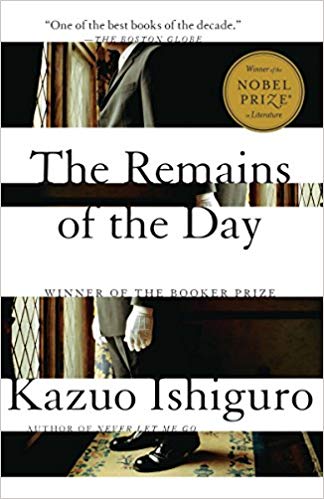
 Why this book: Selected by my bi-monthly reading group as its selection for May 2019. It is a modern classic: The novel won the Booker Prize and the author won the 2017 Nobel Prize for literature, and this is his best known work. I and several others in the group had already read it and wanted to read it again.
Summary in 4 Sentences: A novel written as first-person reminiscences of a butler in one of the great houses of Britain in the period leading up to WWII. He had aspired to a level of excellence in his profession that would put him in league with the greatest butlers of his day, and we learn not only of the art of serving an aristocratic lord, but of the sacrifices and challenges of aspiring to be a top notch professional.. While “butlering” is the setting of Remains of the Day, the story is about so much more – work-life balance, and the costs of a super-charged self-discipline which subordinates one’s emotions and desires to achieving an ideal of greatness in one’s profession. And how we never know the true value of what we serve, and to a certain degree, in today’s very busy and competitive world, we are all butlers.
My Impressions: Wonderful book. Like a lot of great books, it starts slowly, and then builds subtly and beautifully to its conclusion. It is beautifully and simply written, and is the best known of Ishiguro’s works before he was awarded the Nobel Prize in literature. The book’s fame was significantly enhanced by the movie staring Anthony Hopkins and Emma Thompson in 1993 – which is an excellent complement to the book.
It is written in the first person and as such, is a character study of a very disciplined ambitious man who has dedicated his life to achieving a professional ideal, to living up to the standards his father had set for him, which he set for himself, and to which he held others accountable. It is an example of “leadership by example,” taken to an extreme.
The context of the books is a three day vacation taken in the early 1950s by a butler – Mr Stevens (we never learn his first name) toward the waning days of his career. The lord of his manor is away and suggests that Mr Stevens take the lord’s car and get away for a few days to see some parts of England he’d not seen in years. Stevens decides to use this trip as an opportunity to have coffee with a woman with whom he had worked some 20+ years earlier at that same manor. Through his recollections during this trip, we get to know Stevens, his principles and ideals, his self-deceptions and character flaws, the world and the times in which he worked and served his lord, and how he viewed his role in that world
As he shares his thoughts and memories, we get to know a man who has succeeded in subordinating his own emotional needs to his desire to fulfill his ideal as the perfect butler to a great house. He viewed his own personal and emotional needs as weaknesses to be recognized, managed, and overcome. But as he shares his thoughts, we see that he had so successfully subordinated self to profession, he barely recognized his own needs. He believed that a great butler took care of himself almost exclusively in order to better serve his lord and his profession.
In reading this book, I saw parallels to the Samurai Code of Bushido, an ideal which imposed the strictest discipline on Samurai warriors to serve their lord at all costs. To become a “true” samurai, one had to dedicate oneself thoroughly and exclusively to the service of one’s lord – the one over-riding principle was to serve the lord – all other principles and values were subordinate to that goal, and only meant to serve it.
A somewhat tamer version of this warrior ideal is the professional code and oath of the US military officer who will “bear true faith and allegiance” to the US Constitution and will “faithfully discharge the duties” of the office to which s/he is assigned. Though the military does make compromises to such things as family and a personal life, it does idealize service to others and nation at the expense of self, and revers such “warrior monks” as Jim Mattis and others before him, who have have forsaken family to serve their country and the military almost exclusively. In fact at the Naval Academy, midshipmen are taught the “Constitutional Paradigm” of values: Constitution, Service, Mission, Ship, Shipmate, Self. Self is at the bottom.
In reading how Stevens described his dedication to the ideal of being a great butler, I saw similarities to the military profession which demands that its members subordinate their lives and personal desires to something bigger than themselves. The warrior profession demands a willingness to give ones life when called upon, for the demands of one’s country. Even in peacetime and in garrison, soldiers are never “off duty” and must stay prepared to be called at any time for the demands of combat; they are regularly asked to subordinate family and other personal callings to the needs of the nation, the Navy, their job, their shipmates. If one buys into this completely and without balance, then one can never give enough. Remains of the Day takes this ethos to an extreme and we see the costs.
In the military and other similarly demanding professions like medicine, the priesthood, police and first responders, we expect people to take care of themselves and their “human” and family needs as a concession to the long term needs of the profession: We take care of ourselves so that we can better take care of our mission over the long term. The opportunity for a balanced family life is a concession to attract new recruits into the profession and to retain those who have achieved some level of experience and competence. And then there are those warrior monks like Stevens who have bought into the ideal entirely, and who have given their whole life to their profession.
In Remains of the Day, Stevens puts the pieces together of his professional ideal as he considers what it means to be a great butler. He distinguishes between superficial qualities that are often admired, but the utmost criterion is to “be possessed of a dignity in keeping with his position.” This point he returns to repeatedly
“The great butlers are great by virtue of their ability to inhabit their professional role and inhabit it to the utmost; they will not be shaken out by external events, however surprising, alarming or vexing. They wear their professionalism as a decent gentleman will wear his suit: he will not let ruffians or circumstances tear it off him in the public gaze; he will discard it when and only when, he wills to do so, and this will invariably be when he is entirely alone. It is as I say, a matter of ‘dignity.'”
I found his arguments compelling – to a point. Stevens takes this position to an extreme which shows the reader that it is not enough. As an American, my ideal is for a leader in any profession to also be able to demonstrate shared humanity with others of all classes, while also standing apart to effectively inspire, motivate, and lead. It reminds me of the tension between two principles of leadership: The leader should be “authentic” and human, while at the same time the leader should be a model of detached wisdom, as Colin Powell said, “Never let ’em see you sweat.”
Remains of the Day also points to the very conservative view that “ordinary people” should leave resolving the major affairs of the world to the aristocracy who are born and bred to lead, and who have the education and experience to make decisions in very complicated matters. Stevens believes that these great men serve in what he called “the hub” of the world, and their decisions emanate out like spokes on a wheel to the rest of us who keep the wheel rolling. He holds on to this position in spite of how wrong-headed his lord and his friends and colleagues were in their assessment of Hitler.
Ishiguro in the various interviews with him I’ve listened to, makes the point that in some sense, “We are all butlers” serving people, institutions, causes that we don’t fully understand. But we serve with faith in their goodness. Stevens had complete faith and trust in the wisdom and greatness of Lord Darlington, and only at the end realized that his Lord was misguided, though well-meaning. Again, I think of the analogy of those of us in the military, going to war in Iraq (or Vietnam 50 years ago) on faith that our leaders were well-informed, wise, and doing the right thing.
Only in the end of the book does Stevens reveal a crack in the certainty of his conviction that he had fully done his duty as a man. He briefly acknowledges a hint of doubt that he had any other duty other than his complete dedication to Lord Darlington. He briefly acknowledges that perhaps he had abdicated his own moral decision making to his ideal of the great butler and to the decisions of Lord Darlington who he was serving. He asks “Where is the dignity in that?” And then it seems, he dismisses the thought.
One of the other reviewers of this book placed a lot of importance on Stevens’ relationship to his father, and the incident in which he was torn between being with his father on his deathbed, or fulfilling his duties overseeing an important social event in Lord Darlington’s manor. He chose the later, and (probably rightly) justified it that his father would have expected no less of him.
And then there is the Miss Kenton.
Though always professional, Stevens had been close to the woman he was going to visit during his three day sojourn. She also had always been professional but the two of them had clearly been drawn to each other – but out of a sense of professional duty, never spoke of it to each other, never admitted it. She had sought to subtly break through his professional armor, but he had a always rebuffed her – as a professional butler should. He was mildly aware that in his visit to her he was hoping they could rekindle their friendship and warmth toward each other – and perhaps more, but in his narrative, Stevens only admitted to wanting a competent housekeeper to better serve his current master. This story of two lonely people, unwilling to address and confront their own emotional needs and connection to each other was a very powerful and sad sub-theme of the book.
SOME OTHER POINTS and QUOTES to serve me better in my future reflections on this book:
His discussion of “greatness” and “dignity” within the context of butlering, but which may apply in other contexts.
“the most crucial criterion is that the applicant be possessed of a dignity in keeping with his position.”
“dignity is something one can meaningfully strive for throughout one’s career.”33
His discussion of the moral distinction between private behavior and public service to a greater good -a distinction not made in politics or our culture today.114
He identified his own professional prestige as a reflection of the moral worth (public service) of his employer and this he applied to others. 114 We should serve those who are contributing to humanity and thereby do our small share to make the world a better place. Serve a great house and gentleman and through that, serve humanity. Like being in the Navy
The great butlers are great by virtue of their ability to inhabit their professional role and inhabit it to the utmost; they will not be shaken out by external events, however surprising, alarming or vexing. They wear their professionalism as a decent gentleman will wear his suit: he will not let ruffians or circumstances tear it off in the public gaze; he will discard it when and only when, he wills to do so, and this will invariably e when he is entirely alone. It is as I say, a matter of ‘dignity.'” 43
Great houses and the aristocracy are the “hub” of the world, where great decisions are discussed and made and emanate out to the rest of the world – rich and poor who revolve around them.
He was readily willing to tell white lies to avoid unpleasantness – as when several times, he denied service to Lord Darlington, who after the war was reviled as a Nazi sympathizer 126
He struggled with bantering, and with the hazards of uttering “witticisms.”
The metaphor of the importance of polishing silver
The difference between Stevens’ and Ms Kenton’s responses to Lord Darlington dismissing the Jewish girls.
Reading literature – a pleasure – but it had to serve his goals – furthering his command of the English language – Confesses and does not apologize for at times gaining a sort of incidental enjoyment from these stories. 168
He was NEVER off duty. The professional must INHABIT his role. 169
How he reacts to the villigers in the home he stayed at – “ordinary people.”194 Democracy is for a bygone era == the world is too complicated for universal suffrage. Great affairs will always be beyond the understanding of those such as you and I. We best make our mark by concentrating on that which is within our grasp -serving the great gentleman in whose hands the destiny of civilization truly lies. 198-9
“Why should I not admit it- at that moment my heart was breaking.”239
Aging: “More and more errors are appearing in my work.” (Lord Darlington) chose a certain path in life, it proved to be a misguided one, but there, he chose it, he can say that at least. As for myself, I cannot even claim that. You see, I Trusted. I trusted in his lordship’s wisdom…I can’t even say I mande may own mistakes. Really – one has to ask oneself – what dignity is there in that?”
Perhaps it is indeed time I began to look at this whole matter of bantering more enthusiastically…particularly if it is is the case that in bantering lies the key to human warmth. 245
Concludes with committing himself to more bantering and witticisms to better serve Lord Farraday.


 Bob's Books