
 Why this book: I’ve enjoyed several of Ambrose’s other books (Band of Brothers, Comrades, Undaunted Courage) and this one has a great reputation. I was looking for more detail than The Longest Day offered.
Summary in 3 Sentences: This book covers a lot of different perspectives on the D-Day invasion – better than most. Much more so than Atkinson, he includes a lot of vignettes from his extensive interviews with participants, while also covering a macro perspective. It concentrates on the American participation in D-Day, but does give significant attention to the British and Canadian roles, their challenges, successes and failures as well.
My Impressions: This book is broad in scope, and is written in Ambrose’s engaging style, with emotion and energy, and we feel his own fascination with the subject and unrelenting admiration for the men who undertook this great endeavor. He had already written two very well received books on specific aspects of this operation – Pegasus Bridge, and Band of Brothers, as well as Eisenhower- Soldier and President which included much about General Eisenhower’s role in coordinating and leading the Allies during the invasion. D-Day was his magnum opus to bring it all together, to explore the whole operation, as well as include lots of great stories he’d gleaned from his extensive interviews with people who participated in each phase he described. This book is almost like his letter to the American people about how amazing this operation was, and how amazing they and their men performed in this key event in Western History.
Ambrose spends a good bit of time on the extensive preparations and the final days before the launching of the invasion – not just the difficulties of Eisenhower making the decision to launch in marginal weather, but also the experience of the troops. I was unaware that many of the forces involved had been preparing for close to 2 years, and for most, it was their first experience of combat.
He then covers the invasion itself devoting separate chapters to many of it’s multiple facets. Each chapter offers a broad overview and is full of stories from individual participants, adding the human drama that makes for great history and story telling.
I was also fascinated by the chapter on the Navy’s involvement which revealed aspects of this invasion which were new to me. Over 5,000 craft of all typed were part of the invasion on D-Day, and bold action by ship commanders was key to the success on the ground – in the form of naval gunfire support. They also played a key role in saving lives of the wounded – serving as hospital ships, and picking up ships crew and soldiers who in the water after their landing craft had sunk.
One chapter that was unexpected and particularly interesting was entitled “The World Holds its Breath – D-Day on the home front” in which he describes what was going on at home in both Britain and America just prior to the invasion, and when they received word that the invasion had been launched. He describes the jubilation that ensued when people got the word, and how they followed the progress.
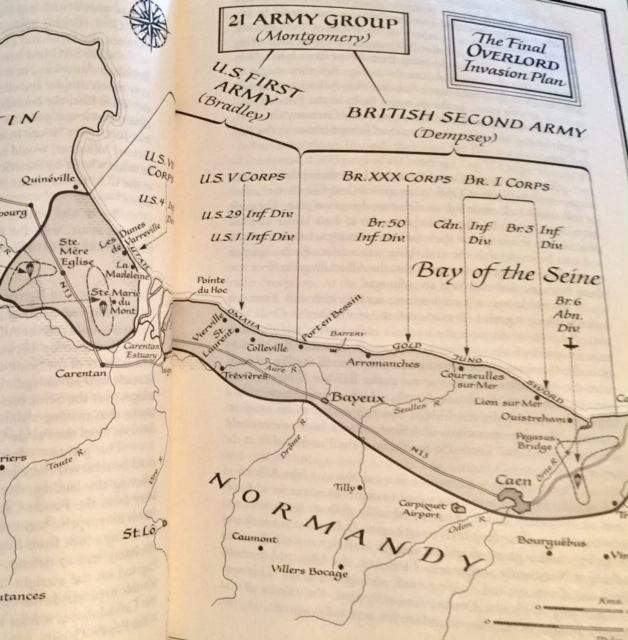
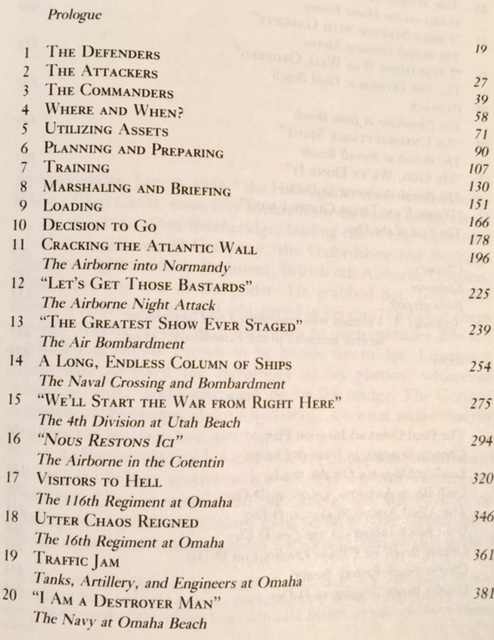
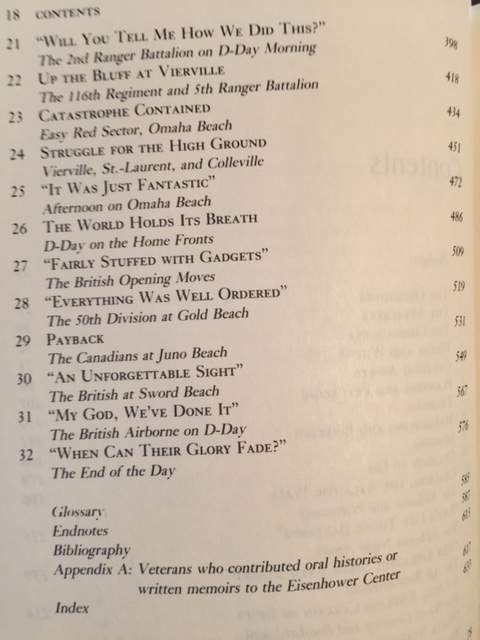
Below is a quick look at an overview map of the landing area -one of the many maps Ambrose provides. Below that is a peek at the Table of Contents, to provide an idea of the scope of the book. D-Day is not a short book, but it is a fun and fascinating all the way through.
Below are a few quotes that give a sense for Ambrose’s style, and how he tells the story:
In most cases anticipation overrode fear. The men were eager to get going. The excitement in the air was nearly overwhelming. The allied high command had deliberately brought the men to the highest level of readiness, mentally and physically. Training had been going on, in most cases, for two years of more. Although there had been transfers and replacement, a majority of the men were in squads and platoons that had been together since boot camp. They had shared the drudgery and the physical and mental demands of training, hated or loved their COs together, eaten their meals together, slept in the same foxhole on maneuvers together, gotten drunk together. They had formed a bond, become a family. They knew each other intimately, knew what to expect from the guy on their left or right, what he liked to eat, what he smelled like. 167
Not many of them were there by choice. Only a few of them had a patriotic passion that they would speak about. But nearly all of them would rather have died than let down their buddies or look the coward in front of their bunkmates. Of all the things that the long training period accomplished, this sense of group solidarity was the most important. 167
Pvt Tom Porcella, also of the 508th, was torturing himself with thoughts of killing other human beings (this was common; the chaplains worked overtime assuring soldiers that to kill for their country was not a sin). “Kill or be killed,” Porcella said to himself. “Here I am, brought up as a good Christian, obey this and do that. The Ten Commandments say, “thou shalt not kill.’ There is something wrong with the Ten Commandments, or there is something wrong with the rules of the world today. They teach us the Ten Commandments and then they send us out to war. It just doesn’t make sense.” 192
Lt Charles Skidmore, a glider pilot, landed safely in a flooded area. He managed to get out of the water and immediately came under rifle fire. It came from a bunker holding a dozen conscripted Polish soldiers with one German sergeant in charge. The men Skidmore had brought in joined him and began firing back. There was a lull in the firefight. Then a single shot. Then shouts and laughter. Then the Poles emerged with their hands held high to surrender. They had shot the German sergeant. 220
What the airborne troops had started, the seaborne armada was about to continue. What Hitler had sown he was now to reap. The free peoples of the world were sending the best of their young men and the products of their industry to liberate Western Europe and crush him and his Nazi Party. 262
The twenty-eight badly would men left behind and two of the three volunteers who provided a rearguard were captured. (The third volunteer, Sgt Bob Niland, was killed at his machine gun. One of his brothers, a platoon leader in the 4th Division, was killed the same morning at Utah Beach. Another brother was killed that week in Burma. Mrs Niland received all three telegrams from the War Department announcing the deaths of her sons on the same day. Her fourth son, Fritz, was in the 101st Airborne; he was snatched out oft he from t line by the Army.) 316 (Bob’s note: this is clearly the inspiration behind the Saving Private Ryan story.)
Maj Sidney Bingham (USMA 1940) was CO of 2nd Batllaioan 116th. When he reached the shingle (on Omaha Beach) he was without radio, aide, or runner. His S-3 was dead, his HQ Company commander wounded, his E Company commander killed, and in E Company there were some fifty five killed out of a total of something just over 200 who landed. 341
Bingham was overwhelmed by a feeling of “complete futility. Here I was, the battalion commander, unable for the most part to influence action or do what I knew had to be done….the individual and small-unit initiative carried the day. Very little, if any, credit can be accorded company battalion, or regimental commanders for their tactical prowess and/or their coordination of the action.” 342
That was how most men got off the beach. Pvt. Raymond Howell, an engineer attached to D Company, described his thought process. He took some shrapnel in the helmet and hand. “That’s when I said, bullshit, if I’m going to die, to hell with it. I’m not going to die here. The next bunch of guys that go over that goddamn wall, I’m going with them. If I’m gonna be infantry, I’m gonna be infantry. So I don’t know who else, I guess all of us decided well, it is time to start.” 345
General Cota came down the beach.. and started encouraging individuals and small groups to move out on their own, saying, “Don’t die on the beaches, die up on the bluff if you have to die, but get off the beaches or you’re sure to die.” 430
(Bob’s note: BG Cota was played by Robert Mitchum in the movie “The Longest Day” – and was awarded the Distinguished Service Cross for his heroic actions and leadership on Omaha beach that day. There has been an ongoing effort to upgrade it to the Medal of Honor)
Pickersgill himself met a French girl inland later that day; she had high-school English, he had high-school French; they took one look at each other and fell in love; they were married at the end of the war and are still together today, living in the little village of Mathieu, midway between the Channel and Caen. 557


 Bob's Books
Pingback: D-Day: My visit to Normandy | Bob Schoultz's Corner