
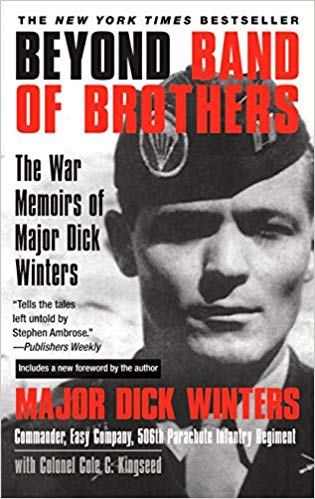
 Why this book: I had read Ambrose’s Band of Brothers, and have seen a few parts of the HBO series. Dick Winters is clearly the hero of the book and the TV series. I was interested reading his perspective on his actions. This book gets very high marks from all I know who’ve read it.
Summary in 4 sentences: This is the back story behind the well known book Band of Brothers by Stephen Ambrose, and the HBO mini-series based on it – in which Dick Winters was one of the lead characters. This is Dick Winters’ very personal auto-biographical account of who he was, how he became a soldier, then an officer, how Easy Company trained in the US and then in the UK, and fought its way through Europe, from D-Day to VE Day. The majority of the book takes place after D-Day as Easy Company engages in France, Holland, Belgium and Germany, and indeed those were the hardest battles that were fought. The book concludes with the challenges of managing occupations troops in the months immediately following Germany’s surrender, then his return to America, re-integration into civilian life, and finally his long term involvement with his fellow soldiers after the war.
My Impressions. This is one of the best first person accounts of an infantry officer in sustained combat that I’ve ever read. It is very personal and he is honest and humble. Most of the first person accounts of combat that I’ve read have been special operations forces, since that has been my specialty, but the brutality of war and the sustained combat he experienced go far beyond what most special operations forces experience.
His and Easy Company’s parachute jump into Normandy, and their support of the D-Day invasion only account for about 20 of the 292 pages in this book; the majority and most powerful are his experiences in Operation Market Garden in Holland, and in Bastogne in Belgium where his rangers experienced their most violent combat, and most severe losses. At the beginning of the book, Dick Winters is a private, was sent to Officer Candidate School to become an officer, and deployed to Europe as a platoon commander. Then in a year of intense combat rose to Battalion commander, from 1st Lieutenant to Major.
This rapid promotion was in part due to attrition – so many officers and senior leaders were killed that officers had to move up to fill the ranks, as well as to make room for the junior replacements coming in. But he was also promoted due to his competence and proven track record under the stress of combat. On D-Day itself, after parachuting into Normandy at night, Winters gathered his men together, rendezvoused with his seniors and then led a 10 man squad against a much larger German force to silence several artillery positions that were decimating US troops landing on Utah Beach. He was awarded the Distinguished Service Cross for this action – the nations 2nd highest award for gallantry in combat. He continued to perform well under pressure, and the senior leaders in the 508th Parachute Infantry Regiment recognized him as one of their strongest tactical leaders.
Beyond Band of Brothers is also a primer on leadership. He treated his men with respect but he also set and enforced high standards. His men knew that he would take care of them, but he never coddled them – he was no harder on them than he was on himself. He led by example in all endeavors and his men knew that he would never ask them to do anything that he wouldn’t do himself. The love and respect he felt for his men was well understood and was mutual.
In the last part of the book he briefly summarizes his life after the war, and shares how many of the other soldiers fared in their post-war lives. Fifty years after the war, when Ambrose’s Band of Brothers was published, and then followed by the HBO mini-series, Dick Winters suddenly became something of a celebrity, but his humility and strength of character were constant. In the last years of his life, he was in great demand as a speaker on leadership and his simple but very effective leadership principles are included in the back of the book.
A quote that caught my attention, from just after describing his actions on and after D-Day, including the action that earned him the Distinguished Service Cross;
As for myself, I never considered myself a killer, although I had killed several of the enemy. Killing did not make me happy, but in this particular circumstance, it left me momentarily satisfied – satisfied because it led to confidence in getting a difficult job done with minimal casualties. Nor did I ever develop a hatred for the individual German soldier. I merely wanted to eliminate them. There is nothing personal about combat. As the war progressed, I actually developed a healthy respect for the better units we faced on the battlefield. But that was all in the future. For the time being, I was just happy to have survived my baptism by fire. I had always been confident in my own abilities, but the success at Brecourt (the action for which he received the DSC) increased my confidence in my leadership as well as my ability to pass it on to my soldiers. (p 94 pp edition)
This is great book on combat, D-Day, on US combat in Europe in WW2 and on combat leadership. And it’s a fun read. Highly recommended.


 Bob's Books
Pingback: D-Day: My visit to Normandy | Bob Schoultz's Corner