
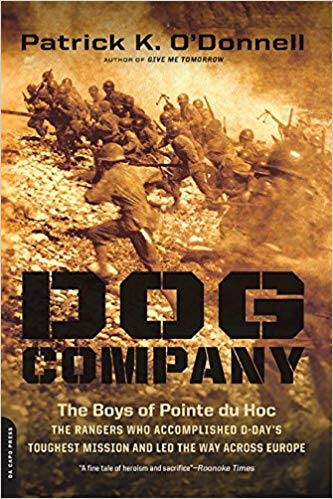
 Why This Book: I knew I’d be visiting Pointe du Hoc, famous for the Ranger raid at the commencement of D-Day, and this book would give me the background to better appreciate that experience.
Summary in 3 Sentences. This book reads almost like a we-were-there, since it is based primarily on interviews with the guys who survived the war, which includes the funny, tragic, and heroic versions of their experiences. It begins with intensive training for nearly 8 months in the UK in the lead up to the invasion, and then the initial phases of the assault and climb, and the battle once they got to the top. After about June 8th they were relieved and the remainder of the book is about the Ranger operations moving East into France, Belgium and Germany until the end of the war.
My Impressions: This book is similar to Maj Dick Winters Beyond Band of Brothers, but it is different in that it is not the personal account of the commander – Patrick O’Donnell is a military historian, researcher and writer, though indeed O’Donnell knew many of the people he wrote about and felt tied to them. O’Donnell not only honors the men and what they did, but provides perspectives on the horrors that the individual combat soldiers faced in the sustained combat of WW2.
O’Donnell did an enormous amount of research to write a very engaging history of this one ranger company that succeeded in one of the most famous missions during the Normandy invasion. In addition to researching memoirs, and archives, and finding previous interviews, he was able to personally interview several of the key D-Company rangers, as well as others who participated in D-company operations at Pointe du Hoc and later. As in Dick Winters’ Beyond Band of Brothers we get to know the soldiers personally through their own voices in the interviews, we follow them through their training and rehearsals, and we get their versions of the operations. Few of the original Boys of Pointe du Hoc were with Dog Company at the end of the war. Many were killed or seriously wounded, and most of those who were with them at the end, had been wounded, evacuated, and had returned to continue fighting.
O’Donnell gives us a detailed account of what Dog Company did on D-Day and the Pointe du Hoc assault and its immediate aftermath – approximately 60 of the 252 pages of the book are about Pointe du Hoc. Like Ambrose’s Pegasus Bridge, this book focuses on how with luck, courage, and an intrepid spirit, a small group of highly trained men succeeded at a very difficult – almost impossible – mission. And then we follow these rangers into the most brutal fighting afterward, all the way to the end of the war. If the number of casualties is the measure how tough the missions were, then Pointe du Hoc was a picnic compared to their battles at Bergstein and Hill 400 in the Hurtgen Forest, and later in the Bulge.
One operation I was surprised I’d not heard of before took place in the battle to retake the city of Brest, France – after D-Day and Pointe du Hoc, but before Bergstein and the Ardennes. A D-Company squad, eventually nicknamed “the Fabulous Four,” kept pressing their luck, and through an amazingly bold gamble, was able to get inside the German fortifications at the Lochrist Battery and get 800 Germans to surrender and surrender the battery itself. The Lochrist Battery was a seemingly impregnable coastal artillery site that commanded the entrance to Brest harbor, and was essentially the model for the Guns of Navaronne. That, and how these guys pulled this off is almost unbelievable – the stuff of Hollywood.
At the beginning of this book, wasn’t as engaged as I was with Winters’ Beyond Band of Brothers. But as I got into it, I became more impressed with the research that O’Donnell had done and the very personal touch he added to the combat, based on the personal reminiscences of the soldiers themselves, as revealed through their interviews. Dog Company the Boys of Pointe du Hoc is another great book on the intrepid spirit of American citizen soldiers put into the most harrowing of combat situations, and how they took care of each other and their missions. It provides a great perspective on the horrors and heroism of soldiers in sustained combat – in WW2.


 Bob's Books
Pingback: D-Day: My visit to Normandy | Bob Schoultz's Corner