
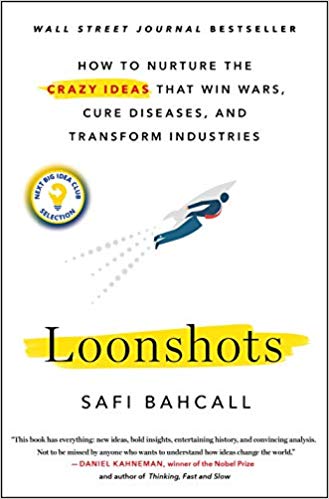
 Why this book: I listened to Tim Ferriss’s interview with Safi Bahcall and liked him and what he said – it was excellent. Also this book was a pick of The Next Big Idea Club, to which I belong.
Summary in 3 Sentences: The thesis of this book is that our society only makes progress when it adopts new ideas, which are almost always resisted by those with a strong vested interest in the status quo. He provides us many fascinating and surprising historical examples to support his thesis that an organization must be structured to separate those supporting the franchise from those developing creative new ideas. He also provides other practical steps for how an organization can cultivate break-through ideas to succeed, and minefields that must be avoided – not only by organizations, but also by the creative individuals themselves.
My Impressions: Fun and fascinating read. Bahcall was trained as a physicist who then went into business. Bahcall grabs our interest with stories about products we now take for granted, which have changed the world we live in, how they were often strongly resisted by those who found them unnecessary, superfluous or bound to fail. Such things as radar in the military, movie ideas such as the James Bond series or Star Wars series, commercial jet travel, medical innovations like statin drugs. In each case the innovator persisted against the nay-sayers and the conventional mindset to eventually succeed in changing the world we live in.
Trained as a physicist and a very astute learner, Bahcall transitioned into business and soon realized that while organizational culture is important to a business success, organizational structure probably is more important when it comes to being creative and innovative.
Loonshots begins by showing how organizational structure can naturally impede creative ideas – what he called and many regard as “loonshots” – ground breaking or seemingly crazy ideas that can change the world. An organization that aspires to win through ground-breaking innovation must separate and shelter radical creative thinkers from those whose job it is to efficiently run the organization. He says that the “artists” must work separately from, and be protected from the “soldiers” who run the “franchise.” Soldiers manage risk in order to run the organization as efficiently as possible. In the short term, radical changes and truly innovative ideas involve risk and accepting failure, and can be very inefficient – anathema to the soldier mentality.
So his first and strongest recommendation is for leaders to structurally, separate the visionary innovators from those who run the franchise. The leaders must be “careful gardeners (who) ensure that both loonshots and franchises are tended well, that neither side dominates the other, and that each side nurtures and supports the other.” p38 This he calls balanced phase separation.
Bahcall points out, again and again, that “the breakthroughs that change the course of science, business, and history – fail many times before they succeed.” p 37. The greatest enemy of a truly good idea is what he calls a “false fail” – an idea that is still immature and/or the test or experiment may not take into consideration key affecting variables. The test/experiment fails or appears to fails not because it’s a bad idea, but because of some other factor that the experiment does not take into account.
He goes on to distinguish between two distinctly different types of loonshots. First are “P-type” moonshot – referring to a new innovative product or piece of equipment. The second are “S-type” loonshots – referring to a new strategy, “a new way of doing business, or a new application of an existing product, which involves no new technologies.” p66 Radar, or polaroid cameras, or statin drugs were P-type loonshots. Examples of S-type loon shots are Walmarts supply chain management and retail system, or how American Airlines creatively managed union contracts, and developed the most efficient computerized reservation system.
He warns against what he calls the “Moses Trap” to which innovative leaders are vulnerable. It is when a creative individual builds a company based on his/her personal loonshot, and then goes on to think that s/he is a genius who should run everything. Such creative geniuses are often artists who don’t know how to run a franchise, nor do they understand how to integrate strong franchise management with creative innovation. He gives several examples of great loonshots that eventually ran out of steam, or failed to capitalize on their wins, because the loonshot creator fell into the “Moses Trap” and failed to adapt with the times and the market – Steve Jobs during his first period with Apple, Ewin Land of Polaroid, Juan Trippe of Pan Am.
He also shared the opposite of the Moses Trap, which he called the PARC Trap -named for the Palo Alto Research Center developed by XEROX where great ideas were born and either died, or were hijacked, due to no phase transition to the franchise side of the business. There was no equilibrium or collaboration between artists and soldiers to permit the business side of the corporation to commercialize and monetize the great ideas. So the great inventions either died, or sat there until others eventually took them to market, changed the world, and made billions.
The second part of the book is very much about organizational dynamics, and how it is almost a law of nature that a successful business will grow until it transforms itself into a less agile and more bureaucratic, more conservative organization. Understanding this, and focusing on maintaining an equilibrium between the creative and the franchise sides of the business won’t prevent that, but it will help to manage it.
The section on Phase Transitions is a bit hard for me to follow – the scientist in Bahcall does analyses of how fires spread, how traffic jams happen, how infectious diseases spread, tracking terrorist activity. His point (I believe) is to look at how little ripples can create big waves, and to better understand how small events can have disproportionate effects. In describing the “axiom of emergence,” he recalls that Sherlock Holmes said that while individuals remain puzzles, man in the aggregate “becomes a mathematical certainty.” p177 He quotes scientist Neil Johnson , “you don’t need to know anything about the individuals,” to detect the patterns in their collective online behavior, and describes this as “the magic of emergence.” p 184
The follow up to that is the certainty that, inside organizations, as the size of the group grows, incentives shift from focusing on collective goals to focus on career and promotion. “When the size of the group exceeds a critical threshold, career interests trump. That’s when teams will begin to dismiss loonshots and only franchise projects…will survive” p 186
He discusses how as organizations grow, the “return-on-politics” increases – meaning that the career/promotion returns from time and energy spent on managing one’s reputation, one’s network, and how one is perceived in an organization, increase relative to the returns gains from putting time into actually working on a project. p198
Bahcall reaffirms what I’ve read in several other places – that about 150 people is the threshold for a team to stay cohesive around a common project. After that, he says, “the system suddenly snaps from favoring a focus on loonshots to a focus on careers.”
He offers a couple of solutions to this dilemma and notes how “soft equity” such as recognition from respected peers can almost serve as “paycheck” to inspire innovation. He looks at DARPA – and how they have avoided having an overstaffed bureaucracy of people pretending to work, by hiring people for shorter periods and offering no or few promotions – just huge gains in reputation and “soft equity,” which most can cash-in on later.
“Tilting the rewards more toward projects and away from promotion means celebrating results, not rank.” p218 And it will make larger groups more likely to innovate. The promotion and increase pay system incentivizes low-to-no risk ventures. He has a great section on changing incentives to increase performance and innovation.
He has a whole section on how span of control is also a factor in facilitating innovation. The narrower the span, the greater the tendency toward micro-management and risk aversion. “Wider spans (15 or more direct reports per manager) encourage looser controls, greater independence, and more trial-and-error experiments. Which also leads to more failed experiments. ” p222..”Which takes us to another reason a wide management span helps nurture loonshots: it encourages constructive feedback from peers….creative talent responds best to feedback from other creative talent. Peers, rather than authority. ” P223.
His penultimate chapter “Why the World speaks English” answers the question: “Why did loonshot(s) appear and spread rapidly in Western Europe, in the seventeenth century, plus or minus a few years, when the empires of China, India, and Islam led the world in wealth, trade, organized study, and early science and technology for a thousand years?” p239 His answer: Loonshots flourish in loonshot nurseries, not in empires devoted to franchises. p257
His concluding chapter “Loonshots vs Disruption” gives fascinating examples of how many of the loonshots that changed the world were creative adaptations to undesired environmental factors. Many of these were not designed to be innovative or disruptive changes – they were simply creative responses to simple challenges. He tells why Sam Walton set up in Arkansa which forced him to find a new retail model; why IKEA found cheaper sources, and allowed customers to shop in warehouses, how google searches and transistors were “sustaining” innovations which had already been developed by others.
Conclusion: For a Loonshot nursery to flourish -inside either a company or an industry -three conditions must be met:
- Phase separation: separate loonshot and franchise groups
- Dynamic equilibrium: seamless exchange between the two groups.
- Critical mass: a loonshot group large enough to ignite. To thrive, a loonshot group needs a chain reaction.
He states: “Leaders well-coached on group dynamics are likely to spend more time with their teams. It’s fun working with high-performing teams who appreciate you. It’s less fun to spend time with dysfunctional teams who hate your guts.” p217
“The ability to innovate well is a collective behavior.” p227


 Bob's Books