
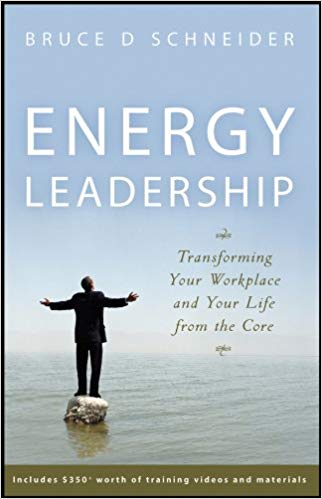
 Why this book: Given to me as a gift from my friend Paul Monahan, a professional executive coach who uses the methodology outlined in this book in his practice. Paul impresses me as a man and a friend, and I promised him I’d read the book. So I did. And I’m glad I did. It was a gift from him that I appreciate.
Summary in 3 sentences: The author uses (I assume) a hypothetical coaching story as a basis for explaining his approach to leadership, as he coaches a CEO of a failing company out of a downward spiral using what he calls “Core Energy Coaching” – the model he describes in this book. In this scenario Bruce Schneider, the author as coach, helps the CEO understand what is happening in his company in terms of the types of energy he transmits to others and that others transmit to each other, and then with this understanding, helps him increase this energy from negative, or catabolic, to positive or anabolic energy, and thereby increase positive energy, morale and profits. The result is a more creative and energized company, more engaged and fulfilled employees and greater success in the market place.
My Impressions: I really liked this book – and found it valuable in understanding how I see myself and others in my world – in terms of the kind of energy I /we/ they transmit. This model applies a positive psychology approach to people and how their interactions drive short or long term success in business. Though there is no “religion” as such in the book, he does refer to the levels of energy he describes as synonymous with levels of consciousness, and the upper levels in his energy hierarchy are very reminiscent of levels of spiritual enlightenment described in many of the world religions. I found that how Schneider applies his philosophy to the work-a-day world of business to be unique, interesting and insightful.
 He describes his hierarchy of energy levels in what he calls his “I-chart,” so named because it is oriented on how the self – one’s “I” – interacts with the world. The levels in the picture are reminiscent of other models I’ve seen, from Kohlberg’s moral development hierarchy to Maslow’s hierarchy of needs to even Buddhist levels of enlightenment. He refers to levels of energy or levels of consciousness as key to who we are and how we affect the world and people around us. Schneider’s philosophy is based on the statement that “The only way to make real, sustainable changes in your life and your organization is to change (one’s ) level of energy,” (p75) and the book is a story about how he coaches a CEO into making his level of energy more positive, and thereby improving the level of energy of his company.
A very quick explanation of the above I-chart: Though he shows 7 levels of energy, these 7 levels are within three main circles, beginning at the center with Self, then Self-Mastery, and finally, Self-Transcendence. He spends most of the book on how to move from the first circle (levels 1 and 2) into the second circle (levels 3-5), since most struggling companies are at level 1 (apathetic, victims) or level 2 (anger and conflict). In Energy Leadership, he works with his CEO to move him (and his company) into the second circle, which begins with level 3 – a more positive level of energy – and then beyond, to level 4 and 5.
He notes that many if not most businesses operate at level 2 in in the market place, focused on “I win/you lose,” with the result that people in the company are also internally competitive, and see personal success as almost necessarily at someone else’s expense. Moving to level 3 is a HUGE step for the company, as well as for employees, in that it demands moving from friction and competition to cooperation, personal responsibility, teamwork, and working toward a common goal with people one may not even like.
Levels 1 and 2 are characterized by a bleak world view, in which leaders and employees focus primarily on efficiency and dealing with problems, moving from crisis to crisis, rather than focusing on solutions and moving from one success to another. Level 3 and beyond maintain a positive view of people, as well as current and future opportunities. Level 4 makes room for heart-felt compassion and empathy – a concern for others. Level 5 sees ALL problems as opportunities with no judgment of “good” or “bad.” This level 5 philosophy reminds me that the Chinese word for crisis is composed of two characters – one for danger and the other for opportunity. It also reminds me of Jocko Willink’s response to every problem his subordinates brought him: “Good. This gives us an opportunity to…. (whatever.”)
He notes that progress for most of us is inhibited by 4 main “blocks” that we impose on ourselves to prevent us from increasing our level of energy and reaching our full potential:
- Limiting beliefs about possibilities and the world;
- False assumptions from our past experiences that affect us today;
- False interpretation of other people’s words, intentions and actions;
- Fear that we are not good or capable enough to achieve what we want.
He offers several tools for becoming aware of these blocks (which is the most important first step) and then afterward, how to not let them hold us back. As a coach, helping his client to recognize and move past one of these blocks, he asks, “What might be another way to look at this? What new thoughts could you adopt that might lead to different results? This question may open new doors of insight and understanding.
He doesn’t spend a lot of time on levels 6 and 7 – the self-transendence circle of his I-chart, I assume because it’s enough work to get from self-centered to self-mastery, from levels 1 and 2, to levels 3-5. But he does give us a chapter on levels 6 and 7 to give us a glimpse of how he believes it is possible for a truly enlightened business, led and run by truly enlightened people to operate. Whether and how this might be possible would be another discussion.
Some other insights I found interesting”
- His guidance on “centering” is very consistent with what we teach the SEALs to do in what we call “arousal control.” The breathing/centering practice is a standard in Yoga and other practices. I use it myself.
- Emotions – he argues against the widespread view that emotions are out of place in the work space, noting that emotions are key to a positive energy work environment. But emotions need to be managed, channeled, and positive. That is much of what this book is about.
- He speaks of Emotional Intelligence as “EI” instead of the more standard “EQ” and notes how expressing emotions “appropriately,” is key to achieve what he calls “IE” – interpersonal effectiveness. “EI is not about just expressing emotions, it’s about expressing emotions appropriately.” (p 181.) Knowing what is “appropriate” and then being able to act on it is the challenge….
- “How we see ourselves determines everything.” p 135
- We are often victims of our inner gremlin – our inner critic, driven by fear and one or more of the four blocks. But we also have a more positive self – what he calls a higher self or an inner genius. He says when we pit our genius agains our gremlin, our genius will trump the gremlin every time.
- In his discussion of levels 6 and 7, he talks about the paradox of “detached involvement’ – being totally engaged in a task or activity, yet completely detached from the result. This correlates closely with what I’ve read about a state of “Flow.”
Throughout the book he suggests viewing short videos (4-6 minutes in length) on his website, which explain different aspect of the Core Energy Coaching approach to leader development, and personal and organizational change. I viewed several of these videos and they are a good supplement to the content of Energy Leadership. Were I to decide to adopt this as an approach to coaching, I would view all of these videos, and then work with a coach to help with the coaching side of this approach. And if I were to decide to become a coach, I’d seriously consider this approach.
Energy Leadership is about a philosophy of personal and organizational development. It also applies a non-directive, inquisitive coaching style to helping a leader to understand this philosophy., understand him/herself and others in their environment. It is a combination of teaching and coaching. I like it. I think it would combine well with the coaching approach advocated in Effective Modern Coaching by Myles Downey.


 Bob's Books
Thank you for the insightful review. The title immediately makes me think of sports psychologist and human performance expert Jim Loehr. Loehr is amazing and the central theme of his work is on helping athletes and CEO’s optimize their energy.
For me, the section about what limits our potential resonates with me the most.
Limiting beliefs about possibilities and the world;
False assumptions from our past experiences that affect us today; (This makes me think of Trevor Mowad and his work on neutral thinking).
False interpretation of other people’s words, intentions and actions;
Fear that we are not good or capable enough to achieve what we want.
My takeaway from this article and my goal for this week is to journal every night on the above 4 things, asking myself these 4 questions.
Today, did I limit my beliefs about what is possible?
Today did I apply neutral thinking?
Today did I apply active listening? And did I not take anything personal?
Today did I demonstrate any fear that I am not good enough or not capable enough?
Thanks again for the insightful review!
Chase – those are great questions to ask oneself! And to make a REAL strong impression, ask them several or at least a couple of times a day! And yes, I wish I had the self discipline to do that! Thanks for your note! Bob