
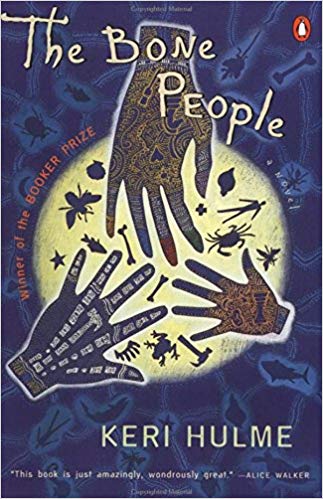
 Why this book: I am making my first trip to New Zealand in a couple of weeks and a friend recommended this book to help me get my head into New Zealand. It is a Pegasus Prize winner and a winner of the Booker Prize.
Summary in 4 sentences: Three good but psychologically wounded people try with the best of intentions to build a relationship that will serve each of them. Kerewin a single woman and a loner, and Joe a widower, both grew up in Maori households and are living lives of “quiet desperation.” The third member of this trio is Simon, a child of about 7 or 8 years old, clearly with “issues,” whose parents are unknown and who Joe is trying to raise. Just as things appear to be moving in the right direction, a misunderstanding leads to a dramatic incident that drives all three apart, and the remainder of the book is about how each finds a more positive path.
My Impressions: A powerful book – not an easy read – and not one I will lightly recommend to most of my friends, who prefer more uplifting literature, but I’m glad I read it. It was well written, in a creative style and approach, with a very different theme. It is a story of love and acceptance, overcoming personal challenges to find connections, a story of forgiveness and redemption. The author’s message and the story she tells to reinforce it, are powerful and impactful and it is a book I’ll not soon forget. It’s a commitment to get through it, though.
The author takes the reader down a difficult path with the three primary characters in the book, and I was drawn in, trying to better understand and appreciate each of them. We get to know the three main characters as they struggle to trust each other and connect in a world where none of them fits. Each was a somewhat broken soul, trying to find their way, but struggling and often making decisions that were NOT helpful in their efforts to connect and find peace — and that was painful to read. As I got into the heads and motivations and struggles of each the three characters, I came to like and root for each of them.
The story takes place on the South Island of New Zealand apparently in the 1970s or 1980s, since the book was published in 1984. The three characters are carrying a lot of baggage – at first we don’t know what that baggage is – though we see its manifestations in their behavior and decisions. The primary protagonist is a woman in her early to mid 30s, who it’s easy to assume is the author’s alter-ego – the author Keri Hulme writing in the voice of Kerewin Holmes. The author’s preface to the first edition sounds almost as if it’s in the voice of the protagonist.
Kerewin Holmes is an artist and a loner, not at all interested in men (or women for that matter,) preferring to live by herself, practice her art alone, very much on the outside of society. She is friendly, polite, but distant to the people she meets. The other adult character is Joe, a laborer and widower who is struggling to raise a boy for whom he assumed sponsorship after the boy was the sole survivor of a boat accident during a storm. Joe is a lonely, probably early 30s, living alone with the boy – having lost his wife and child to a disease a few years earlier, and he finds what company he can in bars. Both Kerewin and Joe drink a lot to psychologically self-medicate and deal with their loneliness – Kerewin often drinking alone, Joe in the bars. The third character Simon, the damaged but clearly precocious child, with no known history before he washed up on the beach. He is mute and can’t or won’t share any memories from his life before. He is clearly very intelligent, and swings between needy curiosity, and bouts of uncontrolled anger. Though he can communicate in writing and with simple sign language, he doesn’t share much.
The setting is a small town on the East Coast of New Zealand’s South Island and both Kerewin and Joe are mixed blood European and Maori heritage, and both grew up with significant Maori culture in their childhood – both speak Maori, and when they communicate with each other, they often inject brief phrases from the Maori language – for which there is a glossary at the end of the book. For some, this could be distracting, but I found that it reinforced the mixture of European and Maori culture not only in the protagonists but also in much of New Zealand. .
These three lonely and somewhat dysfunctional people come together and seek to find a modus operandi in which each can support each other in a way which gives each the space they need to deal with their own demons. The first two thirds of the book is character development – we get to know our three main characters as they get to know each other. And it was unclear to me where the story was going. Then something dramatic and unexpected happens which tears asunder the partnership that had been developing between the three characters. The remainder of the book is about how the three deal with their new situation, and the author goes deeper into the characters of each of the three. Eventually the three re-assimilates into a partnership much stronger than before. There were many surprises in the last portion of the book, and we learn more about Maori culture, mysticism, and metaphysics and how these bump up against the predominant Western-British culture of New Zealand.
Ultimately the book is about isolation and the need for community, home and family, about anger and forgiveness, redemption and renewal, love and connection, life and death. What for most of the book was not an uplifting story ends on a positive note in a surprising manner. The final lines, in Maori are: The End, or the Beginning.
If you’re up for an interesting award winning read that is not a so-called page turner, that offers insights not only into New Zealand but how good people can inadvertently hurt each other and eventually find redemption, then you would probably like this book.


 Bob's Books