
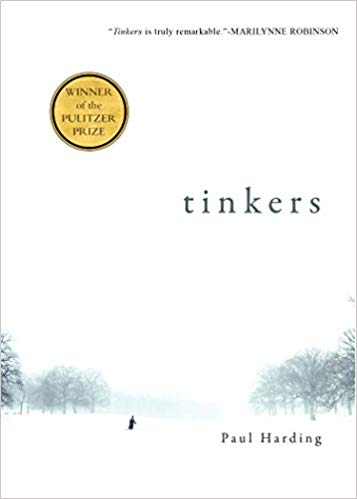
 Why this book: My wife read it twice and was really impressed. It is a Pulitzer Prize winner. My reading group was looking for a shorter book after we had finished a much longer one.
Summary in 3 sentences: It is the story of a father and son – but not about their relationship, but about specific periods in each of their lives. The son we get to know as he is dying; the father we get to know as a boy and a young man, many decades earlier. It is beautifully written exploration of character, of life, death in the context of rural New England 100 or so years ago.
My impressions: Very interesting and powerful book – about life, death, our connection to our parents, and to nature. I’ve never read anything quite like it. It’s short – just shy of 190 pages. The story isn’t linear – the story bounces back and forth between the lives of its two primary characters, several decades apart. The story begins with the son George, dying at home in his 80s, at the end of a good life. Then we get to know George’s father Howard, long since dead, but who continues to pop up in the somewhat hallucinatory and somewhat random and confused thoughts of George, in his delirium in his death bed. Then the narrative switches to Howard’s – the father’s – life, growing up in rural Maine in the late 19th early 20th century. The author describes the world as they experienced it – it is very much internal – about the thoughts and reactions to their experiences of two very introverted men.
Through George, we get a sense for what it is like to have one’s health failing and life ebbing away, as one lies at home supported by family.
Though the book begins and ends with George lying at home knowing that he is dying – we actually learn a lot more about the life of Howard, his childhood and young adulthood in rural New England among poor, working class country folks, with few urban comforts, taking care of each other, struggling to get by. As we get to know Howard as a young boy, and the difficult time he had growing up, we also get glimpses of the Howard’s father, a minister in rural Maine, who was having a psychological breakdown, and the impact that had on Howard.
Then later we get to know Howard as an adult – a Tinker – driving a wagon around the country selling household goods to farms and very rural people for whom getting to town to buy pots, pans, tools, etc is very difficult. George is Howard’s oldest child at home, but the story is mostly about Howard. Howard has a special relationship to nature, beginning as a young boy, continuing into his adult life as he spends so much of his life driving his horse-drawn wagon through the woods and down country roads. This special relationship to nature comes out in the poetic descriptions of how he experiences nature and life.
We also experience the quiet desperation of Howard’s wife, stoically raising children alone, with few resources, while her husband is out selling in the countryside. There are only a few characters in this book but they are well developed and I felt a connection to and empathy for each of them – they are all very quiet and self-contained; thru the author we get to know their internal life.
The book is beautifully written in an almost poetic style, especially his descriptions of nature. Charles also grows up to become a modern day tinkerer; he repairs – tinkers with – clocks and watches, and the author plays with the metaphors of time and the intricacies of clock mechanisms to the world we live in.
This little gem is a meditation on life, and the lives and struggles of ordinary people, and death is treated as a part of life – by looking clear-eyed at what it’s like to die. And in the process we also experience the connection between fathers going back 3 generations
There are a lot of interesting pieces to this little book – my wife Mary Anne chose to re-read it after she had finished it, and I can understand why. Knowing the outlines and end of the story made it easier for her to appreciate and savor the beautiful writing, and notice nuances in the rich descriptions of the key characters in the book. Not a book I’d recommend to everyone, but for those who appreciate beautiful writing and are willing to experience a different type of literature, again, this is a gem.
When she couldn’t attend our reading group to discuss Tinkers which she had recommended to us, Mary Anne wrote the following review:
Tinkers was a book that I bought at the Coronado Book shop, and I had it in my possession for about three years. I finally picked it up to read on a plane ride from San Diego to Florida and I was immediately taken with the author’s use of language to describe very minute and fleeting moments in our lives. Who would have imagined that a small grass woven basket for a tiny bird could be so described for several pages. It highlighted for me that moments are all we have….not grandiose, or important…..just moments when we can become still and see the beauty in these seemingly unimportant evolutions.
It’s not a happy book, but it is a real book, about ordinary people (in New England) during the early 1900 to the present day. I loved that it was the interior thoughts that were emphasized throughout the book. No grandiose happenings, just life, day by day, in a particularly hard environment.
None of the characters were heroic, or did anything that might draw accolades. It is the majority of us! And there are flaws galore with each of the characters…..whether it be physical, like epilepsy or emotional, like Howard’s wife, holding resentment against her lot in life.
The use of time and the work on clocks indicates the fleeting nature of our existence here and we need to be aware of that.
Love the story of the tinker selling soap in a newfangled box and how the women didn’t understand why the box needed to be updated….
Or the deathbed scene in the beginning when the roof caves in and the cellar swallows the bed .
Or, when George thinks about how he will be remembered by his children, grandchildren and great grandchildren….page 65 (too long to copy!)
To me, there is so much in this quiet book that speaks of the mysteries of our existence. I’ll keep this book on my shelf to read again!


 Bob's Books