
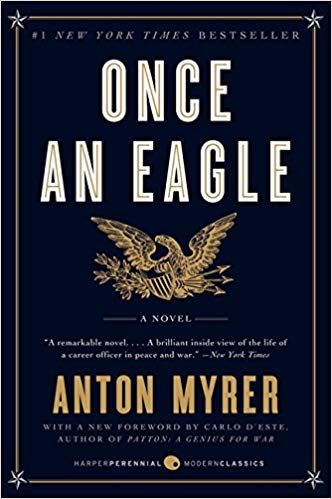
 Why this Book:This book has been recommended to me for many years by friends and acquaintances. It has also been number two (behind Killer Angels) on the survey of recommended books by active and retired 4-star military officers, published as the Leader’s Bookshelf by Adm Jim Stavridis, My friend Dittie Dittmar has been insisting for several years that I ]read it. Then my friend Jay Hennessey brought it up, which resulted in a group of our friends committing to reading it.
Summary in 3 Sentences: It’s a novel about one man’s journey in the Army through most of the first half of the 20th century – to include WW1, the interwar years, WW2, and the beginning of the Vietnam War. We learn a lot about Army culture, marriage and family life in the Army, the experience of the ground soldier in brutal combat, and the challenges of leadership in battle. It is mostly a character study of how a number of people deal with those stresses, but most prominently, the tensions between a rather selfless combat leader who loves his men, and a self-centered and gifted staff officer who is a great manipulator of the system for his own benefit.
My Impressions: Quite an Epic! Covers five decades of the 20th century and so much territory, to include the horrors of battle in two world wars and the beginning of our Vietnam War experience, the challenges of leadership in combat as well as in less dramatic contexts, and how different types of people deal with a variety of different types of adversity and stress. It’s about honor and ambition, about love and friendship, marriage and family, camaraderie and responsibility, a little bit of hate, and lots of killing in the contexts of war. It deserves it’s reputation as a great epic of the 20th century. It will have more (or different) meaning to readers who have a close connection to the military, but I spoke to a good friend with no close contact to the military who loved it.
But more importantly, Once an Eagle is about issues of character – focussing on one main character, but with a rich cast of supporting characters whose stories and behavior add depth to the character discussion. And it is about values, compromise, struggles with conflicting values and loyalty. There is much to discuss and think about in this book. It is not a quick read – the copy pictured above is close to 1300 pages, but it is a fascinating read – not hard to pick up, and often hard to put down. It took me a couple of months, but in that window, I read 3 other books in parallel. I’m really glad my friends Dittie and Jay nudged me to finally pick it up.
Anton Myrer was student at Harvard when Pearl Harbor was bombed. He immediately enlisted in the Marines and served in the Pacific, participating in the battle of Guam, where he was injured, was discharged in 1946 and returned to Harvard where he graduated Magna cum Laude in 1947. He wrote Once an Eagle in the early/mid sixties and so we are looking at the world and how his characters meet their challenges through the eyes of veteran of WWII from that era.
The main character is Sam Damon, who was born at the very end of the 19th century, grew up with classic American midwestern values in a small town in Nebraska (where my parents grew up and where I was born.) Once an Eagle begins when Sam decides to leave home and enlist in the army to fight in Europe, then we follow him to becoming a hero in WW1, awarded the Medal of Honor and eventually a field promotion to be an officer in World War I. We then follow his courtship and marriage at the end of the war and the inter-war years with Sam learning to be an officer in peacetime, as well as a husband and father. Over the next 20 years, he and his environment evolve and change, until the outbreak of WWII, and his eventual promotion to General Officer to lead troops in several critical engagements in the South Pacific.
Courtney Massengale. The other primary character in Once an Eagle is a contemporary of Sam Damon’s, Courtney Massengale, a West Point graduate, full of charm, ambition and a talent for winning the trust and confidence of his superiors in rank and very comfortable in the salons and offices of power. He is uncanny at landing plumb assignments, avoiding combat and the less glamorous jobs, and getting promoted. Massengale is the anti-hero in the book, and his and Damon’s lives intersect at various key interludes. The differences between Damon and Massengale is one of Myrer’s main themes, and they represent two fairly extreme ends of the spectrum of military officers one encounters. Most of officers I know and have met – and I’ll include myself in this group – are somewhere in the middle between these two. The moral and personality clashes between Damon and Massengale, and their different approaches to their roles and responsibilities in the Army form the backbone of the book.
Tommy Damon. A third primary character in the book is Sam’s wife Tommy, which allows the story to explore the challenges of marriage and family life within the military (or any high stress, demanding profession for that matter.) Tommy is independent and headstrong and rebels against the army’s expectation that wives be docile and submissive. Once an Eagle explores the challenges that Tommy and Sam have – two very different, very intelligent and stubborn people – raising a family and making a marriage work within the military. The arguments and tensions between Sam and Tommy were familiar to me – having grown up hearing many very similar arguments between my career Navy father and my mother during the 50s and 60s, and I’ve felt similar tensions between the demands of my Navy career and my very independent and sometimes rebellious spouse. Through Tommy’s and Sam’s friends and fellow officers in the Army, we see other marriages, with both different and similar issues and struggles, and painfully, we also see the impact of the constant threat and reality of loss on military families.
The book concludes in 1962, at the beginning of the Vietnam War, when the Chief of Staff of the US Army asks Sam to come out of retirement and go to Vietnam to look around, evaluate what he sees, and report back – to provide the Chief of Staff with a fresh perspective from an old soldier. Given that the book was published in 1968, Myrer, through Sam Damon, provides a blistering criticism of how the US mis-interpreted what was happening on the ground in Vietnam, and our decision to get involved as we did. Of course, Courtney Massengale appears again in this final section of the book, with his very personal agenda, tuned to which way he sensed the wind to be blowing.
As much as Myrer clearly admired the Army and many (most?) of the people in it, Once an Eagle is very critical of much of Army culture, and he admitted that it is very much an anti-war book. But the paradox that we see in this book is that as much as war brings about so much needless suffering and death, it can also inspires great courage and strength of character. In Once an Eagle we see the horrors of war, the weakness of men, as well as examples of men and women at their best.
In spite of some of the weaknesses critics have pointed out, I think it is a must read for anyone who wants to understand 20th century America, and the issues that drove and defined who we were.
Those are my general comments – Below are my thoughts on different aspects of this impressive book that interested me.
——–
Masquerade: At one point while Sam was in China, Tommy attended a military masquerade ball, and the metaphor was non-too-subtle about how everyone there, overtly pretending to be someone else, was in fact ALWAYS in their work, hiding who they really were, because that is what the Army expected. The metaphor of the masquerade party was brilliant. It’s interesting to me that Myrer included this scene when Sam could not attend.
Guerilla Warfare – China and Vietnam. In the mid 1930s, Sam was detailed to be an observer of the Chinese peasant rebellion against the Nationalist Chinese forces – what would eventually become the Chinese communist revolution. Sam agreed to spend nearly 2 years “embedded” with a Chinese guerrilla group, and at the end had had many close calls, but also gained many important lessons learned. He was awed by their focus, physical and mental toughness and their complete and selfless dedication to their cause. These lessons formed the basis of his assessment of the Vietnam War nearly three decades later. Also, typically, when Sam completed his assignment in China and returned, the senior officer whose vision had sent him on this “errand” was no longer there, and his successor was indifferent to China and to Sam’s insights.
We relive part of Sam’s experience in China when he is able to visit and engage with a guerrilla leader during his visit to Vietnam. It’s clear that Sam has far more respect and admiration for both the Chinese and the Vietnamese revolutionaries than for many with whom he was serving at the time. The guerrillas were fighting for something that they passionately believed in, and they and their troops were willing and able to suffer much more than Americans.
Also, Sam’s experience in China had another side – his family. He had been asked to go – he was not directed – to spend nearly an entire tour of duty in China away from his family. The great challenge, the opportunity to learn and experience something truly novel appealed to him professionally and appealed to the adventurer in him and he agreed. At that time Tommy was not happy with her life; they had two children at home, and she was struggling. His leaving her alone for that amount of time put a great hardship on her and their family. He chose his professional challenge and opportunities over her and the needs of his family. This had long standing consequences.
The Army and The Family –Once and Eagle takes place in an era in which it was frequently said, only partly in jest, that if the Army wanted you to have a wife, they would have issued you one. In the case of Tommy – she went into her marriage already soured on the Army; she was a high spirited and independent woman who had grown up in an Army family (her father was Sam’s primary mentor) and she had fought the yoke of military social propriety growing up. She saw many of the “rules” and expectations she was expected to conform to as having been made by small-minded people with little imagination and a craving for control. She resisted them at every turn. The Army demands conformity to Army rules and codes of behavior, not only in the ranks, but also socially, from the wives and from its soldiers in their private life. This is not so strict today as it was then, but it still exists. It’s part of the sacrifice of being in the service.
Tommy – the voice of cynicism. Tommy expresses her and I believe the author’s cynicism about the patriotism and flag waiving of the Army. “You know something Sam? It’s all a pretty little fraud. band playing, spit-and-polish system you’re wound up in. It is simply insane. The system says you’re all noble knights in modern armor, holding the wall against the shaggy barbarian invaders…The system says Batchelder is a fine, upstanding old soldier and Peavey is a brilliant tactician and Votaw is a wizard with weapons, and that they’re all officers and consummate gentlemen. The fact – the truth which nobody can mention inside this myth-laden booby hatch – is that Votaw is a pompous ass, and Peavey is a power-drunk sadist, and dear old Batchelder is a miserable, wretched, skirt-chasing rummy!” p. 507-08
Through her we experienced the wives clubs, the experience and sisterhood of those left behind when their husbands went to war, and their petty jealousies and social ambitions. These were all familiar to me as I heard so much about it from my mother growing up. My own wife stayed clear of much of that – much easier for today’s military spouses to do than it was in Tommy’s or my mother’s day.
Starting a few years into their marriage, Tommy became a bit ambivalent and even disenchanted with Sam. While she clearly admired and loved him, she could not accept his willingness to quietly accept and abide by the orders of the Army. She clearly started to see him as something of a chump, used and exploited by cleverer men (like Massengale), taking the shit jobs that the clever ones could avoid.
And she never fully forgave him for accepting the challenge to go to China, and leave her for 2 years alone in the Philippines with their two small children. She saw him as more selfishly interested in pursuing his own self-interest and professional development through military adventures, than he was in supporting her and their family. This is also a legitimate charge against many SEALs I know, and my wife would probably include me in that group.
What kind of a leader was Sam There is much more room for discussion of this topic than I feel like giving it – Sam is an admirable character on so many levels. The closest approximation of which I’m aware is Hal Moore, the battalion commander immortalized in his and Joe Galloway’s superb memoir We were Soldiers, Once and Young, and played by Mel Gibson in the movie.
Apart from his competence and love for his troops, I was struck by his constant effort to learn and improve himself, always reading, and learning, and preparing himself to better serve and succeed at whatever came his way, whatever his duty was. He taught himself French to better serve in WW1. He taught himself Chinese in order to better work with the Chinese guerillas. Though he never had a college education, he could quote the classics and discuss literature with the best of them. Languages and knowing literature were the signs of an educated officer in his day – back when officers and “class” were meant to be synonymous.
I also was struck by his calm in battle – as were his men. He epitomized and lived by the dictate to “never let ‘em see you sweat.” This was in part an affectation that came naturally to him, to display confidence and not show fear in order to serve his men and inspire them to better perform their duty. He was always leading by example – that included remaining calm. Also his calmness was a result of his focus – being completely preoccupied with his duty and his men, and having no fear for himself. However, Myrer does show us that he was human, and how he nearly broke down from stress that would kill almost any normal man.
Death and Dying- There was a lot of killing and death in this book – much of it takes place in war. But Myrer gets inside the heads of several characters who we get to know and then we experience with them, their own deaths. He describes that final experience, powerfully, and believably in a way that made an impression on me. Death and dying become more real and more personal, as we got to know these characters, are with them in battle, and we are in their heads with them as they meet their end. Sam notes separately, “Death is not an individual matter. We like to think it is, but it isn’t.” Then Myrer adds: All the dead were alike: all emptied, putrescent flesh was one. It was life that gave individuality, a bright sacredness….
War is a Racket. I suspect that Myrer had read Marine Maj Gen, and two time Medal off Honor recipient Smedley Butler’s monograph War is a Racket, (more about that here) published in 1935. We see its themes throughout Once an Eagle. After WW2, Sam’s speech at the dedication of the war memorial in his home town (p 1166) could almost have been given by General Butler himself. The theme of Sam’s speech: There are many politicians and business leaders who advocate for war out of patriotism, but who themselves don’t go to war, but then profit immensely from it. The costs are dire for the men who fight and die, and for the country as a whole. To his dumb-founded audience of people he’d grown up with, he doesn’t give a rousing patriotic speech, congratulating America for winning the war. Rather he tells them about the brutality of war, the horrors of battle, that there is no glory in so much pointless death and suffering, and it should be avoided at all costs. And once again, he is seen as a renegade in the Army.
War is inevitable – this theme comes out frequently in the book. Sam’s mentor Major General Caldwell states it to keep Sam in the Army after WW1. Then Sam believes it and states it again between the wars. Then after WW2 we hear it again. And we see the generations of Sam’s family – all warriors- his grandfather in the civil war, his uncle in the Spanish American War, then Sam, and Sam’s son in WW2, and then Ben Kisler’s (Sam’s best freiend) son in WW2 and Vietnam.
Sources of Sam’s and Massengale’s characters. The contrast between Sam and Massengale is probably the major theme of the book. How did they become so different? When we look at their backgrounds, where and how they grew up and matured, these differences are not so surprising. This perspective may perhaps allow us a bit more sympathy and even a touch of admiration for what Massengale achieved.
Sam’s moral challenge: At a key point in the book – what I would call the book’s moral fulcrum – Sam faces the challenge of having two primary principles – two North Stars – in conflict. The first principle was to be honest and true to himself and his principles, and to have the courage to call a spade a spade, no matter the consequences, to not be afraid to say or do what needs to be said or done. This had made him something of a renegade within the Army – he stood up for his men, against the establishment, at the expense of his career. The second principle was his complete devotion to his men and their welfare.
These are both admirable guiding lights, but when they came into conflict, Sam had to choose, and whichever principle he chose to follow, would be at the expense of the other.
He was committed to the Army and to being the good soldier, AND he loved and was committed to his men – men who were in the Army to give all of themselves for each other and their nation. Sam struggled with knowing that the men he loved were readily used and exploited by others in the Army whose motives were not so noble, and who had no such love for them. And he realized that to follow his conscience and confront those exploiters would in all likelihood, hurt the men who trusted him to do all he could to take care of them.
David Whyte writes in his book Crossing the Unknown Sea: “To live with courage in any work or in any organization, we must know intimately the part of us that does not give a damn about the organization or the work. That knows how to live outside the law as well as within it…” Sam struggled with living inside the law and outside it, with being a “good soldier” and competent Army officer, and a renegade who marched to his own drummer. He could not commit entirely to either one.
Sam experienced what in moral philosophy is commonly referred to as “dirty hands” – which argues that senior leaders making tough decisions when the stakes are high, cannot be morally pure. At a certain level of leadership, no matter what choice the leader makes, innocents will almost always suffer. For my money, Sam made the right choice for the right reasons, and the pain of his dirty hands was the cost. It bespoke his moral character that he suffered, as he should have. As every leader does after making tough calls, when primary values are in conflict. Almost a Sophie’s choice horrible dilemma. It is part of the burden of being a leader of character.
I never admired Harry Truman for saying he never lost any sleep over dropping the bomb on Hiroshima, which intentionally killed tens of thousands of civilians who had nothing to do with going to war against the United States. Arguably the right call, (extreme emergency) but not one that should leave the leader chipper and with no regrets.
Criticisms of Once an Eagle; There are many critics. Just type the title into google and a number will show up. Most criticize it’s length, lack of imagination, wooden or lack of fully developed characters, that it doesn’t deserve its reputation among military leaders. That said, I and most of my friends who’ve spent a good part of their lives in the military, and many who haven’t, found Once an Eagle a compelling and very worthwhile read.
There is a short article by Major General Scales that claims that Once an Eagle has done damage to the Army by overly glorifying Sam as the archetype of the soldier’s ideal fighting leader, and making the staff officer, represented by Massengale, the villain. Scales notes that the Army needs great staff officers, and though he doesn’t admire Massengale’s character, his skills and abilities as a staff officer are clear. Gen Scales notes that some officers are by nature best suited to be great troop leaders, others to be great staff officers. The Army needs both. When our most talented staff officers are put in line officer leadership positions, and our best line officers are forced into positions that demand excellent staffing skills, the Army and everyone in it suffers. No one will admire Massengale’s ego-centricism or self-serving arrogance, but I admired and envied his social abilities and charm – talents that are clearly valuable in many contexts within the military, and which those who know me know that I don’t have. I agree with Gen Scales, but Army and military culture in general are about War Fighting – and to remain focused on War Fighting, the War Fighters should get the glory they deserve. Perhaps the Army and other services could find a way to give greater recognition and status to great staff officers, who also show selflessness and integrity.
A few quotes that struck me, which I’d like to share:
p. 299 Sam: I’ve never liked him myself, I’ve never approved of certain things he does. But he’s good in combat. He’s utterly fearless…” Col Caldwell: “That’s just it. He has no fear. None at all. I will have no man in my boat who is not afraid of a whale.” (quote from Moby Dick.)
p. 480 Sam: “Massengale will never make an enemy, and he’ll never have a friend.”
p. 930 This was the focal point of what Washington was pleased to call The War Effort. The private in his concealed outpost, soaked to the very marrow of his bones, hungry, shaking with malaria, a jungle ulcer suppurating on his neck, his guts griping and burning with dysentery spasms, straining to hear, alone with his fear of the shadow darker-than-dark, the near flurry of movement, the knife, the cataclysmic flash of the grenade: held together by loyalty to his squad mates, pride in his company, grinding hatred of the enemy who had killed and mangled the bodies of his friends, fugitive dreams of the hometown whose inhabitants now worried about B-cards and points for roast beef and shoes and liquor, who cursed the ration boards and cheered and clapped at the newsreels between the fear films….
p. 1003 Sam thinking of Massengale: And one more thought at this late, dark, heavy hour: if I despise him and am afraid of him, how much of a man am I?
p. 1084 Good girls. They were good girls. They had done what they could, had skimped and saved during the lean years, helped one another out with food and dishes on the evenings they entertained the CO and his wife, and maybe even flirted with one another’s husbands after a post party; and here they were, at the grand climax of the greatest war in history, their sons at the Point or in service, their daughters married or off to school, their husbands away in foreign lands running the big show – and all it meant for them now was separation and dogged cheerfulness and incessant strain.
p. 1121 Sam thinking to himself: For the good of the service. Was he turning into a circumspect subaltern, loyal to the point of subservience, drowning moral principle in the common good, a perfect tool for the arrogant and conniving – was he becoming the kind of soldier he’d always hated and despised? Ben – Ben would tell M to go and fornicate with himself, Ben would already have beaten him to jelly with one arm…1121
p. 1119 Massengale’s sin – there was none greater – was that he had decided neither grace nor nobility nor love existed in this world.
p. 1123 At the doorway he paused, and extended Murasse’s sword; the jeweled hilt glittered in the soft light. “You’re quite sure you won’t accept it?” “Quite sure, General. As you say, it’s a barbaric weapon. I want you to keep it.”
p. 1133 All men had feet of clay, as Court Massengale once said; it was only necessary to discover the particular weakness and play upon it artfully..
p. 1127 You’ve all been stabbed to death by the twelfth century. You don’t see how things operate. Every war has to be a gleaming crusade, with a hovering Grail of Joseph of Arimathea for only the holiest eyes to behold. When the plain fact of the matter is that war resembles nothing so much as a big corporation going full blast, with it’s board of directors meetings and reporters and prospectuses, its graphs and charts and shipping sections, layout and advertising – right down to the final product.


 Bob's Books
Sir, a phenomenal review. I enjoy OAE and the ends of each spectrum we all find ourselves within. Thank you for posting!
All my best,
Ryan
Thanks Ryan – though I would have enjoyed this book many years ago, having a few years under my belt gave it great meaning now. I would argue best read twice – once as a youngster, and again, 20+ years later. Bob