
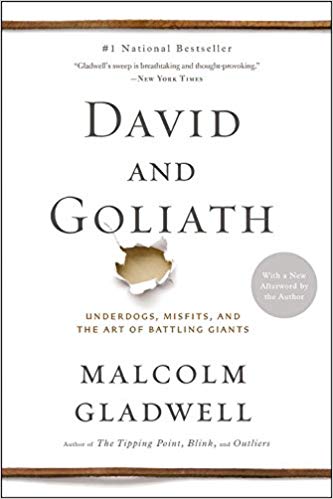
 Why this Book: Selected by my young SEAL gonnabes reading group for our group selection
Summary in 3 sentences: The title tells the story – an amazing collection of stories of people who overcame great odds to succeed – sometimes choosing to take on great challenges – as David did in taking on Goliath – and other stories of people being forced into situations when the odds were stacked against them. The book is full of great stories of “unlucky” people being handed a raw deal, but then struggling and learning, developing more resilience and self discipline than their “luckier” peers, and turning a disadvantage into a life advantage. The concept of desirable difficulties is key to this book and how some of our most successful people have chosen to make bad luck a springboard to great success.
My Impressions: Like all of Malcolm Gladwell’s books I’ve read so far, this one is written to be very readable and engaging. Great stories well-told, make a series of points – built around the idea of reframing a problem, and that “desirable difficulties’ – can lead to great success. He gives many examples of people making an impediment a challenge, and then rising to that challenge to then because of the strength they developed in overcoming that challenge, then succeeding in a larger arena.
There were a number of take-away lessons from the book, apart from the inspiration that comes from reading stories of courage, persistence and intrepidity in the face of overwhelming odds. One is the competitive and survival advantage of a growth mindset. Being willing to consider possibilities apart from the standard, apart from the tried and the true. This was the case in the David and Goliath story; Goliath expected to be fought in the traditional way, and was defeated by an unconventional approach.
He made the distinction between success built on capitalizing on one’s strengths, and success built on compensating for one’s weaknesses. He wrote about how a disadvantage can become an advantage. The “desirable difficulties” he writes about force young people to adapt and grow and become more resilient. He told how several very successful CEOs – an amazing percentage – are dyslexic. To succeed in school and life, they had to find ways to overcome their dyslexia, and they had to have patience and perseverance in the face of repeated failures due to this competitive disadvantage in school. These adaptive mechanisms served them well in later life.
He noted that many people are afraid of being afraid, but that overcoming fear can be exhilarating. Many of those who find the greatest joy in life seek challenges where they can overcome their fear and experience that exhilaration.
Another disadvantage that in several of his examples was turned into an advantage was poverty – and the work, discipline, and patience that it took to overcome poverty served a number of his “Davids” well in the stories he told.
He told a story of a woman who chose the traditional route to success by opting in to the most competitive environments, and was unable to keep up with the most talented, and so gave up her dream and the possibility of making great contributions. She wishes she had chosen to be a bigger fish in a smaller pond.
He told a story of how people in London persevered during the bombing of London during WW2 by believing in their own invulnerability after having survived numerous “near misses.” My Army SF counterpart related to that story by sharing how many times he was nearly shot in combat, noting that the more often they missed, the less afraid he became.
We read of the story of how the civil Rights movement grew out of the patience of one of Dr King’s allies coupled with the aggressive take-no-prisoners approach of another.
We read of how the Irish Catholics in Northern Ireland responded to the overbearing crackdown by the British Army, by standing up to power and illegitimate authority.
We read of how Mike Reynolds changed the laws in California regarding prison sentences for criminals after his daughter was murdered. And then how these stricter sentencing laws may have backfired, after sharing different approaches to criminal punishment in Canada and the Mennonites.
He wrote about courage, and how self-confidence and courage are mutually supportive. Courage breeds self-confidence and vice versa. He referred to Aristotle’s notion of courage and that it is a virtue that is earned. In order to become courageous, we must put ourselves at risk and be courageous. We develop courage by doing courageous acts.
When we discussed this book in our reading group, my partner, an Army Special Forces officer posed the question to each of the young men there: What is your Goliath? What is the thing you are afraid of that you most overcome, that may stop you from fulfilling your dream of becoming a Navy SEAL? The answers were telling and very human – and these young men made themselves vulnerable to each other by sharing what they were afraid of.
A weakness of the book is that it doesn’t hang together all that well. These are great and inspiring stories of people showing great character, resilience and fortitude under adverse circumstances and achieving great things. But some of the stories seem to bear little resemblance to each other – the type of courage, resilience, and persistence shown in very different circumstances. But that is a quibble. I really enjoyed the book – perhaps not the most academically tight argument, but entertaining and inspiring.


 Bob's Books