
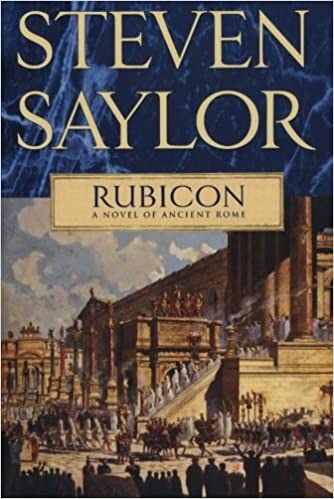
 Why this book: I was looking for a “light” and enjoyable read and this book had been recommended to me many years ago. I have also listened to Dan Carlin’s fantastic series “Death Throes of the Republic” which covers the lead up to the end of the Roman Republic, when Ceasor made himself emperor.
Summary in 3 sentences: During the period when Pompey and Julius Caesar were preparing to do battle over the soul of the Roman empire, a close relative of Pompey is murdered on the estate of our protagonist. Pompey takes our protagonist’s son-in-law as collateral until he can identify the murderer. The story is a first person perspective of our protagonist, who also has a son who is a key member of Julius Caesar’s staff. During the course of our protagonist’s investigation into Pompey’s relative’s murder, we learn about Roman culture at that time, the chaos inside the city as people flee, it’s future is in doubt, how people lived and interacted, and how our protagonist carefully navigates the delicate politics between these two rivals.
My impressions: This is who-done-it that takes place in Rome during the window when Julius Ceasar has crossed the Rubicon and is about to take over Rome and become emperor, essentially spelling the end of the Roman Republic. We see the world of Rome through the eyes of Gordianus, a Roman attorney who has been able to remain essentially neutral in the tension between Caesar and Pompey. But when one of Pompey’s relatives is murdered on his grounds, he can’t stay neutral any longer and has to put himself on the line. He must get involved in the deceit and intrigue and maneuvering for power, influence and money that inhere in such turbulent and uncertain times. Through him we learn about what was happening in Rome in this chaotic time, as well as things about Roman culture.
It’s a good and fun read, not very long, apparently well researched. Reading this during the COVID Pandemic helped me realize that our panic is small potatoes compared to being on the edge of a civil war, with all the people of means fleeing the city for their lives, assuming that whoever wins between Ceasar and Pompey, there will be wholesale slaughter in the city. Gordianus nicknamed “the finder” is called upon and forced by Pompey to resolve a problem that has no good solution, and he and his family are at great risk, almost whatever happens.
I learned a few things about slavery in Rome. Gordianus’s “children” were all adopted slaves. His “son” who was a close associate of Caesar’s was an adopted slave. One of Pompey’s key associates with whom Gordianus travelled to see Pompey was a freed slave. Gordianus had two small boys in the house he was raising who were slaves that he expected to adopt. The title “citizen” in Rome was a title that gave one real privileges. Traveling through the country side in order to link up with Pompey’s forces fleeing Ceasar, we get to know something of rural Italy during this window, the taverns, the roads, how people travelled and lived, their fears of the soldiers. In their conversations and dialogue we learn of their beliefs, their religion, their fears, their hopes.
The ending is climactic and surprising, and leaves the door open to the sequel, Last seen in Massilia as Gordianus must continue to dance between multiple forces, and this time to connect with Caesar’s forces.


 Bob's Books
I read another one by Saylor called “Roma.” It was seven years ago, but from what I remember, the plot covered several generations of events starting at Romes founding through it’s growth into a powerful city-state. My takeaway was that politics and inter-family disputes shaped the history of that city and empire. Also loosely based in history and a fun read….it starts with a few nomadic camping on the banks of a river, settling down due to circumstance, and founding the village which would eventually grow into Rome. Some fun and interesting forays into the underbellies of Roman society.
If you like Saylor’s writing, this would be a good one to check out too. Next time I’m in SD, I may see if. I can borrow your copy of Rubicon, if it’s on your shelf. -brad