
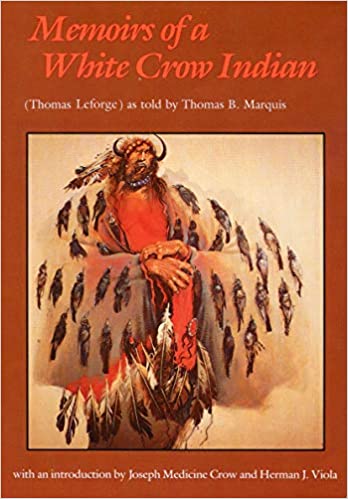
Why this book: While visiting the Little Big Horn Battlefield, I visited a souvenir and curios shop run by the Crow Indian Agency (the Battlefield is on the Crow Indian reservation) and there was a motherlosd of great books about Native Americans in America. This one caught my eye and I bought it.
Summary in 4 sentences: Thomas Leforge grew up in a white family that moved from Ohio to Montana in the late 1850s/early 1860s, where young Thomas grew up with many close friends in the Crow Indian village that was near where his family lived. The more he engaged with them, the more at home he was with them, so in addition to his white biological family, he became part of a Crow family and part of the Crow tribe. He continued to go back and forth between the two worlds, serving as an interpreter, working for whites as well as gaining status as a full fledged Crow Indian warrior within the tribe. He eventually had a Crow wife and family, and when his wife died, he married the widow of his best friend, a Crow scout was killed while supporting Custer at Little Big Horn. Eventually he chose to go back into white society as a business man and entrepreneur where he worked in Colorado, Seattle, eventually also the Alaskan gold rush in Nome, made and lost a fair amount of money, had two more white wives and families before finally returning to live out his final years with the Crow, where he felt most at home.
My impressions: I thoroughly enjoyed this book and was fascinated by the stories he told, the rich and varied life he described, looking back on it as an older man in his 70s. His story was written down and published by Dr Thomas Marquis a friend and doctor for the Crow Indians in the 1920s, who says at the outset of the book, that after dozens of interviews and visits with Thomas Leforge “Horse Rider,” all Marquis did was “merely arranging his tales into consecutive order and clothing them in suitable verbal dress.” The book was published in 1928, three years before Leforge himself died in 1931 at the age of 81.
The book has a very valuable introduction written by Joseph Medicine Crow and Herman Viola provides which was copyrighted in 1974 which provides excellent context for these memoir. Medicine Crow had known Leforge as a child, was actually related to him by marriage, and grew up with some of the people in Leforge’s stories, and he shares some of his experiences with Leforge himself. He and Viola (an eminent Smithsonian anthropologist) fact checked much of what he recalled and found that with the exception of a few insignificant details, Leforge was accurate in the stories he recounted and of the descriptions he gave of life in a Crow Indian village.
The first nearly 300 hundred pages are Leforge’s early life story and his life as Horse Rider – the name the Crows gave him – with the Crows tribe, and includes chapters entitled “Life in the Lodges of the Crows” and “Old Crow Indian Customs and beliefs,” which include fascinating insights into the daily life and cultural practices of the Crows, told from the sympathetic perspective of someone who also knew white culture well.
There is also an entire chapter on his role in the campaign of 1876 against the Sioux which included Custer’s Battle of Little Big Horn. He also has a separate chapter on his active participation as scout and interpreter in the US Army’s post-Little Big Horn campaign against Sitting Bull and the Cheyenne and Sioux, though he doesn’t mention Wounded Knee at all. The last 25 or so pages of the book are a brief synopsis of the final 40 or so years of his life, when he re-engaged in white culture, his various successful and not-so-successful business ventures in the Northwest and Alaska, and his final return to his roots with the Crow to live out the final years of his life, and during which he recounted his life story to Dr Marquis.
Some of the many things I learned and found fascinating in Memoirs of a White Crow Indian:
White – Indian relations. Like most men in my age group, I grew up playing cowboys and Indians, and in the SEAL Teams we often referred to enemy territory as “Indian country.” In fact the Crow were considered friends and allies of the whites in fighting the Sioux, Cheyenne and a couple of other tribes of the Northern Plains Indians. The Crow had no desire to “integrate” with white culture, but simply wanted to peacefully coexist, and early on chose to ally themselves with enemies of their traditional foes – the much more numerous Sioux, Cheyenne and Piegan Indian tribes. Leforge’s recounts many stories of good and mutually respectful relations between the Army and the Crow Indians, Bannacks, Flatheads, Shoshone and a couple of other smaller tribes who worked closely with the whites. Leforge was one of many “squaw-men” – whites who married Indian women and lived with the Indian tribe of their wives as fully enfranchised members of the tribe.
Marriage, Polygamy and promiscuity among the Crow. Leforge describes courting his first Crow wife, Cherry, who he makes clear was the love of his life. He also briefly had a second wife simultaneously and apparently with Cherry’s consent and approval as the second wife was a friend of Cherry’s and they got along well. But Leforge says their mothers quarreled about which was the better “wife” – so there was the drawback of for him of having two mothers-in-law and two families to appease. Leforge eventually had to ask his second wife to leave his abode while they were living at the Crow Agency because of the disfavor with which the whites looked upon polygamy. But he says that bigamy was common, and it was common for a Crow warrior to take on a second or third wife, if the first or primary wife agreed, and if that woman was mature and otherwise living alone and needing a support infrastructure that a family could provide. This was also true of Eskimoes and other groups living in primal circumstances, in which a family unit including two women and a man were more efficient and effective at survival tasks, such as hunting, and taking care of a household and children. In Tibet the relations were reversed – one woman could have two (or more) husbands – to facilitate survival. The children belonged tot he family unit – which of the husbands was the biological father was not important.
Though he doesn’t talk about sexual morays directly (an awkward subject in the 1920s) it is implied that sexual relations did not have the same religious baggage that they do in Christian culture, and parenting of children was more a function of what best served the families, the children and the tribe. Leforge was “adopted” by a Crow family while still a youth, and referred to his Crow father and mother as if they were his biological parents, and as an adult he adopted children and saw and treated them as his own. “Family” and family responsibilities had more of a village sense to them than in white society.
He notes that “sweethearts in every camp was the custom, either for single men or young married men” but he noted that it could get very expensive as it was customary to give presents to “the fleeting entertainers.” After returning from one of his longer trips, he says his wife Cherry “playfully informed me of various supposed sweethearts of mine who had been anxiously inquiring as to when I might return to camp.” This and other stories he tells indicates that marriage was a friendship and partnership of mutual consent and did not necessarily include the assumption or contractual agreement of sexual exclusivity – at least for the men. He makes no mention of any sexual promiscuity among married women.
There was one comment Leforge makes about his first (and favorite) wife Cherry that caught my eye. When he was about to go on a raid that anticipated a great battle, Cherry said to him: “Do not shirk. Be brave. If you should be killed it would leave me very poor; but if there should be a fight, I want to hear of you being in it. Come back with a good name, and bring me a good horse.” It reminds me of the Spartan mothers’ command to their sons as they left to into battle: “Come back with your shield, or on it.”
Tribes within and against Tribes. Leforge was part of one branch of Crow Indians, but there were other branches and sub-branches of the Crow, and he refers to the River Crow as having some different practices than his branch, and there were various villages and groups of Crow living at various locations in Montana. The Crow were a relatively small tribe and allied with the whites to help protect themselves from the much more numerous, powerful and warlike Sioux. The Sioux were a huge group and included many different branches and sub-branches, and in fact the group of 10,000 that Sitting Bull had assembled for the annual sacred Sun Dance ritual at Little Big Horn included multiple Sioux tribes as well as Northern Cheyenne and some Arapahoe. But he notes that “friendly visiting between Crows and Sioux was an occasional event, notwithstanding their continual war status.” There were signals that Indians would give to announce a friendly visit, and to harm a peaceful guest even from an enemy tribe was considered the height of dishonor within and between tribes.
Gift giving and relationships. The Crow viewed gift giving as a sign of wealth, honor, and a means of building or repairing relationships. Anytime an individual or family had good fortune, it was expected that they would aggressively give gifts as indicators of their increased status. Anytime a good thing happened to a family, gifts were given to share that good fortune with others. He notes that gift giving was in some sense a type of “loan” and though there were no debts recognized among the Crow, “honor led to compensatory giving, either at once or at a future time when the recipient became able to return the favor.”
At one point in the book Leforge has performed some honorable act and as a result, he receives many gifts to thank and honor him for that act (blankets, tools, trinkets, even horses) and he says, “And of course my Indian relatives had to give away lots of presents to show how good they felt because of my high standing among the people.” And he notes separately, that “a man’s wealth usually was according to the estimation in which he was held by his people.”
Honor culture. Honor, especially among men (this is a warrior’s story) had many forms. As noted, gift giving was honorable and increased one’s honor, as was capably providing for one’s family. Counting Coup against an enemy had many nuances and variations. Bravery in battle, and not committing dishonorable acts were key to a persaon’s honor. But he notes that successful horse-stealing from the enemy was among the highest honors – in that it required cunning, courage, and skill. Fighting and horse stealing were activities for young men – the upper age normally being about 40.
Spiritual values It appears from this reading that the Crow saw themselves as a chosen people as did it seems, every Indian tribe. The humanity of other tribes was on some occasions respected, on others not recognized. The Sun Dance was a sacred ritual performed by many tribes and included inflicting great pain on a chosen warrior (see the film A Man Called Horse w Richard Harris) who endures this pain to the honor of himself and the redemption of the tribe, and his stoic enduring of this pain is a gift to worship and propitiate the First Maker or “Person Above.” Horse Rider Leforge himself believed he had had a vision which made the eagle his “medicine animal,” and afterward always paid tribute to it. At the end of his life he said, “I worship the Sun and the Big Horn Mountains…to me both father and mother….their offspring lands and streams provided me with an abundance of good food and rich raiment. I was born an Ohio American, I shall die a Crow Indian American.”
—–
A fascinating and fun book to read to gain insights into this key aspect of American culture. As noted above, his stories provide thought-provoking insights into Native American culture, within the context of a rich and varied life story told by a very interesting and adventurous man.


 Bob's Books
Pingback: Nine Years Among the Indians 1870-1879, by Herman Lehmann | Bob's Books