
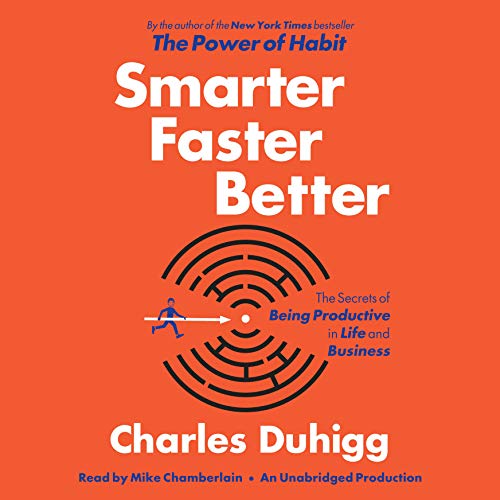
Why this book: Selected by two reading groups I’m in, based on Jay’s recommendation and the outstanding reviews of Duhigg’s Power of Habit.
Summary in 3 sentences: Duhigg was personally struggling to be well enough organized and motivated to be as productive as he felt he could/shold be, and wanted to explore ways to improve his own productivity. He decided this was a common problem, and decided to explore solutions that went beyond the good habits he’d written about in Power of Habit, so researched what had worked for others to see if their tools might work for him. He broke his findings and discussion into 8 chapters: Motivation, Teams, Focus, Goal Setting, Managing Others, Decisions Making, Innovation, Absorbing Data, and he concludes with an Appendix which shares how HE used these lessons.
My impressions. An enjoyable, interesting, and easy read, with a number of great stories to help make his points and back up his arguments. He offers eight major tools for improving productivity and success in one’s endeavors, explored in eight separate chapters. These tools were not new to me, but in his exploration of them, he offers insights and perspectives based on his extensive research that are worthwhile to read and to reinforce important lessons I’ve gotten from experience of other sources. A few new ideas for me – particularly in the innovation and absorbing data chapters. He concludes with an appendix on how he personally has used each of these to help him in his own struggles to be more productive in a world full of chores and other distractions.
The common themes he addresses are eternal and deserve repeating and revisiting – and Duhigg does a good job with the story telling and making the points relevant. My main objection to the book is that, other than a series of success and failure stories that supported a desire to have more success, less failure, and be more productive, I failed to find a strong thread that tied the whole book together. Also there were fairly significant overlaps between the chapters – for example much that he shared in focus, and motivation, could also have been included in decision making. But that didn’t lesson the value of the ideas. That said, I believe it is an excellent book to introduce and generate discussion with those new to leadership management literature. A great book to review chapter by chapter among leaders within an organization.
It is very well researched. Though I didn’t spend a lot of time exploring the extensive notes at the back of the book, the time I did spend was fruitful. For the serious student of these concepts, spending sometime in the notes, reviewing his research and amplifying notes to the chapters will be of considerable interest.
Below are what I found to be the key insights and take-aways, I got from each of his chapters with a few quotes:
CHAPTER 1: MOTIVATION: He introduces the concept of “Locus of Control” – everyone wants to feel like they have some control over the factors that impact their lives, and he says that leaders understanding that is key to motivating their people. It’s the difference between compliance-based cultures – where people just do what they’re told, and commitment-based cultures, where people are personally invested in what they’re doing, because they believe they had a voice in the decisions, and could influence their destiny through the choices they made.
If you want to motivate people, give them a sense that they have some control. It makes people believe that good results are a result of their decisions. If they don’t feel like they have a voice, they often take control by passive aggressive behavior, or even aggressive acts of defiance.
Interesting stories –
- USMC bootcamp changes designed to develop greater initiative and buy-in to decisions in young marines.
- Defiant nursing home residents
- An extremely driven auto-parts tycoon becomes apathetic and his wife helps bring back his motivation and energy.
Quotes:
- “Make a chore into a meaningful decision and self-motivation will emerge.” p30
- “Small acts of defiance were psychologically powerful because the subversives saw the rebellions as evidence that they were still in control of their own lives.” p32
- “People like Robert don’t lose their drive because they’ve lost the capacity for self-motivation. Rather their apathy is due to an emotional dysfunction. They don’t feel anything.” p35
CHAPTER 2: TEAMS: Great teams encourage and love each other’s crazy ideas – and people are supportive of each other even when they disagree. Duhigg argues that the most important thing in successful teams is the “How” they function, not “who” is on the team. In great teams people talk about how teams “felt.” He discusses the how of developing group norms, and creating non-punitive environments that make people more willing to take risks and admit mistakes. Duhigg talks about developing “psychological safety,” that allows people to feel free to disagree.
This chapter discusses “team intelligence” which is greater than the sum of the IQs of its members, and he notes that many teams with lots of intelligent people make dumb decisions. He notes how the team’s norms bring people together, and these norms, not the individual people, make teams intelligent. But there is not a one-size-fits-all set of norms that optimize team performance – they must evolve and adjust to the chemistry of each individual team.
He points out that in meetings, all member of good teams spoke roughly the same proportion, and had high social sensitivity – meaning they were skilled at intuiting how members felt based on their tone of voice,etc. And good teams also contained more women. The best teams have leaders who model the norms of listening and social sensitivity – they demonstrate behaviors that develop psychological safety. In great teams, the whole team is rooting for each other and each person feels like a star.
Lazlo Bock (Google) listed five key norms of the most effective teams:
- People in the team feel that their work is important;
- Their work is personally meaningful;
- They have clear goals and defined roles;
- Members can depend on (trust) one another;
- There is a sense of psychological safety
Interesting stories:
- Saturday Night Live – how the team was formed, and got great results even through tension and disagreements,
- Google – Lazlo Bock and how the team works is more important than who’s on the team.
Quote:
- “During meetings, some team leaders at Google make checkmarks next to people’s names each time they speak, and won’t end a meeting until those checks are all roughly equivalent. p70
- And as a team member we share control by demonstrating that we are genuinely listening – by repeating what someone just said, by responding to their comments , by showing we care by reacting when someone seems upset or flustered rather han acting as if nothing is wrong.” p70
CHAPTER 3: FOCUS: A person’s attention span is like a spot light that can go wide and diffused or tight and focused. Our brains automatically seek out opportunities to disconnect and unwind. “Cognitive tunneling” can cause people to become overly focused on whatever is directly in front of their eyes, or become preoccupied with immediate tasks. When we do cognitive tunneling, we lose the big picture and can miss key indicators that are outside the tunnel – key indicators that can save our lives.
“Reactive thinking” is a cousin – automatically reacting in ways we’ve repeatedly trained – reacting without thinking. While this can often be a valuable tool, automatic reactive thinking can also overpower our ability to use our judgment to make the best decision for THIS particular scenario.
Our most important decision in life is what we choose to pay attention to.
Interesting stories:
- Air France Fit 447, as an example of cognitive tunneling, and
- A good counter-example from an airplane that would have crashed, had the pilot not pulled back and looked at the big picture.
Quotes:
- “We need to stop focussing on what’s wrong and start paying attention to what’s still working.” p98
- “We have to make decisions and that includes deciding what deserves our attention.” p102
CHAPTER 4: GOAL SETTING: He discusses the psychological need many of us have for “cognitive closure” – the desire for a confident judgment – to reach a “final? conclusion that avoids ambiguity and confusion. The decision is made. Though it can be a strength, it can also trigger close mindedness, authoritarian impulses, unwillingness to consider new facts or input. The instinct for decisiveness can make us blind to details that should give us pause.
He describes how GE developed the SMART goals approach to systematize goal setting, but Jack Welch also demanded that executives identify stretch goals – a desirable goal so ambitious that it was hard to describe HOW to achieve it. Yet “for a stretch goal to inspire, it often needs to be paired with something like the SMART system.”
Interesting Stories:
- Yom Kippur War – the intel officer w “cognitive closure” ignored the signs that things had changed.
- How and why General Electric developing SMART goals to organize the goal setting process, and then how and Jack Welch then developed the concept of stretch goals.
Quotes:
- “It feels good to achieve closure. Sometimes, though, we become unwilling to sacrifice that sensation even when it’s clear we’re making a mistake.” p109
- “If you’re being constantly told to focus on achievable results, you’re only going to think of achievable goals. You’re not going to dream big.” p122
CHAPTER 5: MANAGING OTHERS: In this chapter Duhigg outlines five different cultural models he’s seen in organizations:
- The Star model built around hiring from elite universities or prestigious companies and give them lavish perks;
- The Engineer model – anonymous engineers solving technical problems;
- Bureuacratic model -many middle managers with clear directions, charts, handbooks, charged w following and enforcing rules;
- Autocratic model – built around the desires, goals, vision of one person – usually the founder or CEO;
- Commitment model – prioritizes creating a strong culture with committed employees over other priorities such as designing the best product.
Research shows that the only one of these models that is a consistent winner is the commitment model.
Managing others begins with hiring. When you choose employees slowly you have time to find people who excel at self-direction – a key requirement for a commitment culture. That also allows the leader to decentralize decision making – which speeds up progress and inspires the work force. The best leaders devolve decision making to the employees that are closes to the problem – giving them great say in how it is solved.
By giving employees more say, they open the door, and create the right conditions for great ideas to be explored and to take root. But that requires experimentation and allowing for mistakes. The biggest misstep is when there is never an opportunity for an employee to make a mistake.
For example Pixar and Toyota succeeded by empowering low-level employees to make critical choices. Similarly in healthcare, there has been a movement toward giving more authority to nurses and other non-physician health workers – this is referred to as “lean healthcare.:
Interesting stories:
- Solving a kidnapping crime by using a more effective team approach
- General Motors setting up a car company in Fremont Ca, using Toyota management methods.
Quotes:
- “Employees work smarter and better when they believe that have more decision making authority AND when they believe their colleagues are committed to their success.” p165
- “In the end, the rewards of autonomy and commitment cultures outweigh the costs. The bigger misstep is when tehere is never an opportunity for an employee to make a mistake.” p165
CHAPTER 6: DECISION MAKING: This chapter spends a lot of time on Annie Duke’s approach to decision making as a bet – that every decision has uncertainty built into it, and the decision is a bet that it will achieve the desired outcome. He describes thinking “probabilistically”- that is, questioning assumptions and accepting uncertainty. “Losers are always looking for certainty. Winners are comfortable admitting to themselves what they don’t know.” Just as every decision is a bet, it is also a prediction – of the outcome of that decision. So predicting well is also a key aspect of decision making – but you have to start with the right assumptions if your predictions will work out for you. And those assumptions have to recognize and accept uncertainty to work.
Good decisions demand having realistic assumptions and accepting a realistic assessment of risk. Making good choices relies on forecasting the future, and accurate forecasting requires research that exposes us to as many examples of both successes and disappointments as possible. (p196) Many successful people spend a lot of time studying failures – to better understand mistaken assumptions and where uncertainty lies.
Interesting story: Annie Duke’s Poker playing background
Quotes:
- “Probabilities are the closest thing to fortune telling, but you have to be strong enough to live with what they tell you might occur.” p188
- “A lot of poker comes down to luck, just like life. You never know where you’ll end up…You have to be comfortable not knowing exactly where life is going. p203
CHAPTER 7: INNOVATION:
This chapter is about fostering a creative process in an organization. He points out that most creativity is combining old and often conventional ideas, concepts and practices in new and untried ways. That process is usually facilitated by a certain degree of stress or tension, that forces people to throw out old ideas and try out new ones, in order to solve a problem. This is referred to as “creative desperation” – when necessity pushes people to try something really different. Idea brokers are those who facilitate cross-fertilization of ideas that may be conventional in one setting, and then applying them in a new setting to achieve a breakthrough result.
The creative process is built upon failure – learning from mistakes and trying new ideas that don’t quite work and then figuring out why. “Every wrong step gets us closer to what works.”
Sometimes the best way to spark creativity is to disturb the status quo just enough to open the door to new thinking. Disrupt the teams dynamic just slightly – changing settings for work, or roles of key players, or one or two of the key players – that might be just enough to stop everyone from spinning in place.
For a leader to become an idea or creative broker they must 1.Look to their own life for creative fodder – be sensitive to their own experiences; 2. Add a bit of urgency or stress to force people to see old ideas in new ways; and 3. Maintain some distance form what they create, so as not to become blind to alternatives.
Interesting Stories:
- How Disney developed the animation film Frozen
- How the West Side Story became a paradigm busting success
- How forests evolve and new plants can thrive when there is an opening – a slight disruption, which enhances bio-diversity
Quotes:
- “Creativity is just connecting things.” Steve Jobs p223
- “You have to be willing to kill your darlings to go forward. If you can’t let go of what you’ve worked so hard to achieve, it ends up trapping you.” p227
- “When strong ideas take root, they can sometimes crowd out competitors so thoroughly that alternatives can’t proper.” p231
- “People who are most creative are the ones who have learned that feeling scared is a good sign. We just have to learn how to trust ourselves enough to let the creativity out.” p237
CHAPTER 8: ABSORBING DATA:
This chapter is really about how to deal with information overload, and explores how to organize, and harvest good decisions from unwieldy amounts of data. He points out that our brains prefer to organize options into 2 or 3 possible options for decisions – which is a challenge when confronted with a large amount of information.
He offers examples of how to engage employees, teachers students with a lot of data, and thereby help them distill it into practical applications.
He also shows how cognitive tunnelin and becoming attached to binary yes-or-no options blinds us to alternatives or 3rd of 4th alternatives, He also describes how so many people are unable, or unwilling to seek to understand an opposing viewpoint or position, they are so entrenched in what they believe is right.
And he concludes the chapter with examples of how people will retain and use information best if they force themselves to think about it, explain it, apply it in some way in their lives. This helps us create the mental folders, or what he calls mental scaffolding allowing us to build upon the lesson, the information, the new data. Which is also the lesson he teaches us in his Appendix.
Interesting Story:
Cincinnati school systems spent huge resources to examine why students were failing w minimal results, until an experimental program taught teachers how to better utilize the extensive data to change their approach to teaching.
Quotes:
- Our ability to learn from information has not necessarily kept pace with it’s proliferation. 243
- The “engineering design process” forced students to define their dilemmas, collect data, brainstorm solutions, debate alternatives approaches, conduct iterative experiments….until an insight emerges. 258
- When we encounter new information and want to learn from It, we should force ourselves to do something with the data 265
Appendix: A Reader’s Guide to Using These Ideas.
This chapter is a personal note from the author and offers practical advice about how to implement the lessons in chapters 1-8. He provides several examples of how he struggled with writing this book, and then decided to follow his own advice, and then he tells us HOW he used the insights in his book to help him with motivation, goal setting, focus, decision making, etc.
He also provides brief and useful summaries of the chapters on teams, managing others, innovation, and absorbing data. He concludes with a story of how he spent months researching an example of a man with a fanatic devotion to an idea (shipping containers) which ended up changing the world for the better. But he didn’t include it because it didn’t fit with the message he intended. He gave up his “darling.”
For someone who just wants the bottom lines and the condensed version of Smarter Faster Better, reading the Appendix will offer that, without the stories and the examples to back up his points.


 Bob's Books
Pingback: July 2: Rhythms and Yokes – The Thursday After