
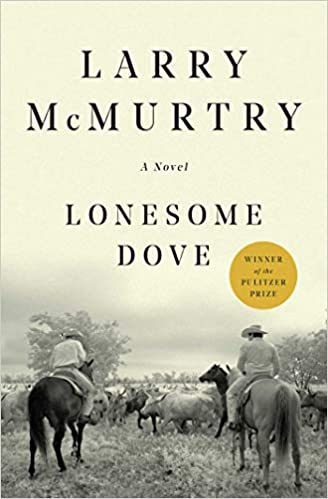
Why this book I read it 25 years ago, remember loving it, though I didn’t remember the story very well. I have been wanting to read it again for quite a while, and prevailed upon my reading group to pick it for our annual long-book-over-Christmas selection.
Summary in 3 sentences Two former Texas rangers in the 1880s are living in Lonesome Dove, a small town in South Texas and decide to gather up some cattle and horses and be among the first cattle ranchers in Montana, which they’d heard was a paradise, compared to South Texas. They put together a crew and head north, finally arriving after several months on the trail. But the story is about the rich tapestry of characters, their relationships to each other, how each individually and the group as a whole confront the various hardships and challenges along the way, and how the characters grew and evolved.
My Impressions: What an Epic! Reading it for the second time, I realize that there is so much in Lonesome Dove beyond “merely” a great story. Friendship, Love, romance and sex (it is decidedly NOT pornographic,) human resilience, good and evil, the history of the American Frontier and the courage and adaptability of those intrepid pioneers who chose to venture into ungoverned and often lawless territory, inhospitable terrain and climate, where criminals roamed and often acted with impunity. There was still a threat of hostile, Native Americans, wild animals, raging rivers, bugs, snakes, critters, and many more threats and challenges. I loved this book the first time, and even more the second.
The characters are interesting – some unforgettable, and we get to know them almost as if we were with them on the cattle drive
It’s a book written by a man focussing primarily on a group of men, mostly young, a few more mature, working and living together on a mission which many don’t understand nor particularly believe in – moving a herd of cattle and horses from south Texas to Montana. They are there for a variety of reasons – adventure, the pay, or because they don’t have anything better to do. They are confronted with a wide variety of unexpected and harrowing challenges in the months their cattle drive takes – and in the process several lose their lives.
And because it’s a man’s book about men, there is a lot in it about women – since women are very much the focus of men’s thoughts and repartee. There are weak and strong women in the story as well, arguably the strongest character in the books is a woman – the love interest of (arguably) the most interesting male character in the book – but she won’t have him.
This book is a great story – but the theme is the strengths and weaknesses of men and women without many choices in a primal often hostile environment and where survival is often a day-to-day struggle, and they must depend on each other to survive.
Without giving away some of the key events of the story, here are a few areas I found most interesting:
The Two Protagonists – Woodrow Call and Augustus (Gus) McCrea are the leaders of the men and the cattle drive. They are a more mature experienced pair of old cowboys who were partners in the Texas Rangers during the settling of Texas in the 1860s, and 70s. They are very different from each other. Gus is very relaxed, enjoys his whiskey, women, relaxing, thinking and talking, and is curious and humorous. Call is stern, stoic, duty driven, mission focused, has no impulse toward fun and prefers to be alone. They chide each other constantly, like an old married couple, but there is HUGE trust between them – that is evident anytime there is a real problem or challenge. And they don’t/won’t let each other down. This makes for a fun pairing. There is much to admire in each of them, and while I didn’t find anything particularly distasteful in either of them, they each had qualities that I would have difficulty calling “virtues.” “The men looked to Call for orders, and got drunk with Augustus.”
Two other very interesting and important male characters in the novel are Jake Spoon and Newt. But you’ll have to read the book to explore the roles they play.
The Three Wise Men There are three men in the story who seem to remain emotionally detached from the day to day chaos and challenges that others in the story struggle with but are key enablers to the success of the men. When things got tough, those around them expected each of these three to have a reasoned and healthy perspective and each could be counted on to do the right thing. And each of these is a non-Anglo outsider. Deets is an African American, trusted and even admired by all – which causes a bit of cognitive dissonance in some of the men. Po Campo the cook on the drive is Mexican with an almost shaman-like wisdom and connection to nature. Cholo an older (70s?) Mexican ranch worker who is a quiet and steadying presence helping Clara with her horse ranch and to deal with the challenges that arise for an isolated single woman running a ranch. It is interesting that each of these would be considered among the more admirable characters in the novel, and none were part of the mainstream Western cowboy culture.
Three Women Though the book centers on men and their thoughts and actions, there are three women who have center stage in the epic. Lorena, a simple good hearted, tough and resilient woman, who is regarded by nearly every man who sees her as the most beautiful woman they had ever seen. Lorena is a prostitute, In the vernacular of the time, a “whore,” which she deals with be remaining completely emotionally detached from men. Until…. Elmeira, a former prostitute, who after impulsively marrying a quiet, naive, and very unworldly sheriff, remains drawn to the dark and wild side. And Clara, one of the strongest and most independent characters in the book, the long time love interest of Gus. Clara runs a horse ranch in Nebraska while taking care of two feisty daughters.
The banality of Sex There is a lot of sex in the book, but it is not related to love, nor is it erotic. It is what cowboys seek when they have a bit of money and time to go into town, to drink, play cards and find a whore. Sex for most of them is a transactional event, a “poke” which whores do to service the cowboys or other men. There is one scene whereby the young (teenage) cowboys go into town to have their first experience of sex with the whores working in a saloon. It’s comic, banal, and decidedly not erotic. Sex is something the men compulsively want, and which some women do for them – for money, or to lure men into marriage, and after marriage, to have children and perhaps to keep the man at home. There is only one woman in the book who seems to have sex for fun – a highly charged, somewhat unhinged whore who one of Gus and Call’s cowboys temporarily shacked up with. The concept of “love” was not associated with the act of sexual intercourse in Lonesome Dove.
Evil and Empathy The characters McMurtry gives us in Lonesome Dove are multi-dimensional and very human. Each has their faults and strengths. There are only three men who are clearly evil, and in whom we see no redeeming qualities – Blue Duck, a renegade Comanche, Dan Suggs a scheming and evil criminal, and Dixon, an arrogant scout who tries to take Dish’s horse. Otherwise, it was easy for me to appreciate and often admire the various characters, to empathize with their failings and their struggles to overcome challenges and difficulties, usually of their own making.
Marriage, love, and infatuation. Marriage gets a bad rap in Lonesome Dove. We don’t see any marriages that we can admire, and few of the men aspire to the domestic life of a married man, not while there was fun, adventure, and good times to be had with one’s buddies, and whores were readily available for sex, for just a few dollars. There was a lot of infatuation in the novel though, which was routinely confused with love – Dish for Lorena; Lorena for Gus, Elmeira for Joe Boot. Xavier and Lippy for Lorena, July for Elmeira and Clara, Gus for Clara, even Clara for Gus…. None of these infatuations were given an opportunity to mature into “love” as I understand it, though there were a couple that I believe had potential. My good friend Yolla pointed out to me that several of the unrequited infatuations in this novel showed how such disappointments can damage or even devastate a life – if the individual is not mature or otherwise equipped to deal with the disappointment of unfulfilled dreams.
In my opinion, one of the most interesting sub-themes in Lonesome Dove was the relationship between Gus and Clara – which included elements of both infatuation and what I would call love. The TV miniseries emphasizes their attraction for each other – certainly her attraction to him a bit more than the book. But it seems they both ultimately realized that being married probably wouldn’t have worked – in that “successful” marriages require compromises and other dimensions apart from being “in love” that they may not have managed well.
Life, Death, and Meaning The story begins with the characters living a squalid, boring existence in the small South Texas town of Lonesome Dove, and through a strange series of events, become engaged in a major cattle drive for over two thousand miles into Montana. The cattle drive and making it to Montana was a goal – but the characters had no real vision beyond that beyond Call wanting to be the first cattle rancher in Montana. For Gus, it was an excuse to see Clara again, and an adventure. For most of the men, the drive had no real meaning other than to get there and survive. There was little thought given to what it would mean to get there, and what that goal was in service of. A number of the characters in the novel lost their lives along the way – and death became a constant companion. Life was life and had inherent value – death was not so mysterious when it was such a constant presence – but it was feared. Much of the death was just the result of accident, serendipity, and bad luck. There was no overriding redeeming value in the cattle drive or the deaths that occurred along the way. It was something most of the men just fell into, some people made it some didn’t ….and then what?
The Lonesome Dove 1989 Television mini-series, available in the library or (to rent) on Amazon Prime, is unusual in that it indeed seeks to stay pretty close to the book and is very well done. It is altogether over 6 hours long and very much worth the time. The casting is quite good, starring Robert Duvall as Gus, Tommy Lee Jones as Call, Diane Lane as Lorena, Danny Glover as Deet, and Angelica Houston as Clara, but unlike most films based on novels, I believe this one is best appreciated after reading the book and I recommend a bit of a break between the book and the mini-series.
The language of the West I loved how Lonesome Dove is written – McMurtry’s language is simple and profound, and fits the setting about which he writes. Great wisdom is mixed in with the colorful and simple language of the cowboys, in their repartee with each other and their descriptions of what they see, describe and think. Here are a few examples: (page numbers from my old beat-up paperback edition I include only for my own reference)
Gus would rattle off five or six different questions and opinions, running them all together like so many unbranded cattle. 11
Gus: “Call’s got to be the one to out-suffer everybody, and that’s the pint. Glory don’t interest Call. He’s just got to do his duty nine times over or he don’t sleep good.” 26
Looking at Lorena was like looking at the hills. The hills stayed where they were. You could go to them, if you had the means, but they extended no greeting. 45
Jasper had a mustache not much thicker than a shoestring and a horse not much thicker than the mustache. 175
Deets had known several men who blew their heads off, and he had pondered it much. It seemed to him it was probably because they could not take enough happiness just from the sky and the moon to carry them over the low feelings that came to all men. 204
Gus: “Jake was up to being Jake. It’s a full-time job. He requires a woman to help him wih it.” 298
Gus to Call: “If you got enough snakes around the place, you won’t be overrun with rats or varmints….Me and you done our work too well. We killed off most of the people that made this country interesting to begin with.” 349
Gus: “It ain’t dying I’m talking about, it’s living. I doubt that it matters where you die, but it matters where you live.” 389
They stared at Roscoe and Janey, silent as owls. 439
In the morning they were right where they had gone to sleep, wet as muskrats but ready to drink a pot of coffee. 463
Call began to wish that somehow things could have been rounded off a little better. Of course he knew death was no respecter. People just dropped when they dropped, whether they had rounded things off or not. 512
Gus: “Yes, but what’s good for me ain’t necessarily good for the weak minded.” 698
All of them envied him because he had a woman and they didn’t. He envied them back, for they were carefree and he wasn’t….He would be lucky to get again such easy pleasures as the men enjoyed, sitting around a campfire swapping jokes. 722
Gus: “It’s hard to enjoy a metropolis like this if you’ve got nothing but your hands in your pockets.” 743
He had seen many men die of wounds, and had watched the turning of their spirits from active desire to live, to indifference. With a bad wound, the moment indifference took over, life began to subside…most lost all impulse toward activity and ended by offering death at least a half-hearted welcome. 866
Gus about Call: “It wouldn’t be his way, to mention it. Woodrow don’t mention nothing he can keep from mentioning. You couldn’t call him a mentioner.” 833
Gus to Call on leadership: “It ain’t complicated. Most men doubt their own abilities. You don’t. It’s no wonder they want to keep you around. It keeps them from having to worry about failure all the time.”863
They were a young couple with two or three children peeking around them, narrow-faced as young possums. 941


 Bob's Books
Pingback: The Wyoming Lynching of Cattle Kate 1889, by George Hufsmith | Bob's Books