
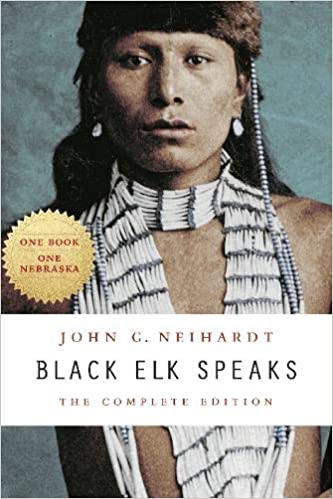
Why this book: I just finished Empire of the Summer Moon about the Comanches and it revived my long term interest in Native American culture. I have been carrying Black Elk Speaks around with me for nearly 50 years. and the SEAL reading group I’m in had selected Native American history/culture as a genre for our next session. After reading Empire and a great discussion I was inspired to finally read what Black Elk had to say. Glad I did.
Summary in 5 Sentences: This book is Black Elk as an older Oglala Sioux medicine man (in his 60s) relating his life story to a trusted “Wasichu” (white man – John Neihardt) in the presence of a couple of his friends and contemporaries, with his son translating. It begins with him describing an incredibly detailed and powerful vision he had while he was a very sick and unconscious 9 year old boy – a vision that shaped the rest of his life. Then he tells stories about his boyhood growing up in his Sioux tribe, his participation as a teenager in the Battle of Little Big Horn, followed by the subsequent difficult and unpleasant period his tribe experienced trying to maintain their way of life while being pursued and and pressured by the US Army. He subsequently participated in Buffalo Bill’s Wild West Show traveling in Europe, returned and also fought US soldiers during the slaughter at Wounded Knee. It’s a sad story about his unsuccessful efforts as a Sioux medicine man and shaman to forestall the demise of the Sioux Indian Nation.
My Impressions: This is one of the most powerful and personal first person stories I’ve read from a Native American growing up and living in the northern plains of America during the final years of the Sioux nation. It is also a powerful story of a Sioux medicine man, his spiritual values, his mystical view of the world, and of his role as an intermediary between the world of spirit and the world of the earth, of nature, of man.
When the story begins in the 1870s the Sioux were still living more or less the life they’d lived for centuries, but it was all about to end. Treaties with the “Wasichus” – the Whites – were being made and regularly broken and the floodgates were open to more and more settlers moving into the region. And then they discovered “the yellow metal that makes Wasichus crazy” in the Black Hills, which were supposed to belong to the Sioux. When it became clear that the US Army was not going to keep the whites out, the Sioux didn’t feel obligated to stay in their assigned areas either, which ultimately led to Custer, Generals Crook and Terry being dispatched to discipline them and the Battle of the Little Big Horn.
The life Black Elk describes as a boy growing up prior to Little Big Horn sounds idyllic in a very communal and safe way – how the young men prepared themselves to be hunters and warriors, and the community by and large felt safe and at home in the mountains of what is now Wyoming, Montana, and South Dakota. The power of his boyhood vision, which he took very seriously and literally but kept to himself, made him feel separate and different from the other boys as he grew up, but otherwise he had a normal Sioux boyhood. As he got into his teens, tensions with the whites were escalating and there were battles and killings, and at age 14, he finds himself in his first warrior role responding to Custer’s attack on his village at the Little Big Horn, and his description fits other accounts I’ve read. It it was truly a baptism by fire.
All through the book he recognizes that during his vision, “the six Grandfathers” he encountered had given him special power and a mission to fulfill during his lifetime. For a long time, he didn’t know what to do with the vision or his power, and he felt it was a burden. Finally with the help of some other Sioux medicine men, he undertook a ritual with his tribe which gave him clarity on who he was and what he was supposed to do, and he became a healer of sick people. He didn’t know how his power worked, but he felt that he was only a conduit for a life force – a power that was much greater than he.
Other well known Sioux leaders play roles in his story, most notably Black Elk’s cousin Crazy Horse who the Sioux regarded as a truly gifted and mystical warrior and a leader. Crazy Horse had also had a powerful vision and spent much time alone and apart from his tribe, where he communed with the spiritual world. He was murdered by the Army during negotiations, not killed in battle. Red Cloud was a Sioux chief who sought to reduce the violence between the whites and the Sioux by trying to find compromise to help save his people. Red Cloud was seen by some as overly compliant to the whites, and seen as the leader of those referred to as the “hang-aournd-the-fort people.”
As an adult, Black Elk had several other powerful visions he describes in the book, reinforcing his reputation as a mystic and powerful medicine man. In each he would have a sudden “queer” feeling, became unconscious and had very clear visions of a spiritual world, or of events/people who were not colocated with him.
Black Elk Speaks is ultimately a sad story, as Black Elk considered himself a failure for not having fulfilled the mission of saving the Sioux nation given to him by the Six Grandfathers in his vision. It is interesting that the biography of Black Elk in Wikipedia notes that in his later years, he converted to Catholicism and became an important teacher and catechist teaching others about Christianity, and was nominated for beatification. On his death bed he is said to have told his daughter that the only thing he really believed in was his original Sioux beliefs about the nature of the world and “the pipe religion.”
At the conclusion of my copy there is a short chapter “About this book and its Author.” It notes that “Black Elk’s personal story, spoken in Sioux and translated by his son, wasn’t a chronological cohesive, organized account of his life and vision….Black Elk Speaks is actually a re-creation in English of the holy man’s account of his life and vision, given form, coherence and choronogy by Neihardt (who was) an adopted member of the Oglala Sioux, chosen by Black Elk as heir to the seer’s mystic powers. “
SOME QUOTES FROM BLACK ELK SPEAKS that I found notable (page numbers for my reference only, they are from my no-longer-in-print version.)
“(The spirit world) is the real world that is behind this one, and everything we see here is something like a shadow from that world.” p71
“I always got up very early to see the rising of the daybreak star. People knew that I did this, and many would get up to see it with me, and when it came, we said: ‘behold the star of understanding!’” p148
“Men and women and children I have cured of sickness with the power the vision gave me; but my nation I could not help. If a man or woman or child dies, it does not matter long, for the nation lives on. It was the nation that was dying and the vision was for the nation; but I have done nothing with it.” p152
“You have noticed that the truth comes into this world with two faces. One is sad with suffering, and the other laughs; but it is the same face, laughing or weeping. When people are already in despair, maybe laughing is better for them; and when they feel too good and are too sure of being safe, maybe the weeping face is better for them to see. And so I think that is what the heyoka ceremony is for.”p159-60
“The Six Grandfathers have placed in their world many things, all of which should be happy. Every little thing is sent for something and in that thing there should be happiness and the power to make happy. Like the grasses showing tender faces to each other, thus we should do, for this was the wish of the Grandfathers of the World.”p163
“We made these little gray houses of logs that you see, and they are square. It is a bad way to live, for there can be no power in a square. You have noticed that everything an Indian does is in a circle, and that is because the Power of the World always works in circles and everything tries to be round.” p164
“Behind the woman’s power of life is hidden the power of man…The woman is the life of the flowering tree, but the man must feed and care for it.” p178
“Nothing can live well except in a manner suited to the way the Power of the World lives and moves to do its work.” p180
“I could see that the Wasichus did not care for each other the way our people did before the nation’s hoop was broken. They would take everything from each other if they could, and so there were some who had more of everything than they could use, while crowds of people had nothing at all and maybe were starving. They had forgotten that the earth was their mother.” 184


 Bob's Books
Thanks for this, Bob. I am so disheartened reading about the treatment of Native Americans. It hasn’t ended even today with pipelines going through reservations, etc.
The European settlers could have learned a better way to live in harmony with nature and people who are “different”. It makes me wonder so much about human nature, greed, capitalism and the white American adoration of rugged individualism. It is all so magnified in today’s nationalist environment.
I have the book but haven’t gotten into it yet. Your review is spurring me to get busy
Thanks again.
Patsy
Patsy – It is a sad chapter. That said, I’d suggest reading Empire of the Summer Moon – about the Comanche Wars in Texas. That is an excellent book that I think gives a bit better understanding for how the settlers saw the Indians. They saw them as we see Isis now. With it’s lead character being a half white, half Comanche, who became a Comanche leader, it offers a great story and a unique perspective. I reviewed that one as well. Bob